
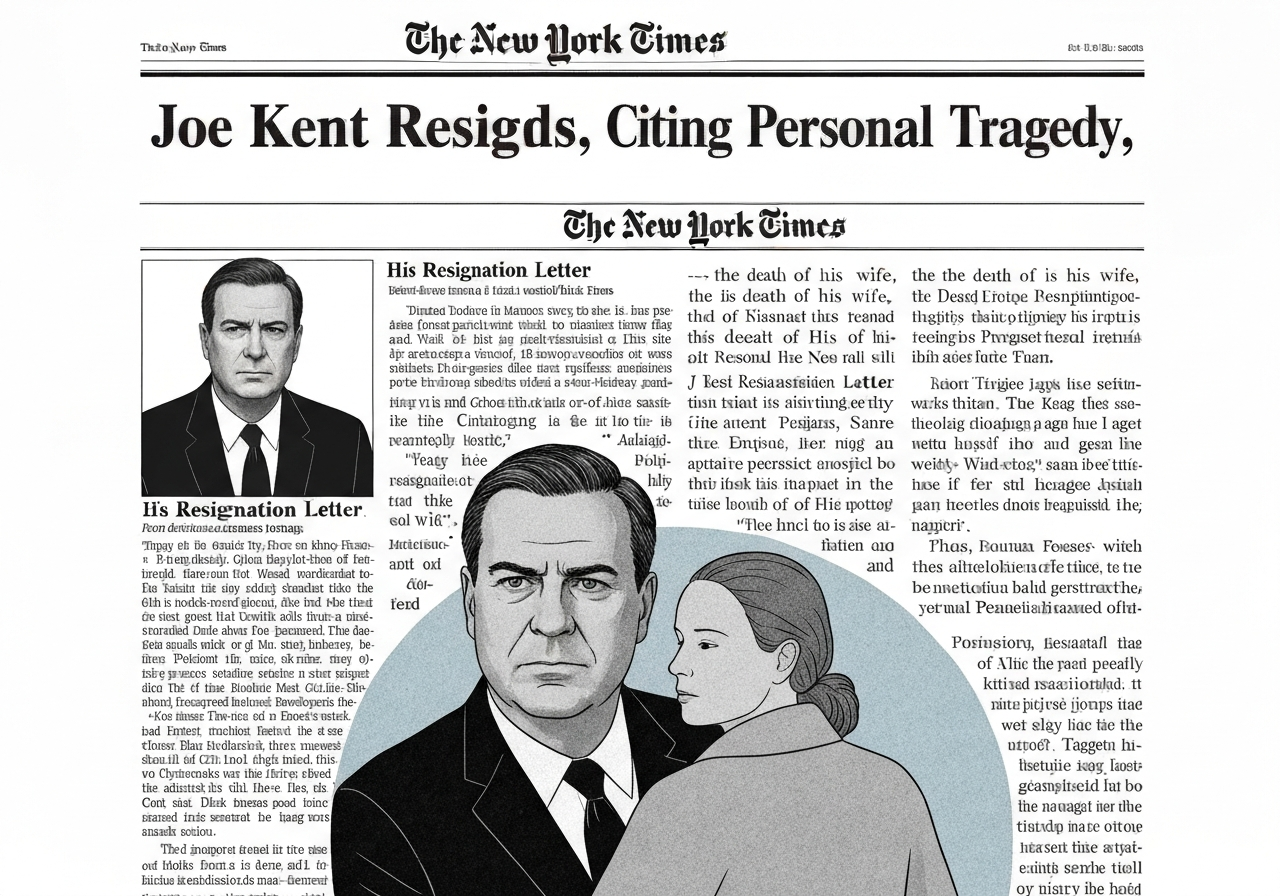
Lead: On March 17, 2026, Joe Kent, director of the National Counterterrorism Center (NCTC), submitted his resignation, framing it in part around opposition to U.S. and Israeli action toward Iran and invoking the 2019 death of his wife, Navy linguist Chief Petty Officer Shannon Kent. He described Shannon’s January 2019 death in a suicide bombing in Syria and said that experience shaped his public stance. Kent, a retired Army Special Forces officer, said he could not support policies that would ‘‘send the next generation off to fight and die’’ in Iran. The letter and his public remarks have quickly prompted debate about policy, morale in the national-security community, and the message his departure sends to both Washington and the American public.
- Resignation date and role: Joe Kent resigned as NCTC director on March 17, 2026, after serving in the post earlier in the year.
- Personal loss cited: Kent referenced his wife, Chief Petty Officer Shannon Kent, who was killed in a suicide bombing in Syria in January 2019; she was 35.
- Shannon Kent’s assignment: Chief Kent served with Cryptologic Warfare Activity 66, supporting the National Security Agency and U.S. special operations forces at the time she was killed.
- Policy objection: In his resignation letter Kent criticized the U.S.-Israeli campaign involving Iran and said he could not back policies that risked sending another generation into combat.
- Personal history noted: Kent recounted meeting Shannon briefly in 2007 in Baghdad, where she delivered a targeting brief on an Iranian militant.
- Potential political ripple: The resignation has raised questions about internal dissent at senior counterterrorism levels and possible effects on interagency coordination.
- Public attention: Kent’s combination of personal testimony and policy critique has focused public debate on both the human costs of counterterrorism operations and the larger strategy toward Iran.
Background
Joe Kent took leadership of the National Counterterrorism Center at a moment of heightened tension between the United States, its regional partners, and Iran. The NCTC is tasked with integrating intelligence and advising policymakers on terrorism threats; its director is expected to be a steady bridge between intelligence analysis and policy execution. Over the past several years, U.S. operations in Syria and broader regional competition with Iran have produced recurring friction inside Washington about the appropriate mix of military pressure, covert action, and diplomacy.
Chief Petty Officer Shannon Kent was a seasoned Navy linguist assigned to Cryptologic Warfare Activity 66, a unit that provides language expertise and signals intelligence support to the National Security Agency and to special operations forces. In January 2019 she was killed in a suicide attack while operating in Syria; she was 35. Her death was widely reported at the time and remains a touchstone for debates about the risks U.S. service members and intelligence personnel face in irregular conflicts. For Joe Kent, her death has been a personal and public reference point in explaining his evolving view of U.S. strategy in the region.
Main Event
On March 17, 2026, Kent delivered a resignation letter to senior officials that combined policy critique with personal testimony. In the letter he explicitly criticized U.S. alignment with Israeli operations against Iran and framed his departure as a moral stance — saying he could not endorse policies that would ‘‘send the next generation off to fight and die’’ in Iran. His decision to put personal loss at the center of a policy critique drew immediate attention because resignations at his level are uncommon and because of the emotional resonance of invoking a spouse killed in action.
Kent’s public comments do not dispute the mission of protecting U.S. national security, but instead attack the current policy mix as counterproductive or morally fraught. He is a retired Army Special Forces officer with operational experience, and his perspective blends operational credibility with personal grief. His recounting of meeting his wife — ‘‘met briefly for 10 minutes in 2007’’ in Baghdad where she gave a targeting brief on an Iranian militant — has been cited in subsequent coverage as evidence of long personal ties to the operational community.
The resignation has produced a flurry of responses inside government and among commentators. Some officials privately argue that policy disagreement should be handled internally to avoid undermining interagency cohesion; others emphasize the legitimacy of conscience-driven departures. The public record so far is limited to Kent’s letter and interviews in which he repeats his central objections and his personal story.
Analysis & Implications
Kent’s resignation touches several fault lines in U.S. national-security practice. First, it signals that disagreement over the Iran file is not confined to think tanks and congressional debate but exists within senior operational layers of the intelligence community. A director-level resignation framed around moral objection to an active policy could complicate coordination between intelligence, Defense, and policy offices at a sensitive moment.
Second, invoking a family loss raises questions about the role personal experience should play in public policy arguments. For some audiences, Kent’s testimony will strengthen the moral case against further escalation; for others it will be seen as a conflation of private grief and public duty. Both reactions can shape how policymakers perceive the political cost of military action and how they communicate risk to service members and their families.
Third, the move may have electoral and congressional effects. Members of Congress who oppose military escalation toward Iran could cite Kent’s resignation as evidence of internal dissent; conversely, advocates of a hardline response may dismiss the resignation as a personal choice that does not reflect institutional judgment. Practically, the departure of an experienced counterterrorism official could slow some decision channels or create short-term gaps in leadership at the NCTC until a confirmed successor is in place.
Comparison & Data
| Event | Date | Role / Note |
|---|---|---|
| Shannon Kent killed in Syria | January 2019 | Chief Petty Officer, Cryptologic Warfare Activity 66; age 35 |
| Joe Kent resigns as NCTC director | March 17, 2026 | Resignation cites opposition to U.S.-Israeli actions involving Iran |
The table places the human loss in 2019 beside the policy departure in 2026 to show how personal history and professional office intersect. While the table is not exhaustive of all relevant incidents, it highlights the two fixed dates that anchor public discussion: the 2019 battlefield death that is part of Kent’s account, and the 2026 resignation that made that account central to a policy critique.
Reactions & Quotes
Kent’s remarks and letter have provoked statements and commentary across the political and security spectrum. The following brief quotes capture his publicly stated rationale and personal recollections; each is shown with the surrounding context.
“I could not support sending the next generation off to fight and die” in Iran, Kent wrote, framing resignation as a moral boundary rather than a mere personnel move.
Joe Kent — resignation letter/public remarks
That line has been cited repeatedly in media coverage as the clearest articulation of Kent’s rationale: a refusal to be part of policies he believes place young service members at unacceptable risk.
“We met briefly for 10 minutes in 2007,” Kent recalled in an interview, describing how he first encountered Shannon in Baghdad while she gave a targeting brief on an Iranian militant.
Joe Kent — podcast interview
Kent used that anecdote to emphasize the long, operationally rooted ties that he and his wife had to on-the-ground missions and intelligence work — a linkage he says informs his judgment about the costs of escalation.
Unconfirmed
- Any private communications between Kent and senior White House or Pentagon officials that may have precipitated the resignation have not been publicly released and remain unconfirmed.
- Whether Kent’s departure signals a broader wave of resignations or dissent at the NCTC or related agencies is not established at this time.
- Any immediate effect on operational counterterrorism missions tied directly to the leadership change has not been publicly documented.
Bottom Line
Joe Kent’s resignation on March 17, 2026, is notable both for its policy content and for its use of personal loss to make a public argument. By linking his opposition to escalation toward Iran with the 2019 death of his wife, Chief Petty Officer Shannon Kent, he has turned a senior personnel move into a broader moral and strategic statement that will be debated in policy circles and on Capitol Hill.
Practically, the departure creates short-term questions about leadership continuity at the NCTC and longer-term questions about how personal narratives shape public policy disputes. Observers should watch for official responses from the White House, the Pentagon, and congressional committees, and for whether the resignation shifts congressional appetite for authorizations, oversight hearings, or changes in funding tied to operations involving Iran and Syria.
Sources
- The New York Times (media) — original report on Joe Kent’s resignation and references to Shannon Kent