
Lead
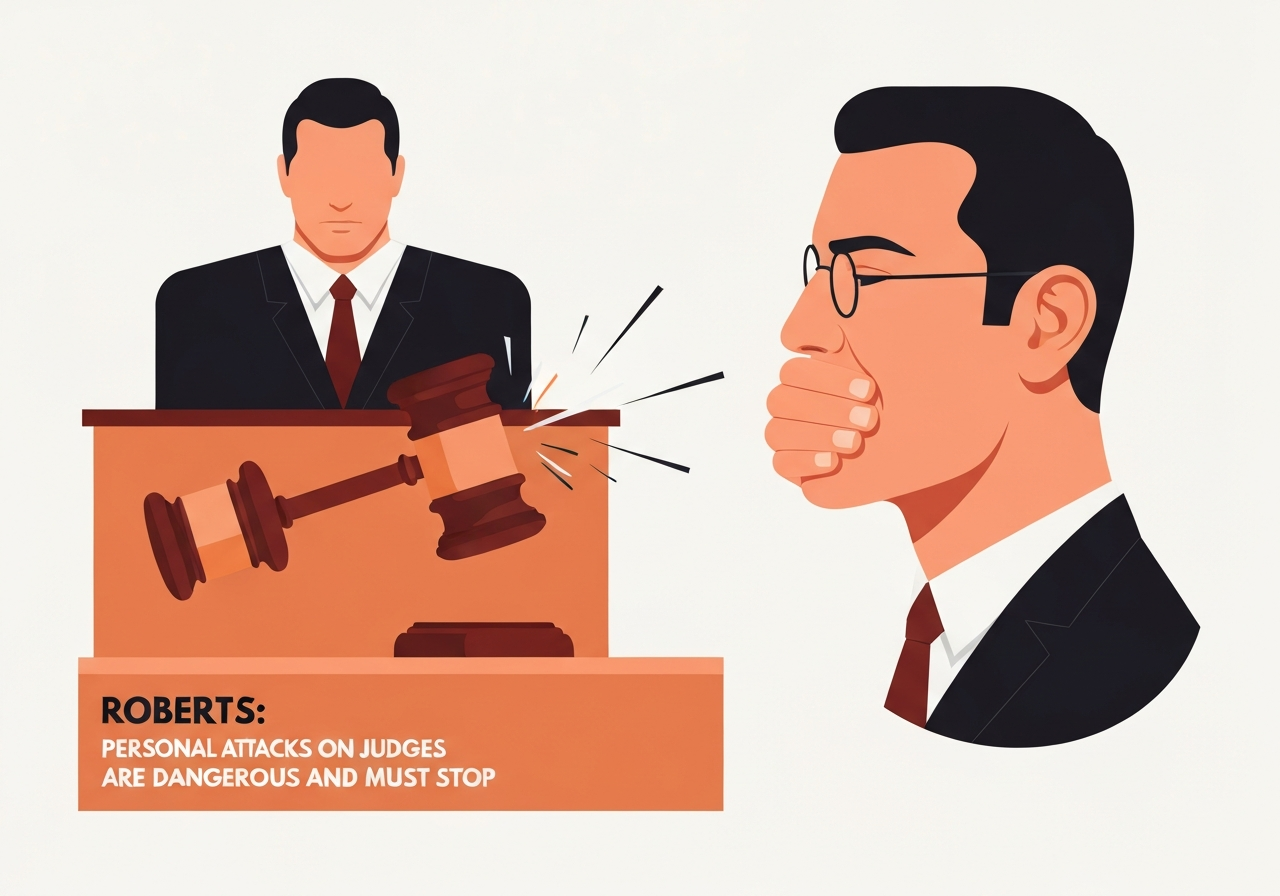
Chief Justice John Roberts warned Tuesday at Rice University’s Baker Institute in Houston that personally directed attacks on federal judges threaten the rule of law and “got to stop,” a statement delivered two days after President Donald Trump publicly denounced a judge who ruled against the administration. Roberts avoided naming any one person or party, repeating that criticism of judicial decisions is expected but that attacks on judges’ motives or safety cross a line. U.S. District Judge Lee Rosenthal, who appeared with Roberts, expressed public gratitude for the chief justice’s remarks. The U.S. Marshals Service reported 564 threats to judges in the government fiscal year that ended in September, and Roberts noted Congress has increased security funding in response.
Key Takeaways
- Chief Justice John Roberts spoke at Rice University’s Baker Institute in Houston on Tuesday and cautioned that personal hostility toward judges is dangerous and must end.
- Roberts did not single out President Trump but said attacks are not limited to any single political viewpoint.
- The U.S. Marshals Service recorded 564 threats to judges in the government fiscal year ending in September, up from the prior year.
- Roberts emphasized that critique of judicial reasoning is part of democratic debate, distinguishing it from personally directed hostility.
- Two days before Roberts’ remarks, President Trump posted critical comments about U.S. District Judge James Boasberg after a ruling involving the Justice Department and the Federal Reserve.
- U.S. District Judge Lee Rosenthal publicly thanked Roberts for his support, underscoring judicial concern about safety and institutional integrity.
- Department of Justice officials and Trump allies have publicly criticized other judges recently, including posts by Deputy Attorney General Todd Blanche targeting Judge Brian Murphy.
Background
The remarks come amid a sustained period of sharp public criticism of judges from high-profile political figures. In recent months, several judicial rulings have curtailed executive actions ranging from immigration enforcement to pandemic-era policies and emergency trade measures, prompting heated commentary from political leaders and administration allies. Historically, U.S. courts have been subject to partisan disagreement about legal outcomes; what Roberts highlighted is a shift from legal critique to attacks that question judges’ motives, character or fitness for office. The U.S. Marshals Service, responsible for judicial protection, has documented rising threats and Congress has responded with additional security appropriations, signaling institutional concern about protecting judges and court staff.
Chief justices have long defended the judiciary’s independence as a constitutional necessity, and past public spats between presidents and courts have tested those norms. Roberts has previously intervened in high-profile disputes—most notably when he publicly rejected efforts to pursue impeachment for a judge after a contested ruling concerning deportations to El Salvador. The current environment features social media posts and public statements that escalate quickly and circulate widely, increasing both reputational pressure and tangible security risks for individual jurists. Court administrators and the U.S. Marshals Service must balance transparency about risks with the practical need to safeguard personnel.
Main Event
At Rice University’s Baker Institute, Roberts acknowledged that robust critique of judicial opinions “comes with the territory,” but drew a firm boundary when commentary turns personal. He said personally directed hostility is dangerous and “it’s got to stop,” a line he repeated without naming President Trump or other specific critics. The appearance included U.S. District Judge Lee Rosenthal, who publicly thanked Roberts, saying the chief justice’s support matters to judges who face threats and intense public scrutiny.
The timing followed a Truth Social post by President Trump criticizing U.S. District Judge James Boasberg as “a Wacky, Nasty, Crooked, and totally Out of Control Judge” after Boasberg quashed subpoenas the Justice Department had issued to the Federal Reserve. Roberts’ reluctance to single out individuals reflects an effort to preserve institutional impartiality while addressing a problem that has drawn bipartisan attention. Separately, Deputy Attorney General Todd Blanche posted a critical message on X about Judge Brian Murphy after a federal court blocked an administration vaccine-policy change, illustrating that administration officials have also taken to public platforms to rebuke judges.
Roberts referenced the rise in threats recorded by the U.S. Marshals Service—564 in the government fiscal year that ended in September—and noted Congress has increased funding for judicial security. The chief justice framed these measures as a necessary response to protect courts and the individuals who administer justice, and he urged leaders and participants in civic debate to keep criticism within legal analysis rather than personal invective.
Analysis & Implications
Roberts’ intervention is both symbolic and practical: a symbolic defense of judicial independence and a practical appeal to reduce conduct that can create real safety risks. When criticism moves from legal argument to attacks on judges’ character or patriotism, it can erode public confidence in impartial adjudication and may intimidate lower-court judges deciding politically charged cases. That chilling effect is difficult to quantify but poses a systemic risk if repeated and amplified by high-profile actors.
Security implications are immediate. The U.S. Marshals Service’s tally of 564 threats in the referenced fiscal year underscores an operational burden—protective details, threat assessments and facility security all require resources. Congress’ increased appropriations for judicial security respond to that burden, but sustained politicized rhetoric could drive further costs and strain local court systems. Courts may also adopt additional protective measures that affect public access and transparency in some proceedings.
Politically, the chief justice’s measured rebuke places pressure on elected officials to weigh the institutional consequences of their rhetoric. In an era of intense polarization and ubiquitous social media amplification, institutional actors face choices about when to respond publicly. Roberts’ stance aims to reaffirm norms without escalating confrontation, but its long-term effect depends on whether influential figures alter public messaging and whether enforcement mechanisms—ethical rules, congressional censure, or political rebuttal—are used more frequently.
Comparison & Data
| Measure | Reported Figure |
|---|---|
| Threats to judges (U.S. Marshals Service, gov’t fiscal year ended Sept.) | 564 |
| Change from prior year | Reported increase (previous year lower) |
The available data point—564 threats—shows a measurable uptick from the prior year, though the public summary does not provide a precise previous-year count in the cited report. That increase aligns with anecdotal and publicized incidents of threatening behavior and helps explain congressional action to boost security funding. Without a full multi-year series in this piece, readers should treat the single-year increase as a sign of growing operational pressure rather than a long-term trend confirmed by extensive time-series data.
Reactions & Quotes
Roberts’ remarks drew immediate attention from both inside and outside the judiciary. His careful language was intended to de-escalate while underscoring institutional needs.
“Personally directed hostility is dangerous and it’s got to stop.”
Chief Justice John Roberts
Roberts used that phrase to distinguish between routine legal criticism and attacks that target judges personally; his office has repeatedly emphasized the judiciary’s need for public confidence and physical protection. Lee Rosenthal, who shared the stage, expressed appreciation for the chief justice’s stance.
“We always know that you have our backs and that means a great deal.”
U.S. District Judge Lee Rosenthal
Rosenthal’s comment signaled the judiciary’s relief at public support from its highest-ranking member. In contrast, the president’s sharply worded post drew attention to how quickly criticism can become personal and widely circulated.
“A Wacky, Nasty, Crooked, and totally Out of Control Judge”
President Donald J. Trump (post)
That post targeted U.S. District Judge James Boasberg after a ruling involving subpoenas to the Federal Reserve and illustrates the type of language Roberts warned against. Officials within the administration have also directly criticized other judges on social media and other platforms.
Unconfirmed
- Whether the 564 reported threats can be directly linked to specific public figures or social-media campaigns is not publicly confirmed.
- The precise number of threats attributable to political rhetoric versus other causes has not been publicly released by the U.S. Marshals Service.
Bottom Line
Chief Justice Roberts’ public admonition is a deliberate effort to defend the judiciary’s institutional integrity without engaging in partisan counterattacks. By distinguishing legitimate legal critique from personal hostility, Roberts aimed to renew norms that protect judges’ safety and the public’s faith in impartial courts. The U.S. Marshals Service’s report of 564 threats and Congress’ subsequent security funding demonstrate that the issue carries concrete operational consequences beyond rhetorical debate.
Moving forward, watch for whether political leaders moderate public remarks about individual judges, how courts and Congress allocate resources for protection, and whether new incidents prompt further institutional responses. The chief justice’s appeal is clear: criticism focused on legal reasoning is part of democratic life, but personal attacks that endanger judges undermine the system and must stop.