
Lead
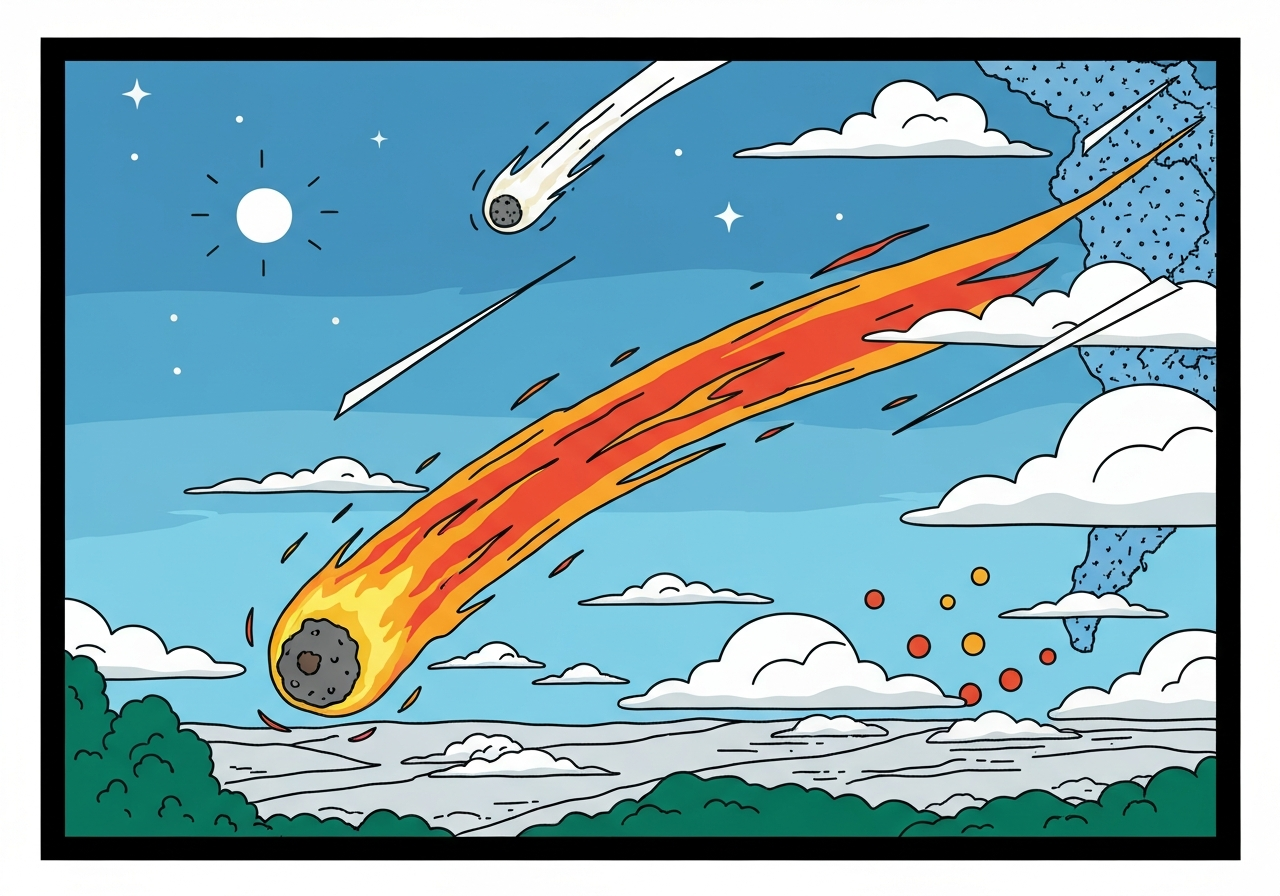
On Tuesday, March 17, 2026, a bright fireball streaked over the Cleveland area, producing a loud boom that shook homes and alarmed residents. Witness reports and video submissions said the phenomenon was visible across multiple states, with the American Meteor Society receiving accounts from Wisconsin to Maryland. Officials from the National Weather Service in Cleveland reported hearing the shock and feeling vibrations but had no immediate confirmations of large debris. Astronomers and meteor experts described the object as a likely meteor or small asteroid fragment that largely burned up on entry.
Key Takeaways
- Event timing: Morning of March 17, 2026; observers reported the fireball at about 9 a.m. in the Cleveland region.
- Wide visibility: The American Meteor Society logged reports ranging geographically from Wisconsin to Maryland.
- Audible effects: National Weather Service staff in Cleveland reported hearing a boom and feeling ground vibrations related to the event.
- Expert assessment: AMS executive director Carl Hergenrother called it a fireball—consistent with a meteorite or small asteroid entering the atmosphere.
- Estimated scale: Hergenrother estimated the incoming object could have been the size of a softball to a basketball or larger, entering at many tens of miles per second.
- Debris outlook: NWS meteorologist Brian Mitchell said most of the object likely burned up; early checks found no confirmed ground fragments.
- Frequency context: Scientists note a typical meteor falls over U.S. skies about once per day, while much smaller space dust enters far more frequently.
Background
Meteors—objects from space that glow as they enter Earth’s atmosphere—are a common, well-studied phenomenon. Many brighten into visible fireballs when larger fragments intersect the atmosphere at high speed; most are small and disintegrate before reaching the ground. Observational networks run by professional groups and volunteers deploy all-sky cameras and sensors to capture trajectories and recoverable fragments when possible.
In recent years, public reporting has grown as cellphone and security cameras multiply, producing a rising volume of video evidence for researchers to analyze. That increase helps scientists triangulate paths and estimate size, speed, and likely fall zones. However, not every bright streak is a natural meteor: reentering human-made objects such as defunct satellites or rocket stages can produce similar sightings, though they typically have different brightness and fragmentation patterns.
Main Event
Shortly before 9 a.m. EST on March 17, 2026, multiple eyewitnesses in northeast Ohio reported a brilliant flash and a loud sonic boom. The American Meteor Society recorded submissions describing a greenish-white fireball and widespread visibility extending into states as far west as Wisconsin and east to Maryland. Video posted by local offices, including a morning capture credited to a Pittsburgh-area employee, helped corroborate timing and appearance.
Carl Hergenrother, executive director of the American Meteor Society, described the phenomenon as consistent with a fireball and said the object’s speed would have been many tens of miles per second on atmospheric entry. He offered a preliminary size range—roughly the size of a softball up to a basketball or possibly larger—based on the brightness and reports. Hergenrother also noted that while reentering satellites sometimes produce trails, such objects rarely reach the same brightness seen in this case.
Staff at the National Weather Service office in Cleveland reported hearing the boom and feeling vibrations, which matched many public accounts of an explosive sound. NWS Cleveland had no immediate reports of substantial debris on the ground; meteorologist Brian Mitchell said only small fragments, if any, would likely survive the intense heating during entry. Local emergency services did not report injuries or structural damage tied to the event.
Analysis & Implications
Scientifically, bright meteors provide useful opportunities to refine atmospheric entry models and to map fragments that survive to the ground. If fragments are recovered and authenticated, they can be analyzed to learn about composition and origin—information that helps both planetary science and impact-risk assessments. However, the probability of large, dangerous fragments reaching populated areas from typical fireballs remains low.
The event also underscores the importance of coordinated reporting networks. Professional camera arrays, amateur video submissions, and official sensor logs together enable more accurate trajectory reconstructions than any single source. Rapid sharing of time-stamped videos and ground observations can narrow search areas for potential meteorite recovery, improving chances of retrieving scientifically valuable pieces.
From a public-safety perspective, the most immediate concerns are structural damage from shock waves and the potential for falling debris in limited areas. In this case, preliminary indications point to minimal risk: no injuries or major damage reported and early assessments suggesting most material burned up. Still, local authorities and researchers will monitor for any confirmed finds that could adjust that assessment.
Comparison & Data
| Item | Typical Small Meteor | This Event (est.) |
|---|---|---|
| Visibility range | Local to regional | Wisconsin to Maryland (multi-state reports) |
| Estimated size | Pea to softball | Softball to basketball (per AMS estimate) |
| Frequency over U.S. | ~1 visible meteor/day | Consistent with daily fireball occurrence |
| Debris survival | Often none to small fragments | Likely small fragments; no large debris reported |
The table contrasts typical small meteors with the available estimates for the March 17 event. While brightness and wide visibility set this sighting apart from more common tiny meteors, its physical consequences align with many fireball events: notable spectacle but low probability of major ground impact. Recovery efforts, guided by camera triangulation and witness reports, would be the next step if fragments are suspected in accessible terrain.
Reactions & Quotes
“This one really does look like it’s a fireball, which means it’s a meteorite — a small asteroid,”
Carl Hergenrother, American Meteor Society (executive director)
Hergenrother’s comment summarized the AMS’s preliminary assessment and anchored professional interest in the event. He cautioned that final classification depends on recovered material and further trajectory analysis.
“There could be some small fragments, but a lot of it would have burned up in the atmosphere,”
Brian Mitchell, NWS meteorologist
Mitchell framed the early damage assessment and explained why NWS had not yet reported confirmed finds. His remarks reflected standard expectations for fireball disintegration at high altitude.
“One of our employees, Jared Rackley, caught this morning’s meteor on camera from the Pittsburgh area,”
NWS Pittsburgh (official tweet)
Regional NWS offices and local observers sharing images and video played a key role in validating the timing and multi-state visibility of the fireball.
Unconfirmed
- No verified meteorite fragments have been publicly confirmed from this event as of initial reports.
- Precise size and mass estimates remain provisional pending trajectory reconstructions and material recovery.
- Attribution to a natural meteor rather than a reentering human-made object is assessed as likely but not yet fully validated.
Bottom Line
The March 17, 2026 fireball over Cleveland was a widely observed, scientifically useful event that alarmed residents but, based on early evidence, posed low physical risk. Experts characterize it as a likely meteor or small asteroid fragment that mostly combusted in the upper atmosphere, producing a bright flash and an audible boom.
Follow-up work—triangulating camera footage, canvassing possible fall zones, and analyzing any recovered fragments—would be needed to confirm composition and refine size estimates. For the public, the incident is a reminder that bright meteors are both regular and recoverable scientific opportunities; authorities encourage reporting and sharing of timestamped videos to assist researchers.
Sources
- KSL News — (regional news report summarizing local observations and official comments)
- American Meteor Society — (nonprofit observing network receiving public fireball reports)
- NWS Pittsburgh (Twitter) — (official regional National Weather Service post with observational image)
- National Weather Service Cleveland — (federal agency office statements and local reporting)