
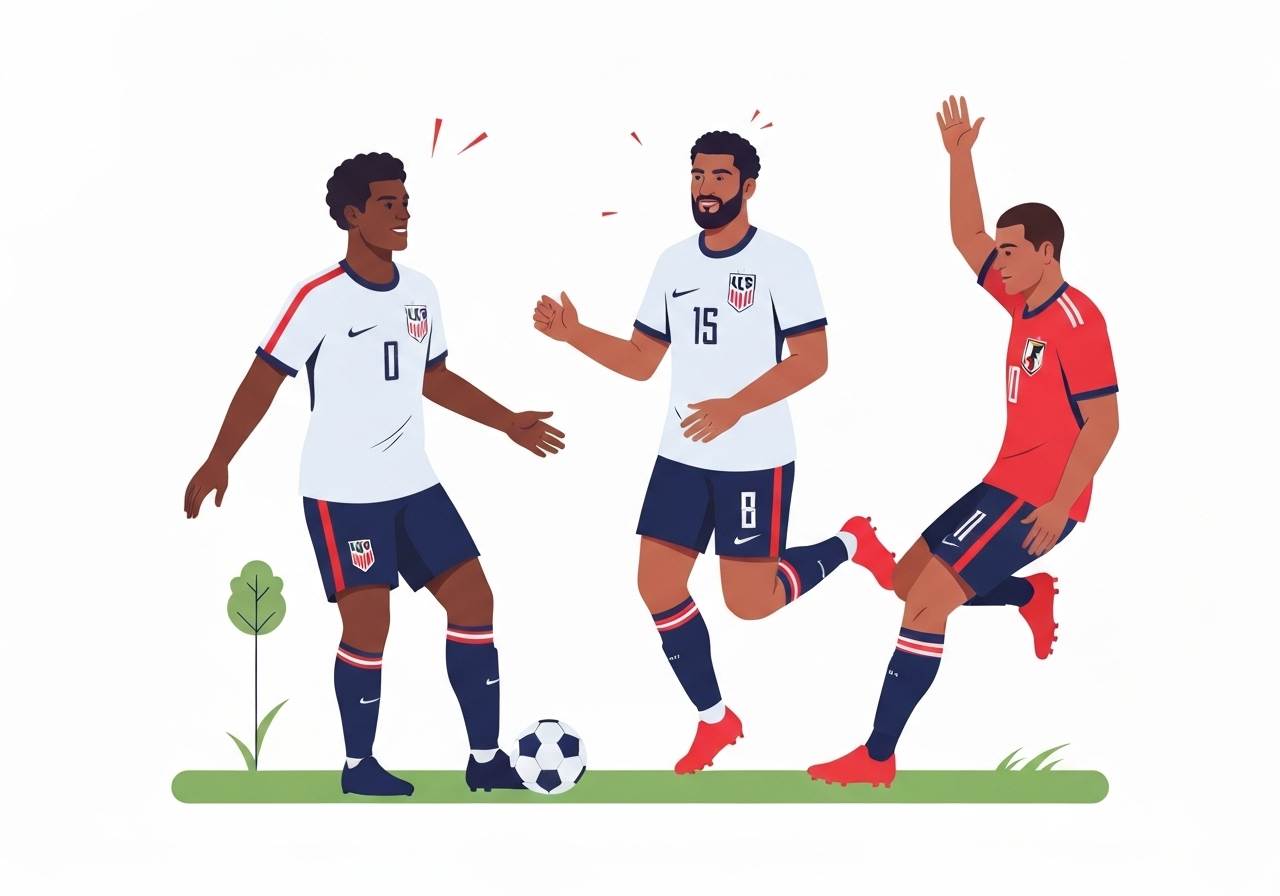
— The United States men’s national team delivered a steady, rotated performance to beat a Japan side 2-0 at Lower.com Field in Columbus. Alejandro Zendejas opened the scoring around the half-hour mark and Folarin Balogun added a second later in the match, giving the visitors a clean sheet and a morale-boosting result. Mauricio Pochettino used the friendly window to test a wider roster and fresh tactics, deploying a 3-4-2-1 shape and handing meaningful minutes to several fringe players. The win tempered concerns after a prior 2-0 loss to South Korea and offered a clearer picture of depth ahead of the World Cup.
Key takeaways
- The US beat Japan 2-0 at Lower.com Field in Columbus on 9 September 2025, with goals from Alejandro Zendejas and Folarin Balogun.
- Mauricio Pochettino started a rotated XI in a 3-4-2-1 formation to evaluate squad depth and new combinations.
- Young and fringe players were prominent: Alex Freeman (right wing-back), Max Arfsten (left), and Jack McGlynn and Damion Downs as influential substitutes.
- Defensive trio Chris Richards, Tim Ream and Tristan Blackmon provided a more stable backline after recent communication issues.
- Goalkeeper Matt Freese kept a clean sheet but showed occasional uncertainty on crosses and set pieces, leaving the starting keeper role unsettled.
- Japan fielded a heavily rotated team after using first-choice starters in a match on Saturday, but still created moments of threat through pace.
- Balogun created several clear chances early but failed to score until later; his finishing remains a focus ahead of the World Cup.
Background
Entering the international window, the USMNT faced questions after a 2-0 defeat to South Korea that exposed defensive miscommunication and bluntness in attack. Coach Mauricio Pochettino publicly defended his broader plan, arguing recent results should be seen in the context of preparing a larger roster for the World Cup. With the tournament less than a year away, the staff has prioritized match minutes for players beyond the likely starting XI to build options and cover for potential injuries or tactical shifts.
The fixture calendar compressed opportunities to trial systems, and friendlies against teams like Japan and Mexico were treated as purposeful rehearsals rather than standalone must-wins. Japan’s manager Hajime Moriyasu likewise rotated after using many first-team players in a prior draw, meaning both camps were balancing evaluation with results. Against that backdrop, Columbus offered a controlled environment to assess how new combinations perform under stadium pressure and crowd expectations.
Main event
Pochettino delivered on his promise to rotate. He selected a back three of Chris Richards, Tim Ream and Tristan Blackmon, used 21-year-old Alex Freeman at right wing-back and deployed Max Arfsten down the left. Cristian Roldan started alongside Tyler Adams in midfield, while Alejandro Zendejas and Christian Pulisic operated as dual No.10s behind striker Folarin Balogun. The setup put emphasis on possession and vertical support for Balogun up top.
The breakthrough arrived just after the half-hour mark when Arfsten beat his marker on the left and floated a measured cross that Zendejas took from the air and guided into the bottom corner. The finish rewarded a sequence started by Arfsten’s aggressive wing play and highlighted how crossing quality could unlock opportunities against Japan’s retooled defense. Zendejas celebrated by acknowledging the assist, underscoring the team’s collective build-up.
Balogun had a flurry of gilt-edged chances inside the opening 20 minutes but was denied by Japan goalkeeper Keisuke Osako, who produced several strong saves. The striker’s finishing woes early on echoed concerns from the South Korea match, though he eventually converted later to secure the scoreline. Matt Freese recorded the shutout and made notable saves, but he occasionally appeared unsure when dealing with crosses and set-piece deliveries.
Substitutes Jack McGlynn and Damion Downs injected further energy after coming on; McGlynn produced two curling efforts from distance (one saved, one striking the bar) and Downs fashioned a near goal from a central interchange. Collectively, the bench moments illustrated improved cohesion and a squad more comfortable with proactive pressing and ball circulation than in prior outings.
Analysis & implications
Pochettino’s rotation and formation shift served two linked purposes: to probe depth and to trial a system that might offer defensive solidity without sacrificing attacking options. The 3-4-2-1 allowed the US to crowd midfield, support wing-backs in wide attacks, and keep a physical presence up front. For a national team preparing for the condensed pressures of a World Cup, exposing multiple players to such a shape is valuable for contingency planning.
The performance reduces immediate alarm over personnel uncertainty, especially at full-back and in midfield. Tristan Blackmon recovered from a shaky debut to show competence in central areas, and Arfsten’s role on the left appeared to suit his strengths when freed from heavy defensive duties. Cristian Roldan’s steadiness beside Tyler Adams reinforced the view that experienced MLS-based players can supply reliable minutes in a major tournament scenario.
However, outstanding questions persist. Balogun’s profligacy in the final third remains a concern if the US expects him to lead the line against top World Cup defenses. Similarly, Freese’s mixed handling under aerial pressure suggests the goalkeeper position is still under assessment. How Pochettino balances short-term results with long-term peaking—preserving form and fitness for the World Cup while finalizing a starting XI—will be a central managerial task.
Comparison & data
| Match detail | Information |
|---|---|
| Score | United States 2–0 Japan |
| Goals | Alejandro Zendejas (around 30′), Folarin Balogun (second half) |
The simple scoreboard masks several internal improvements: greater ball retention, clearer wing service, and bench impact late in the game. Although Japan did not field many first-choice starters, their tactical approach—seeking to use pace and technical combinations—tested the US in ways that revealed both strengths and areas for refinement.
Reactions & quotes
Pochettino framed the result as part of a larger formation of the squad rather than an end in itself, stressing the importance of expanding the pool of players and testing ideas under match conditions. He emphasized that the World Cup is not the time for long experiments but is the place to bring a settled, tested roster.
“We must build and know the squad; this window is for giving players minutes and answering questions ahead of the World Cup.”
Mauricio Pochettino, US head coach (paraphrased)
From Japan’s perspective, manager Hajime Moriyasu acknowledged rotation and praised the competitive spirit of his side despite the loss. He noted the fixture was part of ongoing preparation and that younger or rested players had important learning outcomes even in defeat.
“We rotated after a heavy schedule; the match tested our depth and gave players important experience against a physical US team.”
Hajime Moriyasu, Japan head coach (paraphrased)
Local media and supporters in Columbus highlighted Arfsten’s assist and the way the team’s second unit contributed to a calm, professional performance. Social reactions favored the idea that the squad looked more comfortable and cohesive than in the recent loss to South Korea.
“The bench impact and wing-play were promising signs that the squad has more viable options than before.”
Local sports analysts (paraphrased)
Unconfirmed
- Whether Mauricio Pochettino’s rotation strategy will yield a fully ‘peaked’ team at the World Cup remains speculative and cannot be proven from one friendly.
- It is not yet confirmed who will be the regular starting goalkeeper for competitive matches; Freese’s position remains under evaluation.
- The degree to which performances against rotated Japan sides translate to success versus top-tier World Cup opponents is uncertain.
Bottom line
The 2-0 victory over Japan offered concrete evidence that a broader USMNT roster can produce controlled and positive displays when given a coherent tactical outline. The match validated Pochettino’s decision to rotate and to seek out combinations that might not be obvious from looking only at a default starting XI. It also provided encouraging signs from specific individuals—Arfsten, Zendejas, Blackmon, and energetic substitutes—who could play useful roles in tournament scenarios.
At the same time, the performance did not erase lingering questions: Balogun’s finishing consistency, the goalkeeper hierarchy, and how the system will fare against fully deployed elite sides. The most actionable outcome is that the team now has a clearer shortlist of options to refine in the months ahead; the coaching staff’s next challenge will be to convert these insights into a settled, reliable World Cup roster.