
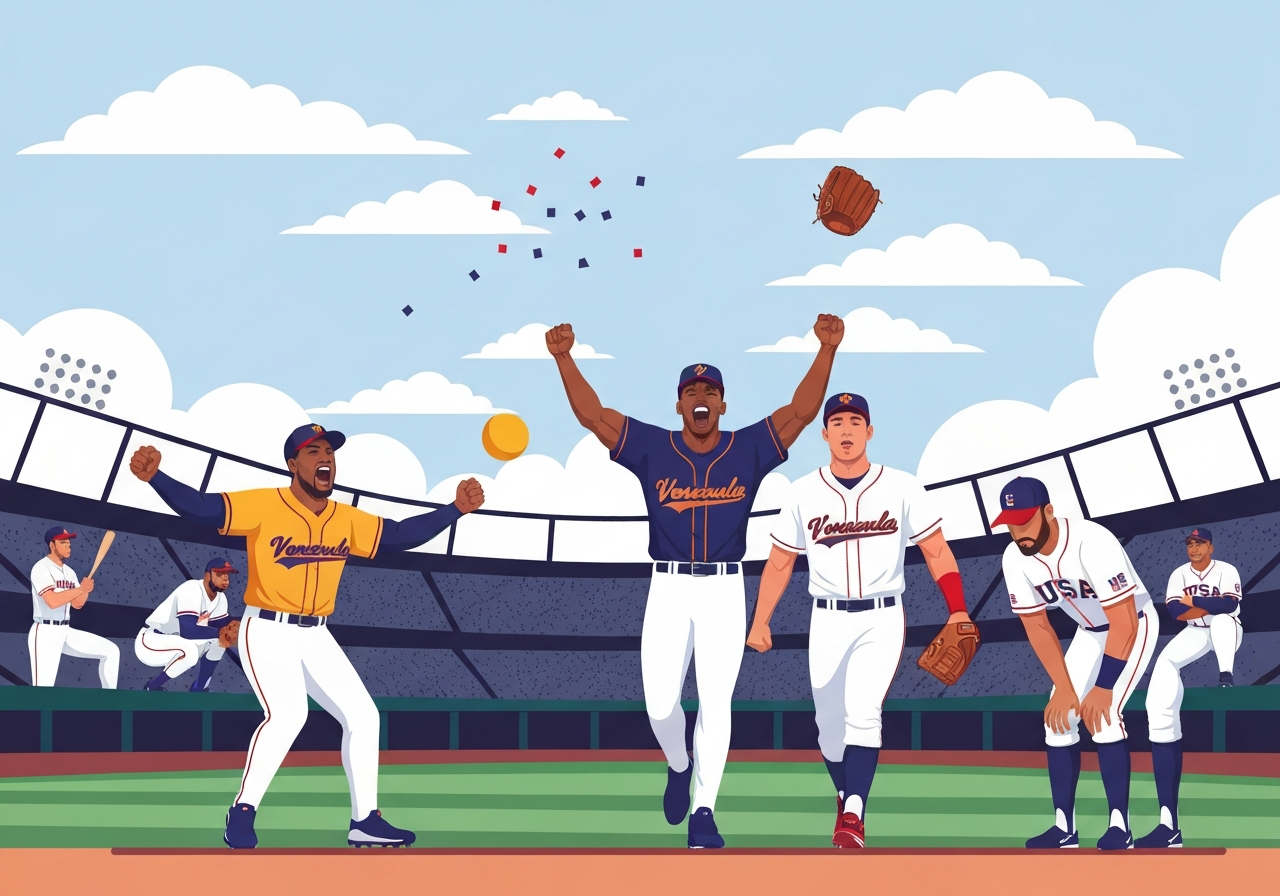
Venezuela claimed its first World Baseball Classic title on Tuesday, edging tournament favorite the United States 3-2 in a tense final. The score was tied 2-2 entering the ninth inning before Venezuela manufactured the decisive run: Luis Arráez drew a walk, Javier Sanoja entered as a pinch runner and stole second, and Eugenio Suárez delivered a go-ahead double to left-center. Daniel Palencia retired the U.S. side in order in the bottom of the ninth to seal the victory. The result capped a knockout-stage run that included wins over defending champion Japan and a strong Italy squad.
Key takeaways
- Final score: Venezuela 3, United States 2; Venezuela wins its first WBC championship and first gold in the tournament’s history.
- Decisive sequence: Luis Arráez walk, Javier Sanoja pinch-run and steal, Eugenio Suárez double in top of ninth produced the go-ahead run.
- Closer Daniel Palencia retired the U.S. 1-2-3 in the ninth to preserve the lead and secure the title for Venezuela.
- Venezuelan scoring: Maikel Garcia drove in the game’s first run with a third-inning sacrifice fly and Wilyer Abreu hit a 414-foot solo homer in the fifth.
- Starter Eduardo Rodríguez delivered 4 1/3 innings with four strikeouts and one hit allowed, handing a 2-0 lead to the bullpen.
- United States offense: tied the game in the bottom of the eighth on a 434-foot Bryce Harper home run after a Bobby Witt Jr. two-out walk; Team USA had only three hits and nine runs across its final three games.
- Aaron Judge, the reigning AL MVP, was held 0-for-4 in the final, including three strikeouts; the U.S. lineup produced only three hits in the championship game.
Background
The World Baseball Classic has grown into a premier international tournament that pits major-league talent against national teams. This edition saw several high-profile rosters and intense knockout-round matchups, with the United States entering the final as the pre-tournament favorite given its star-studded lineup. Venezuela had previously been competitive in international play but had never won the WBC; its run to the final included an upset of defending champion Japan in the quarterfinals and a win over Italy in the semifinals. National pride and MLB-level talent elevated stakes for both squads, with managers and federations emphasizing the event’s growing prestige.
Baseball in Venezuela carries outsized cultural significance, producing many major-league stars and passionate fan engagement. For the United States, the WBC remains a chance to translate MLB depth into a global title—the U.S. last won the tournament in 2017. Tournament structure—short series and knockout games—often magnifies the role of pitching changes, bullpen management, and timely hitting, which shaped both teams’ paths to the final. Expectation management and roster construction were recurring themes in media coverage leading into the championship.
Main event
The scoring began in the third inning when Maikel Garcia delivered a sacrifice fly to put Venezuela ahead. Venezuela continued to apply pressure at the plate, registering at least one hit in each of the first three innings and building momentum against U.S. starting pitching. Wilyer Abreu extended the lead with a 414-foot solo homer to center in the fifth, giving Venezuela a 2-0 advantage. Eduardo Rodríguez, the Venezuelan starter, worked 4 1/3 outstanding innings, striking out four while allowing a lone hit before the bullpen took over.
The U.S. offense struggled for much of the contest, failing to reach base until the third inning and rarely generating sustained rallies. That run of futility threatened to leave the team scoreless until the bottom of the eighth when Bobby Witt Jr. drew a two-out walk. Immediately after, Bryce Harper launched a 434-foot home run to center that tied the game 2-2 and briefly swung momentum back to the Americans. Aaron Judge, however, could not follow Harper’s spark; he finished 0-for-4 with three strikeouts and a groundout that left a runner stranded.
In the top of the ninth, Luis Arráez reached on a walk and was replaced in the running game by Javier Sanoja, who put pressure on the U.S. defense by stealing second. Eugenio Suárez then delivered with a double to left-center, scoring Sanoja and making it 3-2. Daniel Palencia, called upon to close, retired the United States in order in the bottom of the ninth to clinch the championship. The Venezuelan bullpen had been relied upon extensively in the late innings across the knockout stage, and manager decisions in matchups proved decisive.
Venezuela’s path to the title mixed timely offense, strong starting pitching from Rodríguez, and effective late-inning work from relievers. The U.S. ultimately generated only three hits in the final, an uncharacteristic output for a roster loaded with proven MLB bats. The final highlighted how single plays—walks, steals, and a clutch two-bagger—can determine outcomes in tournament baseball, particularly in a nine-inning championship setting.
Analysis & implications
Venezuela’s title reshapes recent WBC narratives by introducing a new champion and underscoring the depth of international baseball talent. The win validates Venezuela’s player development pipeline and gives its federation a global showcase moment that can boost participation, sponsorship and youth investment domestically. For MLB franchises, Venezuelan prospects and major-league veterans alike now have a higher-profile international accolade that factors into player legacies and marketability. The victory also enhances the WBC’s credibility as a venue where national programs—not just established powerhouses—can prevail.
For the United States, the loss raises questions about roster assembly, timing, and situational hitting in short tournaments. The U.S. scored only nine runs across its final three games, indicating that even elite individual talent can be neutralized by effective opposing pitching and small-sample variance. Managers and front offices may revisit how to balance star power with players whose recent performance and matchup profiles fit tournament play. The result also means the U.S. will wait at least four more years for a shot at redemption, which could influence offseason planning and international commitments from top players.
Internationally, the outcome may shift scouting and competitive dynamics ahead of other events and the next WBC. Nations that advanced deep into the bracket will point to Venezuela’s model—mixing veteran leadership with timely situational play—as a blueprint. Meanwhile, broadcasters and sponsors can highlight the tournament’s unpredictability to attract audiences who value close, meaningful games. On the field, tactical elements like successful pinch-running, aggressive base-stealing and bullpen allocation were decisive, and teams will likely emphasize those skills in future editions.
Comparison & data
| Team | Runs | Hits | Notable homers |
|---|---|---|---|
| Venezuela | 3 | — | Wilyer Abreu (414 ft) |
| United States | 2 | 3 | Bryce Harper (434 ft) |
The table summarizes key game data: final runs, hits for the U.S. (three), and the two solo home runs that changed momentum in the middle innings. Eduardo Rodríguez’s 4 1/3 scoreless-ish innings (one hit, four strikeouts) set the tone before the bullpen preserved the lead. Over the final three games of the tournament, the United States scored nine runs total, a marked decrease for an offensively oriented roster. Those small-sample offensive swings illustrate how tournament formats magnify single-game variance relative to a 162-game MLB season.
Reactions & quotes
Officials, analysts and fans offered immediate reactions that emphasized the historical weight of the result and the dramatic fashion of the win. Venezuelan baseball leaders framed the victory as a national milestone and pointed to player professionalism and depth as key factors. International baseball organizations praised the quality of play and the WBC format for producing a meaningful championship encounter.
“Historic achievement for Venezuelan baseball and its players.”
World Baseball Classic (official statement)
Baseball analysts highlighted managerial moves—especially the decision to insert Sanoja as a pinch runner and the timing of reliever usage—as decisive execution under pressure. They noted that small, high-leverage plays often determine outcomes in short tournaments and that Venezuela executed those moments more cleanly in the final. Commentators also underscored the value of Eduardo Rodríguez’s early innings in allowing the bullpen to dictate late-game matchups.
“A clutch double and smart, aggressive baserunning defined the championship sequence.”
Independent baseball analyst
Unconfirmed
- No major unconfirmed claims affecting the outcome were identified at time of publication; reports of specific internal roster disputes or injury statuses remain unverified.
Bottom line
Venezuela’s 3-2 victory over the United States delivered the country’s first World Baseball Classic title and highlighted how timely hitting, small-ball tactics and effective late-inning pitching decide short international tournaments. Eduardo Rodríguez’s strong start and the bullpen’s execution set up a ninth-inning rally characterized by smart baserunning and a clutch Suárez double. For the United States, a lack of consistent offensive production—three hits in the final and only nine runs over the last three games—proved decisive despite a roster of marquee names.
The result elevates Venezuela’s international baseball standing and will shape narratives around roster construction, tournament strategy and player availability in future WBC editions. Fans and federations should expect renewed investment and interest in Venezuelan baseball programs, while the U.S. faces questions about how to translate MLB talent into consistent tournament performance. The WBC itself emerged with another compelling final that underscores its growing significance on the global sports calendar.
Sources
- NBC News — media report of the game and game details (news coverage)
- World Baseball Classic — official tournament site (official/organizer)