
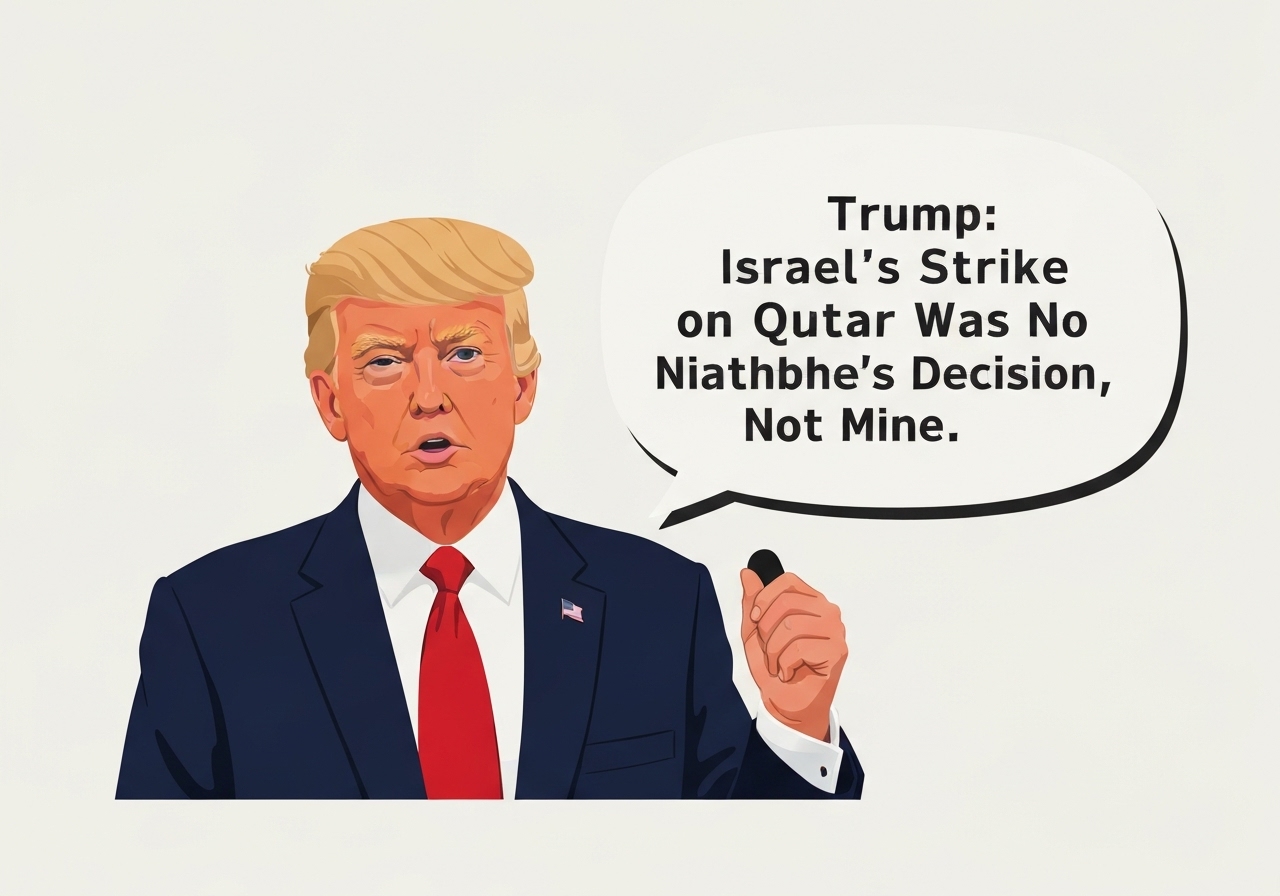
Lead: On Sept. 9, 2025, U.S. President Donald Trump said Israel’s airstrike inside Qatar was a decision made by Israeli Prime Minister Benjamin Netanyahu, not by the U.S. president. The strike, aimed at senior Hamas figures, occurred in Doha and killed at least five Hamas members, according to the group. Trump said he ordered a U.S. envoy to warn Qatar but acknowledged the warning arrived too late; Qatar denied receiving an advance alert. The attack has heightened regional tensions and complicated Qatar’s role as a mediator in ceasefire and hostage-negotiation talks.
Key Takeaways
- President Trump said on Sept. 9 that Netanyahu ordered the strike on Qatar and that he, Trump, did not authorise it directly.
- Hamas reported five members were killed in the Doha strike, including the son of exiled Gaza leader Khalil al-Hayya.
- Trump said he instructed U.S. envoy Steve Witkoff to warn Qatar before the strike but said the notice came too late; Qatar denied receiving any advance warning.
- Qatar is a U.S. security partner and has been mediating ceasefire and hostage-release talks between Israel and Hamas.
- Protesters in Washington expressed anger at U.S. policy, chanting pro-Palestinian slogans near the White House as Trump spoke to reporters.
- The broader Gaza war, which began after the Oct. 7, 2023 Hamas attack that Israel says killed 1,200 people and produced 250-plus hostages, has led to tens of thousands of deaths and a severe humanitarian crisis in Gaza.
- Trump described the Qatar strike as counterproductive to U.S. and Israeli objectives while also reiterating support for removing Hamas.
Background
The Israel–Hamas conflict has dominated the region since Oct. 7, 2023, when Palestinian militants launched an attack that Israeli authorities say killed roughly 1,200 people and left more than 250 hostages. Israel launched a large-scale military campaign in Gaza in response, which rights groups and some scholars have characterised as producing catastrophic civilian harm; reports describe tens of thousands of people killed, mass displacement and widespread food insecurity.
Qatar has positioned itself as a diplomatic intermediary in the conflict, hosting back-channel talks aimed at pausing hostilities, securing hostage releases and shaping post-conflict arrangements in Gaza. The United States counts Qatar as a strategic Gulf partner, hosting military facilities and cooperating on regional security, even as U.S. policy has remained closely aligned with Israel on many security priorities.
Political dynamics inside Israel and the United States shape decision-making on military actions beyond Israel’s borders. Previous Israeli operations targeting militant leaders outside Gaza have produced diplomatic strain when conducted on or near the territory of states that host mediators or U.S. partners.
Main Event
On Sept. 9, Israeli aircraft struck targets in Doha, Qatar, in an operation Israel described as aimed at senior Hamas operatives. Hamas said five of its members were killed, among them the son of Khalil al-Hayya, an exiled Gaza official. The strike triggered condemnation across parts of the Middle East and concern among U.S. and regional officials that the move could widen the conflict.
President Trump told reporters he had learned of the planned strike and ordered U.S. envoy Steve Witkoff to alert Qatari authorities, but that the communication arrived after explosions were already heard in Doha. Qatar issued a statement contradicting a U.S. heads-up, saying any call it received came only after blasts were audible in the capital.
Trump said he had spoken by phone with both Israeli Prime Minister Benjamin Netanyahu and Qatar’s emir, Sheikh Tamim bin Hamad Al-Thani, and assured Qatar’s leader that such strikes would not recur on Qatari soil. He added publicly that he was “not thrilled” with the way the operation unfolded, while reiterating U.S. interest in recovering hostages held by Hamas.
The operation followed months of tense diplomacy and military exchanges across the region, including strikes attributed to Israel in neighboring countries. In Washington, protesters demonstrated near the White House as the president addressed reporters, reflecting domestic divisions over U.S. policy and Israel’s conduct in Gaza.
Analysis & Implications
The strike exposed fault lines among U.S. allies: Israel’s decision to act inside the territory of a U.S. partner complicates Washington’s balancing act between backing Israel’s security needs and preserving relationships with Gulf states that serve as intermediaries. Qatar’s role as a broker in hostage negotiations means damage to trust could slow or derail delicate talks aimed at pauses in fighting.
Diplomatically, the episode raises questions about coordination and warning protocols between allies when operations risk crossing sovereign borders. Even if the decision originated in Jerusalem, the event demonstrates how operational surprise can generate immediate political costs and require rapid crisis management, including high-level calls and public assurances.
For Israel, the strike signals a willingness to pursue militant leadership across borders, but it also risks alienating Gulf partners whose cooperation is valuable for intelligence, deconfliction and post-conflict reconstruction planning. For Washington, the incident may prompt reassessments of how to ensure partners are forewarned and how to leverage relationships to keep mediation channels open.
Domestically in the U.S., Trump’s distancing from the decision is likely to be read through partisan lenses: critics may view it as inadequate control over an important ally, while supporters may see it as acknowledging complex operational realities. Internationally, the strike could embolden or provoke other actors, increasing the risk of wider regional conflagration if retaliatory dynamics take hold.
Comparison & Data
| Event | Date | Fatalities (reported) | Hostages (reported) |
|---|---|---|---|
| Hamas attack on Israel | Oct. 7, 2023 | Approximately 1,200 (Israeli tallies) | Over 250 taken hostage (Israeli tallies) |
| Israeli strike in Doha | Sept. 9, 2025 | 5 Hamas members (Hamas statement) | — |
| Gaza conflict (cumulative) | Since Oct. 2023 | Tens of thousands killed (various reports) | — |
These entries juxtapose initial attack figures and the most recent cross-border operation; differences in sourcing and methodology mean comparisons should be read cautiously. Official tallies and independent counts vary by source and are updated over time.
Reactions & Quotes
“Unilaterally bombing inside Qatar, a Sovereign Nation and close Ally of the United States… does not advance Israel or America’s goals,”
Donald J. Trump (public post)
Trump’s comment framed the strike as counterproductive to U.S. and Israeli interests while also reiterating support for removing Hamas as an organization. He balanced criticism of the operation’s location with reinforcement of the broader objective of securing hostage returns.
“Reports of prior notification are false; any U.S. call came after explosions were heard in Doha,”
Qatar government statement
Qatar’s denial of an advance warning directly contradicted the White House account of a pre-strike alert and underscored the diplomatic friction created by incidents on Qatari territory.
“Five of our members were killed in the attack, including the son of Khalil al-Hayya,”
Hamas (organizational statement)
Hamas’ tally and naming of a relative of an exiled leader served both as an immediate casualty report and as a messaging tool to regional and domestic audiences.
Unconfirmed
- Whether Trump’s envoy Steve Witkoff provided any actionable warning before the strikes remains contested; Qatar says any U.S. contact came after explosions were audible.
- The chain of command within Israel that led to the decision — including whether the operation had prior U.S. coordination at any level — has not been publicly detailed and remains unclear.
- Independent verification of the identities and roles of the five people Hamas said were killed in Doha has not been made public.
Bottom Line
The Sept. 9 strike in Doha marked a significant and sensitive escalation: an attack on the soil of a U.S. partner and mediator complicates diplomacy at a moment when hostage negotiations and ceasefire talks are fragile. President Trump’s public distancing of the U.S. from the operational decision reflects the political and strategic difficulty Washington faces when allied actions have cross-border consequences.
Going forward, the immediate priorities will be clarifying facts about notification and command, assessing damage to Qatar’s mediator role, and containing the risk of broader regional retaliation. For diplomats and policymakers, restoring trust among key interlocutors will be essential to any near-term de-escalation and to preserving channels needed for hostage recovery and humanitarian access.