
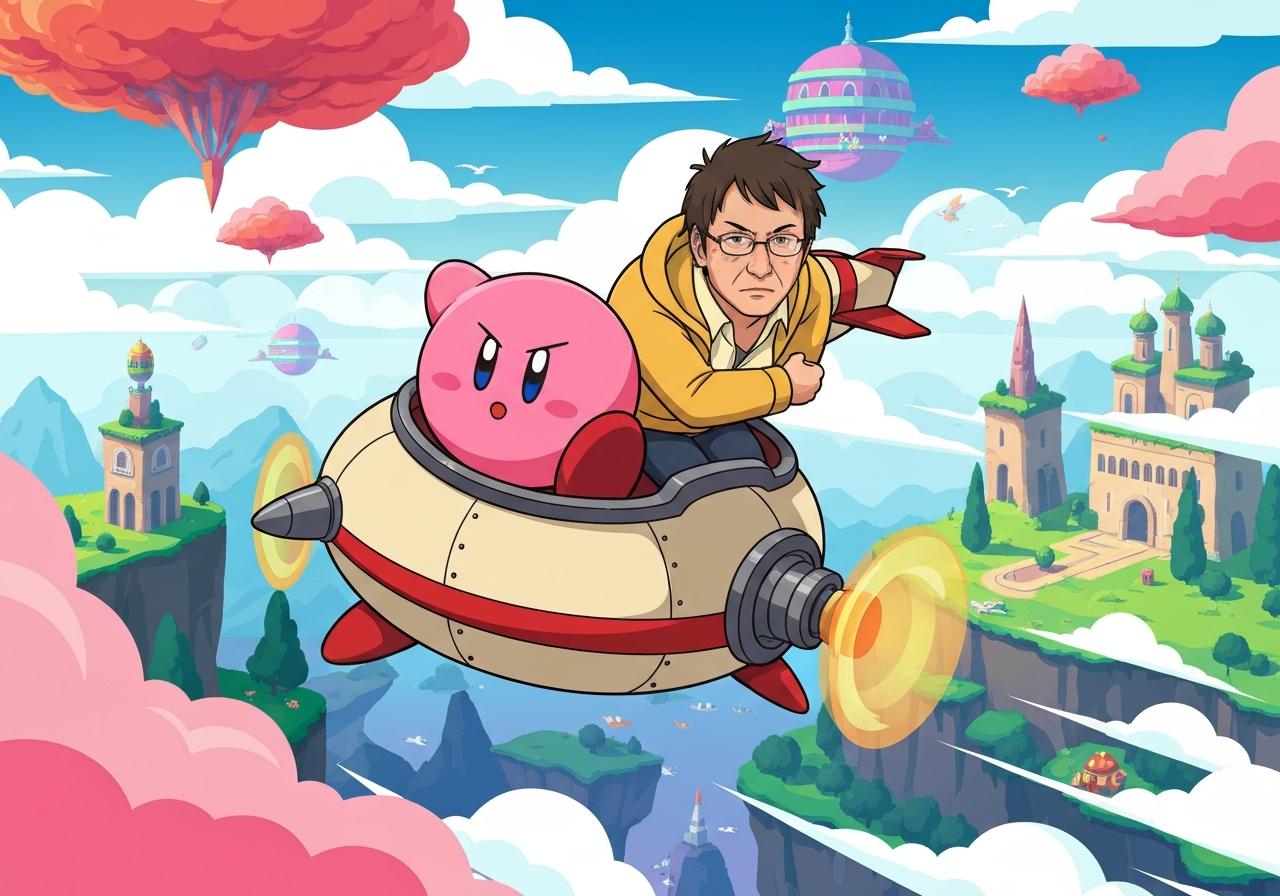
In Part 4 of an interview published on Nintendo.com, Kirby Air Ride director Masahiro Sakurai outlines why the Road Trip mode was created and how its narrative and structure were assembled. Sakurai says Road Trip was not in the original design, but was added to broaden single-player appeal alongside City Trial and Air Ride. He explains that the mode uses branching routes and machine-centered storytelling to give players longer, varied sessions rather than repeating short races. The result is a journey-focused single-player option built from existing gameplay elements and a deliberate selection of route characters drawn from across the Kirby series.
Key Takeaways
- Road Trip was not part of the initial design plan and was conceived to expand single-player options beyond City Trial and Air Ride.
- The mode offers three branching paths and larger branches to create multiple distinct worlds for replayability.
- Sakurai framed the Road Trip story around machines—Zorah, Nova, Gigantes—rather than Riders, because Riders are player-selected and lack narrative foreknowledge.
- Zorah’s backstory: flung into space, he collects machines, minerals and meteorites, and is not inherently malicious; Galactic Nova is likewise non-malicious.
- Characters like Leo and Gigantes were part of the concept from early design, and planned boss battles tie into the route structure.
- Design alternatives considered included sequential rival encounters and City Trial–style task events, but those were judged potentially tedious when repeated.
- Route characters were chosen by the design team to create unpredictability and to reference many entries in the Kirby canon for a festival-like feel.
Background
Kirby Air Ride launched with three core experiences: City Trial, Air Ride races, and additional modes. As contemporary expectations for single-player content grew, Sakurai and his team sought ways to extend playtime without inventing entirely new mechanics. The design challenge was to repackage existing systems—racing, battling, event tasks—into a coherent single-player progression that felt fresh rather than repetitive. Road Trip emerged as the solution: a sequence of challenges and choices that let the existing gameplay breathe over longer sessions.
Within the Kirby series, machines such as Zorah and Nova already had precedent—Zorah first appeared in Kirby Super Star—so connecting Road Trip to existing lore helped ground the mode. The development team also had access to multiple franchise characters spanning decades, which made it possible to create route characters drawn from many titles. This historical breadth influenced the decision to present Road Trip as a collection of surprises and callbacks rather than a Rider-centric narrative.
Main Event
Sakurai recounts that Road Trip began as an attempt to give players more single-player objectives: win a race or win a battle, repeated across branching routes to avoid monotony. He considered several structures, including waves of rivals and event-driven tasks like those in City Trial, but concluded that simply cycling through isolated challenges would become tedious. Framing the mode as a journey with three main branches and occasional larger forks allowed the team to combine obstacles, stage transitions, and unexpected solutions into coherent routes.
Story-wise, Sakurai deliberately avoided centering the narrative on player-picked Riders because those characters, by design, have no prior knowledge of events and differ depending on player choice. Instead, he focused the plot on the machines themselves—Zorah, Nova, Gigantes—making them the narrative anchors. Zorah’s accidental flight into space and his subsequent accumulation of materials became the emotional and mechanical catalyst for Road Trip’s mid-mode incident, which implies the presence of a hostile force threatening Planet Popstar.
Route characters were created collaboratively by the design team to inject unpredictability and to form logical links between stages—examples include connecting a ground obstacle to a rainbow bridge that leads to a sky stage. The team tracked the origin titles of candidate characters to ensure the roster felt like a celebration of the series, deliberately balancing representation so no single game dominated the selection. Boss encounters and larger set-piece machines such as a mountain-like Gigantes were folded into the routes to provide variety and clear milestones.
Analysis & Implications
Sakurai’s approach highlights a pragmatic game-design principle: when new mechanics are limited, reshape existing ones into new structures to create the perception of fresh content. Road Trip repurposes races, battles, and tasks into a branching campaign, raising replay value through route variety rather than mechanical novelty. That decision addresses player expectations for modern single-player longevity while conserving development resources by avoiding wholly new systems.
Choosing machines as the story’s focus achieves two things. First, it bypasses narrative complications tied to player-selectable Riders, who would otherwise require distinct motivations or scripted knowledge. Second, it roots the story in franchise-established elements (Zorah, Nova), which preserves continuity and appeals to longtime fans. This is a low-risk way to enrich lore without contradicting character-facing canon.
The deliberate curation of route characters from across the Kirby timeline reinforces franchise cohesion and encourages discovery. Players who recognize older characters gain a sense of reward, while unfamiliar players still experience unpredictable interactions. From a design standpoint, balancing references prevents nostalgia from overwhelming gameplay and helps attract both veteran and new audiences.
Comparison & Data
| Mode | Primary Goal | Replay Focus |
|---|---|---|
| City Trial | Collect items and set up matches | Sandbox discovery, item variance |
| Air Ride | Short races | Skill and course mastery |
| Road Trip | Branching challenges and story progression | Route selection and character encounters |
The table above summarizes how Road Trip differs from the other two core modes: instead of emphasizing short sessions or sandbox freedom, Road Trip structures play as a sequence of choices and milestones. This design creates longer play loops and encourages repeated playthroughs to explore alternate branches. It also integrates boss fights and route characters to mark progression points and diversify pacing.
Reactions & Quotes
Several responses clarify Sakurai’s intent and how the team implemented it. The quotes below are short excerpts from the interview and are presented with context.
“We didn’t have Road Trip in the initial design planning stage, but players would surely want some more elements that can be enjoyed in single player.”
Masahiro Sakurai, Director (Nintendo interview)
This quote frames the mode as a reactive design choice aimed at single-player longevity rather than a preplanned flagship feature. It underscores the team’s priority to keep play sessions meaningful without inventing brand-new mechanics.
“I made it about the machines themselves, not the characters.”
Masahiro Sakurai, Director (Nintendo interview)
Sakurai’s decision to anchor the narrative on machines is a practical narrative strategy to avoid contrived motivations for player-selected Riders and to draw on existing franchise lore like Zorah and Galactic Nova.
Unconfirmed
- Sakurai mentions “all kinds of scenarios” he hopes to share someday; those future scenarios and whether they would be published or used in later titles remain unconfirmed.
- No public metrics were provided on how players responded to Road Trip after release; exact player engagement numbers for the mode are not disclosed in the interview.
Bottom Line
Road Trip represents a careful design compromise: it increases single-player depth by recombining existing gameplay elements into a branching journey, rather than adding wholly new mechanics. By anchoring the narrative to machines like Zorah and Nova, Sakurai avoids the constraints of player-selected Riders while tying the mode into established Kirby lore. The curated route characters and branching map create replay value and a celebratory tone that references the franchise’s history.
For players and designers alike, Road Trip is an instructive example of how limited resources and preexisting systems can be recomposed to meet modern expectations for content length and variety. Sakurai’s explanations provide insight into practical narrative choices and the balance between fan service and gameplay coherence.
Sources
- By Director Mr. Sakurai: Kirby Air Riders — Development Insights, Part 4 (Official interview, Nintendo)