
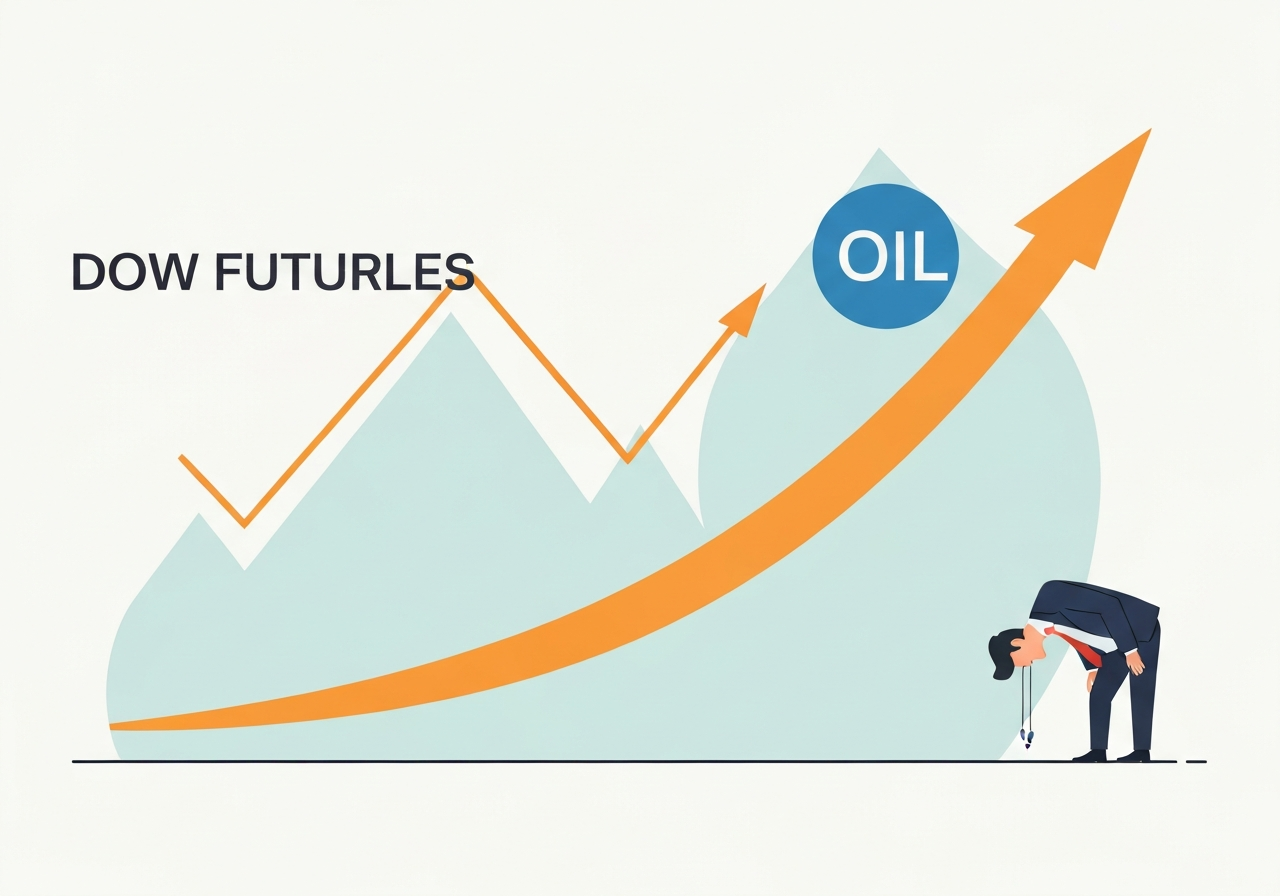
Dow Futures Steady as Oil Surges; Micron Slides Despite Blowout Q2 Results
Lead: Early Thursday, Dow Jones futures were little changed while S&P 500 and Nasdaq futures showed muted movement as global oil prices surged in volatile trade but pulled back from intraday highs. Micron Technology reported blowout fiscal second-quarter earnings and raised guidance late Wednesday, but its shares fell in subsequent trading. Storage peers SanDisk and Western Digital also traded lower. The broader U.S. stock market retreated solidly on Wednesday, leaving investors weighing commodity volatility against strong semiconductor revenue signals.
Key Takeaways
- Dow futures were little changed early Thursday; S&P 500 and Nasdaq futures showed similar limited movement following a risk-off session on Wednesday.
- Global oil prices surged in volatile trade, briefly reaching highs before easing, adding inflation and growth concerns for markets.
- Micron reported blowout fiscal Q2 results and raised guidance on March 18, 2026, signaling strong AI data-center demand.
- Despite the results, Micron shares fell after hours; memory and storage peers SanDisk and Western Digital also traded lower.
- Wednesday’s broad-market retreat set a cautious tone, with investors parsing earnings beats, commodity swings, and macro signals.
- Market reaction suggests earnings beats do not always translate immediately into higher stock prices when macro or sector-specific risks persist.
Background
Equity futures entered Thursday trading with little directional conviction after a notably softer session the day before. Commodity moves — particularly in oil — have intermittently altered risk appetite over recent weeks, amplifying the sensitivity of equity markets to external shocks. The semiconductor and storage sectors have been under intense focus as investors try to separate durable demand trends tied to artificial intelligence and data centers from cyclical inventory dynamics. Memory suppliers like Micron, and storage peers SanDisk and Western Digital, sit near the intersection of secular AI-driven capex and shorter-term price cycles in chips and flash storage.
Oil price swings have two direct market effects: first, they affect inflation expectations and real consumer purchasing power; second, they shift forward-looking profitability assumptions for energy-intensive industries. Both channels can influence central bank calculus, bond yields and equity valuations. Against that backdrop, corporate earnings reports—especially from large-cap technology and industrial suppliers—have a disproportionate effect on intraday sentiment. That combination of macro uncertainty and sector-specific narratives helps explain why even strong results can produce mixed immediate stock reactions.
Main Event
Late Wednesday, Micron disclosed fiscal second-quarter results that outperformed consensus estimates and issued guidance that pointed to continued strength in AI-related data-center demand. Company commentary and the headline beat were characterized by Investor’s Business Daily coverage as a notable upside surprise for the memory maker. Despite the surprise, Micron shares declined in follow-on trading; traders cited profit-taking, valuation resets, and the broader market pullback as likely contributors to the drop.
At the same time, SanDisk and Western Digital, two related storage-equipment and flash-memory names, traded lower, underlining a sector-wide hesitation. Market participants noted that supply-chain timing, pricing environment for NAND and DRAM, and expectations about incremental capital spending by hyperscalers were influencing prices across the group. The net result was a divergence: corporate fundamentals improving for some names while investor positioning and macro risks pushed prices lower.
Commodity markets added to the day’s complexity. Global oil benchmarks surged in early moves before easing from intraday highs, reflecting a mix of supply concerns and demand recovery signals. That volatility in energy markets tightened risk premiums, prompting some investors to step back from equities despite idiosyncratic positive corporate news. The combined story for the session was not a single-event market move but overlapping forces—earnings beats, sector re-evaluation and commodity-driven risk aversion—pulling in different directions.
Analysis & Implications
Short-term price action shows that headline earnings beats are necessary but not sufficient for sustained stock gains when macro volatility is present. For Micron, the fiscal Q2 beat and stronger guidance reinforce the narrative that AI data-center growth is real and supporting semiconductor revenue. However, the memory industry is historically cyclical and sensitive to inventory and pricing dynamics; investors are likely recalibrating near-term expectations even as they acknowledge improving secular demand.
Energy-price volatility complicates the market picture. A sustained rise in oil would raise input-cost and inflation concerns, potentially squeezing margins outside the tech sector and prompting risk-off positioning in broader markets. If oil volatility persists, it can feed through to bond yields and currency moves, raising the hurdle rate investors use to value equities. That creates a scenario where strong corporate data must compete with macro headwinds to sustain rallies.
For policymakers and longer-horizon investors, the coexistence of firm semiconductor demand and commodity-driven uncertainty raises questions about differentiated policy impacts. Central banks will monitor whether energy-driven inflation proves transitory or persistent; either outcome affects real rates and equity multiples. For the tech sector specifically, sustained AI-driven capex would support capital expenditure cycles, but timing and margin outlooks for memory vendors will remain a focal point.
Comparison & Data
| Instrument | Overnight / After-hours Move |
|---|---|
| Dow futures | Little changed |
| S&P 500 futures | Little changed |
| Nasdaq futures | Little changed |
| Global oil | Surged, then eased from highs |
| Micron (MU) | Reported blowout Q2 results; shares fell after hours |
| SanDisk (SNDK) / Western Digital (WDC) | Traded lower |
The table summarizes market moves referenced in this report in qualitative terms because intraday numeric ranges varied across exchanges and benchmarks. The pattern—muted futures, commodity spikes and mixed corporate reactions—highlights how cross-market volatility can blunt the immediate impact of earnings beats. Traders often wait for follow-through in regular-session volume or confirmation in sector peers before committing to new directional positions.
Reactions & Quotes
“Micron smashed estimates for its fiscal second quarter,”
Investor’s Business Daily (media)
This succinct headline captured the company’s earnings surprise and the market narrative that AI data-center demand is lifting memory revenue. The phrase has been widely cited as shorthand for the strength in Micron’s top-line performance for the quarter.
“Global oil prices surged but also came off highs in volatile trade,”
Investor’s Business Daily (market summary)
That line reflects the intraday commodity swings that influenced investor sentiment across equities and fixed income. Market summaries emphasized how brief spikes in energy benchmarks increased near-term risk aversion.
Unconfirmed
- Whether Micron’s after-hours decline was driven primarily by profit-taking, valuation concerns, or specific elements of its guidance remains unconfirmed without detailed trade-level data.
- The precise drivers of the oil intraday spike—whether supply disruption, inventory surprises, or speculative positioning—require further confirmation from energy-market reports.
Bottom Line
Markets showed a cautious tone as futures were steady early Thursday while commodities spiked and then eased, illustrating how cross-market volatility can mute the immediate effect of corporate earnings. Micron’s fiscal Q2 beat and raised guidance underscore durable demand in AI-related data centers, yet the stock’s drop highlights that headline beats can be outweighed by macro and sector concerns in the near term.
Investors should watch follow-through trading in the days ahead: confirmation in sector peers, clearer signals from energy markets, and subsequent corporate commentary will determine whether earnings-driven momentum can overcome commodity-induced risk aversion. For longer-term allocations, sustained AI-driven capex would support memory demand, but timing and cyclicality in pricing will remain central to valuation judgments.
Sources
- Investor’s Business Daily — media market coverage and earnings summary