
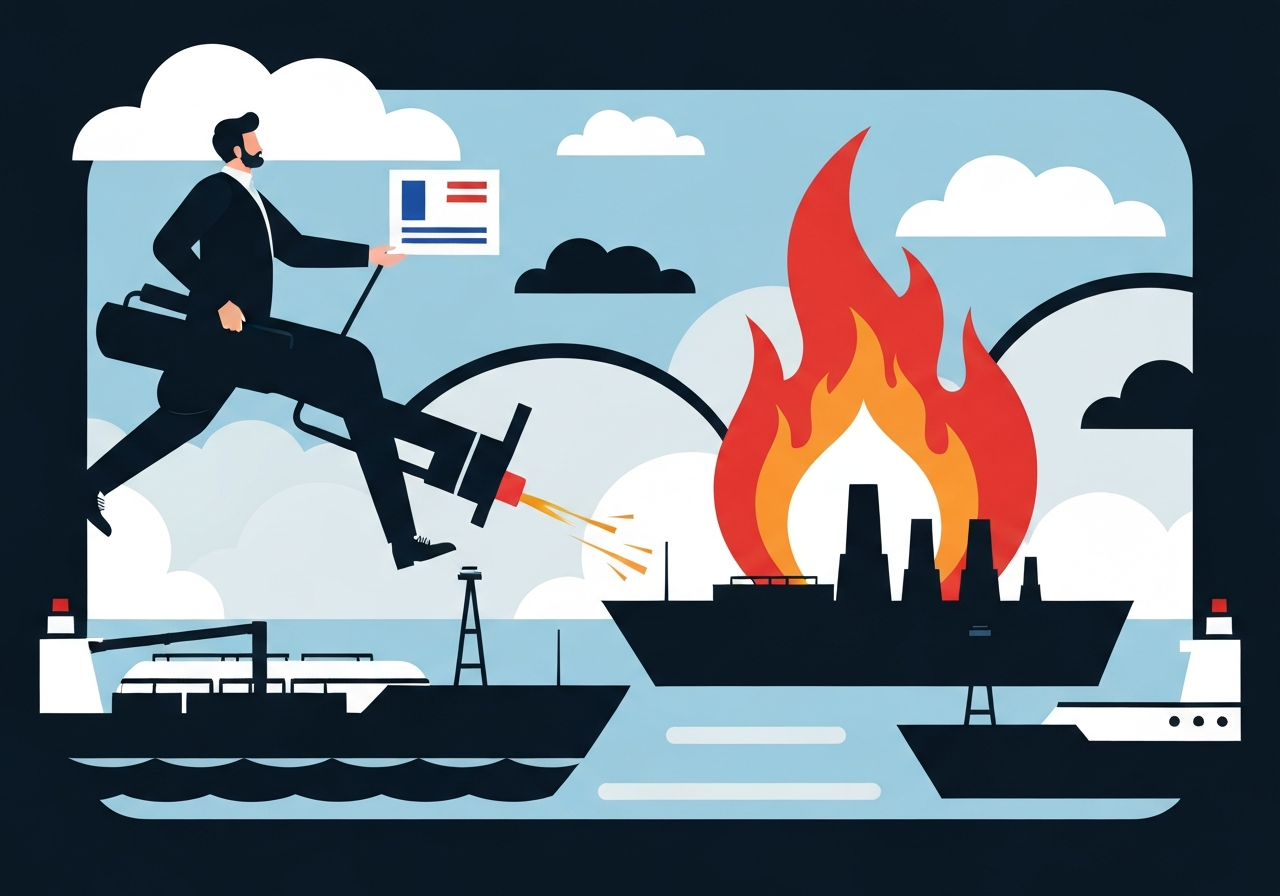
Israeli forces struck the South Pars gas field this week and Iran responded with waves of attacks on Gulf energy infrastructure, sending oil and gas prices sharply higher and prompting international alarm. U.S. and allied militaries have carried out precision strikes deeper into Iran, including an operation on Kharg Island that reportedly hit more than 90 targets. Six U.S. partners — the U.K., France, Germany, Italy, the Netherlands and Japan — issued a joint statement offering to “contribute to appropriate efforts” to reopen the Strait of Hormuz. Markets reacted immediately: global benchmarks for oil and natural gas jumped, and regional states reported wide-ranging air-defense activity and infrastructure damage.
Key takeaways
- Israeli strike on the South Pars gas field, shared with Qatar, triggered retaliatory strikes on Ras Laffan and other Gulf energy sites, disrupting LNG flows that normally supply roughly 20% of global shipped gas.
- Brent crude climbed to about $116.38 per barrel after trading under $73 per barrel before the war; U.S. crude was quoted near $96.45 and European natural gas benchmark TTF rose about 24%.
- U.S. military leaders said forces have struck more than 7,000 Iranian targets to date; Joint Chiefs Chairman Dan Caine reported precision strikes last Friday on over 90 targets on Kharg Island.
- The UAE reported intercepting seven missiles and 15 drones in a single day, and overall said defenses have now downed 349 missiles and more than 1,700 drones since the conflict began.
- Six allies (U.K., France, Germany, Italy, the Netherlands, Japan) pledged readiness to help ensure safe passage through the Strait of Hormuz but gave no operational details.
- Commercial satellite firm Planet Labs paused release of fresh imagery for 14 days covering Iran, the Persian Gulf and allied bases, citing risks of tactical exploitation.
- The U.S. carrier USS Gerald R. Ford is sailing to Crete for repairs after onboard fires and system failures, amid extended regional deployments that have strained crew rotations.
Background
The current confrontation dates to the opening of large-scale hostilities on Feb. 28, when U.S. and Israeli operations against Iran escalated into sustained strikes and counterstrikes. The Strait of Hormuz, through which roughly one-fifth of seaborne oil passes, has been repeatedly targeted by Iranian missile and drone actions that have effectively paralysed much commercial traffic. South Pars, the offshore gas field shared by Iran and Qatar, is one of the world’s largest gas reservoirs; attacks on its facilities threaten liquefied natural gas exports that underpin global supply chains.
Kharg Island has long been Iran’s principal crude loading terminal, historically handling 85–95% of the country’s seaborne exports; damage there would sharply curtail Iran’s ability to move oil to market. At the same time, Gulf refining hubs — including large facilities in Kuwait, Saudi Arabia and the UAE — have reported strikes, fires and temporary shutdowns. Political pressure on U.S. allies has mounted: President Trump has publicly urged deployment of foreign forces to reopen the Hormuz sea lane, while several partners signal reluctance to join active combat operations and instead talk of post-hostility support such as mine-clearance assets.
Main event
This week, an Israeli strike on South Pars shifted the conflict onto the “plumbing” of the global energy system, according to market observers. QatarEnergy reported damage at Ras Laffan Industrial City and said the Pearl GTL facility and other LNG-related assets sustained fires and “extensive damage,” forcing shutdowns. President Trump posted on social media that Israel would not again strike South Pars and warned that the U.S. could destroy the field if Iran continued attacks on Qatar’s LNG facilities.
U.S. military officials described a stepped-up campaign of precision strikes across Iran. Joint Chiefs Chairman Dan Caine said forces hit more than 90 targets on Kharg Island during a Friday operation that focused on air defenses, naval infrastructure and mine storage. Defense Secretary Pete Hegseth termed the most recent operations “the largest strike package yet,” and the Pentagon reported that strikes were pushing farther east into Iranian territory to hit ammunition depots, mine stores and fast-attack craft.
Beyond strikes inside Iran, U.S. helicopters have struck Iran-backed militia positions in Iraq to limit threats to American forces and interests. At sea, naval and maritime-authority reports include an unverified incident where a vessel near Qatar’s Ras Laffan was reported hit by an unknown projectile; all crew were reportedly safe. In parallel, Saudi, Kuwaiti and Emirati refining and gas facilities reported strikes and fires, prompting damage assessments and, in some cases, temporary shutdowns.
Analysis & implications
Energy markets are reacting to a credible risk of sustained supply disruption. South Pars and Ras Laffan are central nodes in LNG shipping routes; loss of their output combined with a partially closed Strait of Hormuz tightens global supply and raises the prospect of prolonged higher energy prices. Analysts warn this creates a stagflation risk — slower growth with rising inflation — because energy-driven cost pressures can feed through to transport, manufacturing and household bills.
Strategically, the attacks broaden the theater of the war beyond cross-border strikes to encompass economic infrastructure, making de-escalation more complex. Damage to Kharg Island would sharply reduce Iran’s export revenues, potentially prolonging the conflict by incentivizing deeper retaliation. Conversely, expanded international naval operations to reopen Hormuz would escalate coalition involvement and raise political costs for reluctant allies, especially those constrained by domestic law or public opposition.
Allied responses to date show a mixture of diplomatic support and operational caution. The six-nation joint statement offers planning cooperation but stops short of committing forces for combat operations; several governments have indicated they might provide niche capabilities — mine countermeasures or surveillance assets — after active hostilities subside. Economically, if disruptions persist, central banks face a dilemma: higher energy-driven inflation amid slower growth complicates monetary policy and fiscal planning worldwide.
Comparison & data
| Metric | Latest reported | Pre-war / note |
|---|---|---|
| Brent crude | $116.38 per barrel | Under $73 per barrel before hostilities |
| U.S. crude (WTI) | $96.45 per barrel | Substantially lower pre-conflict |
| European TTF gas | +24% (session) | Volatile; regionally sensitive |
| Kharg Island role | Handles ~85–95% of Iran’s seaborne crude | Primary export terminal |
| Qatar LNG share | ~20% of global shipped LNG | Ras Laffan key export terminal |
| Mina Al-Ahmadi refinery capacity | 730,000 barrels per day | One of region’s largest |
These figures show how concentrated energy flows are in a handful of facilities and chokepoints. Even limited damage or extended closures at one or two nodes can immediately tighten markets. Policymakers and market participants now track repair timelines for affected facilities, naval security for tanker transit, and potential replacement shipping routes or incremental supply from non-Gulf producers.
Reactions & quotes
Global leaders and military officials have issued terse statements that reflect both alarm and restraint. Six allied leaders emphasized willingness to help secure shipping lanes but did not specify commitments, underscoring the political limits of coalition involvement during active combat.
“Readiness to contribute to appropriate efforts to ensure safe passage through [the Strait of Hormuz].”
United Kingdom, France, Germany, Italy, the Netherlands, Japan (joint statement)
U.S. military leadership described continuing pressure on Iranian military infrastructure and the objective to deny Iran capabilities that directly threaten shipping and regional forces.
“We continue to strike against Iran’s defense industrial base and will continue to do so.”
Joint Chiefs Chairman Dan Caine
The U.S. president used stark language on social media to deter further strikes on shared energy infrastructure, linking future action to potential destruction of the South Pars field — a statement that raises the stakes for all parties involved.
“NO MORE ATTACKS WILL BE MADE BY ISRAEL” (and a warning that the U.S. could act against South Pars).
President Donald J. Trump (social media)
Unconfirmed
- Attribution of the South Pars strike: President Trump said the U.S. “knew nothing” about the Israeli strike; Israeli officials have not publicly acknowledged the operation — independent confirmation of the attacker is not available.
- Reports of fatalities from strikes in the West Bank and specific ground-level casualty counts in some targeted sites remain unverified by independent sources.
- The Washington Post report that the Defense Department will seek $200 billion for the Iran war is cited by Iranian officials, but U.S. authorities have not publicly confirmed that amount.
- Details about the vessel reportedly “hit by an unknown projectile” off Ras Laffan — including the projectile type, damage extent and attacker identity — have not been independently corroborated.
Bottom line
The strike on South Pars and subsequent attacks on Gulf energy infrastructure mark a material escalation that directly threatens global energy flows and raises the economic cost of the conflict. Markets have already priced in a supply shock: higher oil and gas prices will likely feed through to inflation and slow growth, complicating economic policy choices worldwide.
Diplomatically, allies face a difficult calculus between supporting reopening of the Strait of Hormuz and avoiding direct combat engagements that would widen the war. The coming days will hinge on the resilience of energy facilities, the pace of military operations inside Iran, and whether international partners move from planning to concrete mine-clearance or naval protection roles.
Sources
- CBS News — live updates (news)
- Reuters — market and regional reporting (news agency)
- Planet Labs — company notice on imagery delays (commercial provider)
- QatarEnergy — company statement on attacks (state-linked energy company)
- U.S. Department of Defense — official briefings and statements (official)