
Lead
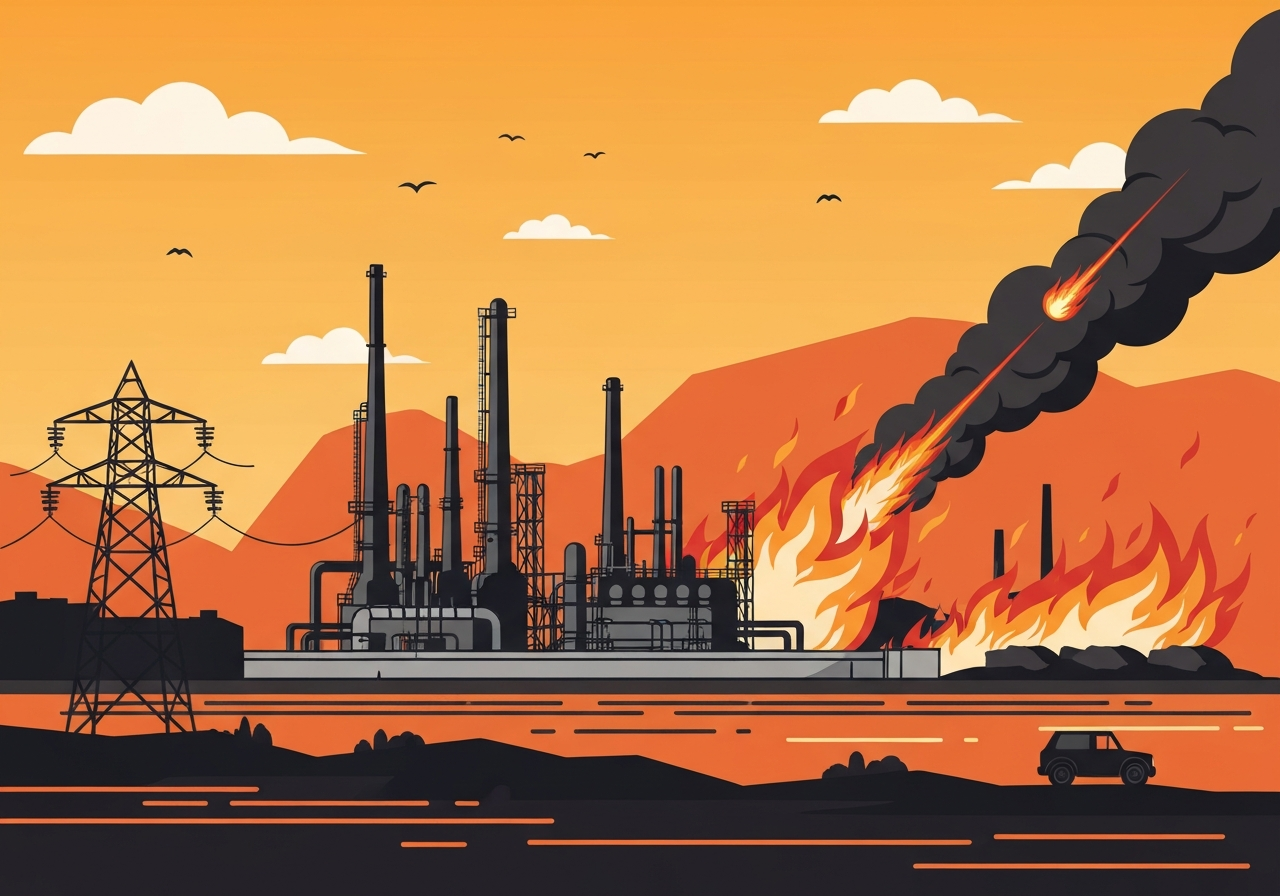
On Thursday afternoon an Iranian-launched missile struck the Bazan oil refining complex in Haifa Bay, producing visible smoke, a fire and a hazardous materials assessment. The strike was part of a wider barrage that included launches from Iran and rocket fire from Lebanon, and officials reported sirens across large areas of Israel. Power outages affected parts of Haifa after multiple impact sites were reported and at least one person was lightly wounded by shrapnel in Yokneam. Emergency teams mobilized rapidly; the scene was secured and monitoring for hazardous substances was underway.
Key Takeaways
- At least one missile from Iran hit the Bazan refineries in Haifa Bay on Thursday afternoon, causing facility damage and visible smoke.
- Initial assessments indicated the projectile carried a cluster warhead, leading to several impact points across Haifa.
- Fifteen firefighting teams were dispatched to the Bazan site; no injuries were reported at the refinery itself.
- A vehicle in Yokneam was struck by shrapnel and one person there was lightly injured; several people in Shfaram received treatment for shock.
- Power outages were reported in parts of Haifa; Israel Electric Corporation crews restored electricity to most affected customers by the evening.
- Shares of Petrochemicals Ltd. fell more than 10% on the Tel Aviv Stock Exchange and Bazan stock dropped over 6.5% following the strike.
- Sirens sounded across the Golan Heights, Kiryat Shmona, the Galilee, Tel Aviv metro, Jerusalem area, parts of the Shfela and in Ashdod during the wider launches.
- The Home Front Command later announced the incident had ended and residents could leave protected spaces.
Background
Tensions between Iran and Israel had escalated after Israeli strikes on the South Pars gas facilities, which Tehran cited when claiming the launches were retaliatory. The Thursday barrage combined long-range launches from Iran with additional rocket fire from Lebanon, marking one of the more complex, multi-directional exchanges in recent months. Haifa Bay hosts key energy infrastructure, including Bazan facilities that refine and supply fuel widely used domestically; any hit to these sites raises immediate economic and civilian risk.
Past incidents involving cross-border fire and targeted strikes have repeatedly underscored the vulnerability of Israel’s northern and coastal installations to regional escalation. Stakeholders include national emergency services, the Israel Electric Corporation responsible for the grid, commercial operators such as Bazan and Petrochemicals Ltd., and security agencies tracking incoming threats. Public alerts and siren activations have become a regular civil defense mechanism in populated areas across the north and center.
Main Event
According to official briefings and on-scene reporting, the missile impact produced multiple ground strikes in Haifa, with smoke rising from the Bazan refinery complex. Fire and Rescue Services reported dispatching 15 firefighting teams to contain flames and secure the site while conducting air and ground searches. Crews worked to extinguish the blaze and simultaneously carried out monitoring for a suspected hazardous materials incident at the facility.
Initial assessments suggested the warhead dispersed submunitions or produced multiple impact points, which complicated suppression and inspection operations. Power interruptions were reported in several Haifa neighborhoods, attributed to infrastructure damage caused by debris and multiple impact sites; Energy and Infrastructure Minister Eli Cohen described the damage to the northern grid as localized. Magen David Adom confirmed it had not received reports of serious injuries in the Haifa area, while emergency responders treated shock victims in Shfaram and a lightly wounded person in Yokneam.
Markets reacted quickly: shares of Petrochemicals Ltd., a stake-holder in Bazan, fell more than 10% on the Tel Aviv Stock Exchange and Bazan’s own shares declined over 6.5% after the news. Authorities later reported that the Home Front Command declared the incident over and residents could exit protected spaces, signaling a transition from acute emergency response to damage assessment and restoration.
Analysis & Implications
The strike on a major refining complex highlights the exposure of critical energy infrastructure to regional military escalation. A direct hit to refineries can interrupt fuel production and distribution, with short-term effects on transport, industry and civilian supplies. Even if fire suppression limits structural damage, the need for hazardous materials monitoring can prolong operational closures and slow recovery timelines, raising economic costs beyond immediate repair bills.
Financial markets registered the event as a risk signal for energy and industrial investors, reflected in double-digit share moves for firms linked to Bazan. Those market reactions are likely driven by uncertainty over the extent of damage, potential production stoppages and the time needed to certify the site as safe. Insurers and corporate risk managers will be monitoring remediation costs, potential environmental liabilities and supply-chain disruptions tied to northern Israel’s fuel distribution.
Strategically, Tehran framing the launches as retaliation for attacks on South Pars ties this incident into a broader tit-for-tat dynamic that could prompt additional exchanges. Israel’s rapid restoration of most power customers suggests operational resilience, but repeated strikes—especially on clustered or dispersed warheads—raise the risk of cumulative infrastructure degradation. International actors and regional partners will watch whether this exchange remains limited or triggers further escalation across Lebanon, the West Bank or maritime zones.
Comparison & Data
| Item | Reported Figure |
|---|---|
| Firefighting teams dispatched | 15 |
| Petrochemicals Ltd. share move (TASE) | Down >10% |
| Bazan share move | Down >6.5% |
| People lightly wounded | 1 (Yokneam) |
| Impact type | Multiple impact sites; initial cluster warhead assessment |
The table summarizes confirmed numbers and immediate market reactions. While firefighting and medical response figures are operational counts provided by emergency services, financial moves reflect intraday trading and may adjust as markets open or more information emerges. Damage assessments and production impacts at the refinery will determine longer-term economic consequences and are still being established.
Reactions & Quotes
Officials described the operational response and the status of civilian services as teams worked on scene.
Forces are conducting extensive searches in the area and working to extinguish a fire that broke out at the site. Teams have secured the scene and are carrying out monitoring operations to examine a suspected hazardous materials incident.
Fire and Rescue Services (official statement)
Government leadership framed the grid impact as limited while crews restored power to most customers.
The damage to the northern power grid is localized and not significant. Crews are operating in the field and electricity has been restored to most affected customers.
Eli Cohen, Energy and Infrastructure Minister (official)
Emergency medical services reported limited casualty information amid ongoing assessments.
We have not received reports of serious injuries in the Haifa area at this time.
Magen David Adom (official)
Unconfirmed
- Exact extent and cost of structural damage to the Bazan refinery remain under official engineering assessment and are not yet public.
- Whether all reported impact sites correspond to submunitions from a single cluster warhead or to multiple munitions is still being verified by ordnance teams.
- Any immediate or latent environmental contamination levels from the fire and potential fuel releases are pending laboratory testing.
Bottom Line
The Iranian-launched strike on the Bazan refineries in Haifa Bay caused an immediate local emergency, prompted hazardous-materials monitoring and triggered power interruptions and market nervousness. Emergency services contained the fire and secured the site, and officials reported that most electricity service was restored by evening, while investigations and technical assessments continue to define the full damage profile.
Beyond the local impact, the incident underscores the vulnerability of energy infrastructure to regional military exchanges and the potential economic ripple effects from even time-limited disruptions. Observers should watch for official engineering and environmental reports, Bazan production notices, and any follow-up military or diplomatic moves that could either de-escalate the situation or lead to broader confrontations.
Sources
- Ynetnews (Israeli news report summarizing official statements and on-scene reporting)
- Magen David Adom (official emergency medical services)
- Ministry of Energy and Infrastructure (official government department)
- Fire and Rescue Services (official emergency responder statements)
- Tel Aviv Stock Exchange (market data and trading platform)