
Lead
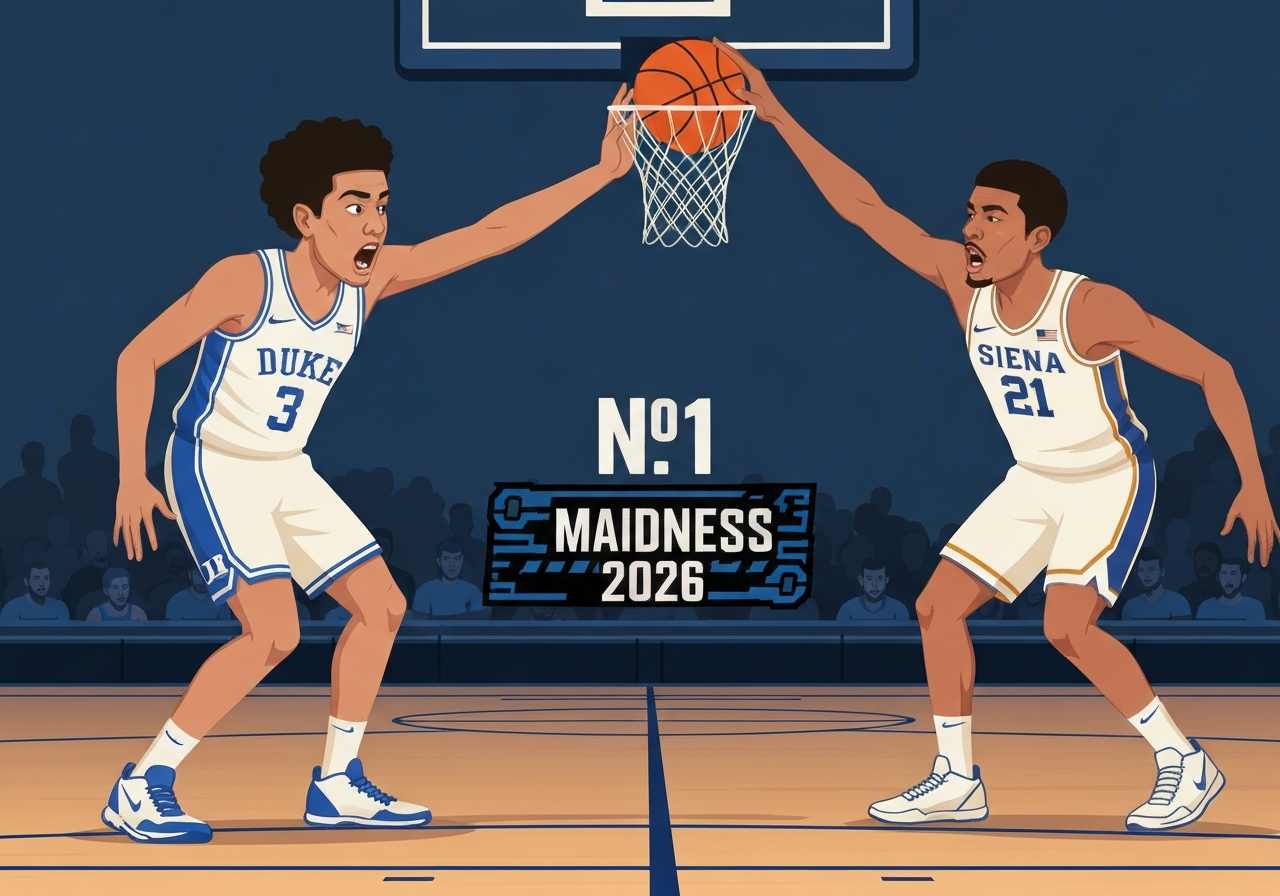
On March 19, 2026 in Greenville, South Carolina, No. 1 Duke narrowly escaped a major upset, edging No. 16 Siena 71-65 at Bon Secours Wellness Arena. Siena led 43-32 at halftime and pushed the Blue Devils to the final possession before Duke closed the gap in the second half. The win keeps Duke’s 32-2 season intact and advances the Blue Devils to the round of 32, while Siena finishes 23-12 and earns widespread praise for a near-historic performance. Key individual lines included Gavin Doty with 21 points and Cameron Boozer with 22 points and 13 rebounds.
Key takeaways
- Duke 71, Siena 65: The Blue Devils survived a 16-over-1 scare after trailing by 11 at halftime on March 19, 2026 in Greenville.
- Siena starters played heavy minutes: Five Saints largely stayed on the floor through the first half and finished with Gavin Doty (21) and Francis Folefac (18) leading the scoring.
- Blue Devils balanced attack: Cameron Boozer had 22 points and 13 rebounds, Cayden Boozer scored 19, and Isaiah Evans posted a 16/10 double-double.
- Siena nearly joined UMBC (2018) and Fairleigh Dickinson (2023) in 16-seed history but fell short in the final minute.
- Earlier results on the same day included No. 9 TCU 66, No. 8 Ohio State 64; No. 12 High Point 83, No. 5 Wisconsin 82; and No. 4 Nebraska 76, No. 13 Troy 47.
- Coaching spotlight: Siena coach Gerry McNamara praised his players postgame and drew attention amid external rumors linking him to other vacancies (see Unconfirmed).
- Injuries and availability: Multiple teams posted final injury reports before tipoff; notable absences included several players for Duke and Siena per tournament lists.
Background
The 2026 NCAA Tournament carries the usual mix of heavy favorites and wary underdogs. Duke entered as the No. 1 overall seed after a 32-2 season and an ACC Tournament title; Cameron Boozer was widely discussed as a national player of the year candidate. Siena, a 16 seed, earned its berth by winning the MAAC Tournament and improved dramatically under coach Gerry McNamara, reaching the NCAA field for the first time since 2010.
Historically, 16 seeds rarely threaten No. 1 seeds: only UMBC over Virginia (2018) and Fairleigh Dickinson over Purdue (2023) have completed such upsets. Siena’s program has rebounded from a 4-28 season two years ago and rode a medal of continuity — including a starting five that logged extensive minutes — into a matchup with Duke. The national attention on McNamara has increased because of his pedigree as a Syracuse player and assistant, but any coaching moves remain outside the confirmed facts of this game.
Main event
The game opened competitively, with Siena jumping to an early lead on back-to-back baskets from Francis Folefac and timely 3s from Brendan Coyle. By mid-first half Siena had extended the margin, and the Saints carried a 43-32 advantage into the break after an assertive interior presence and efficient offense in transition. Duke missed several perimeter attempts early and struggled to find consistent spacing against Siena’s pressure.
In the second half Duke adjusted defensively, deploying zone looks that limited Siena’s rhythm and forced a stretch of misses after halftime. The Blue Devils chipped away behind balanced production: Cayden Boozer scored 19, Cameron Boozer combined scoring and rebounding (22 and 13), and Isaiah Evans added a 16-point, 10-rebound double-double that proved decisive in the final minutes. Duke finally regained the lead in the late stages and converted key possessions down the stretch.
Siena never relented. The Saints maintained aggressive pace and defensive intensity, with Gavin Doty finishing with 21 points and Francis Folefac contributing 18. Siena played almost without substitution for long stretches—no bench player entered until the 39:50 mark—an endurance demonstration that nearly produced one of the tournament’s signature shocks. In the closing minute a Riley Mulvey putback and a missed 3 from Doty set up a final possession; Duke inbounded out of a timeout with about 10 seconds left and closed out the 71-65 result.
Analysis & implications
Siena’s performance has multiple implications. On-court, the Saints demonstrated that disciplined small-conference teams with veteran lineups can pressure elite programs with interior toughness and high-effort defense. The extended minutes for Siena’s starters underline both the team’s conditioning and a coaching decision to ride hot matchups; that choice nearly delivered a historic upset and raises questions about roster depth for prolonged tournament runs.
For Duke, the game exposed late-game vulnerabilities—particularly perimeter shooting early and a second-half defensive slide—but it also reinforced the Blue Devils’ depth and ability to execute under pressure. Cameron and Cayden Boozer’s combined scoring (39 points) and Isaiah Evans’ double-double will be cited as the kind of production top seeds need to survive close calls in single-elimination settings.
Bracket impact: With Duke advancing, TCU (winner of the 9-8 game) will face the Blue Devils in the second round. Upsets elsewhere—High Point over Wisconsin and TCU over Ohio State—mean the East Region’s balance has shifted; projected second-round matchups are now more favorable to mid-seeded teams that can exploit style mismatches. Betting markets and predictive models will likely update Duke downward as a favorite after the close call, while Siena’s tournament stock will rise for program reputation despite the loss.
Comparison & data
| Game | Year | Result |
|---|---|---|
| UMBC vs Virginia | 2018 | UMBC 74, Virginia 54 |
| Fairleigh Dickinson vs Purdue | 2023 | FDU 63, Purdue 58 |
| Duke vs Siena | 2026 | Duke 71, Siena 65 |
The table highlights how rare completed 16-over-1 upsets remain; Siena’s lead at halftime (43-32) placed it in rare company as only the 13th 16 seed to lead a 1 seed at halftime. Statistical takeaways from the game include Duke’s late rebounding and free-throw production that offset Siena’s early offensive efficiency. Coaches and analytics staff will review shot-location charts and substitution patterns to evaluate how Duke recovered momentum and how Siena’s heavy-minute approach affected late-game execution.
Reactions & quotes
Postgame responses reflected respect from the favored program and pride from the underdog.
“I don’t think I’ve ever been more proud of a group of kids I’ve been around.”
Gerry McNamara, Siena coach (postgame)
McNamara’s comment framed the narrative of a smaller program overachieving against a national power. The coach emphasized effort, preparation and the players’ mental toughness in postgame remarks on site in Greenville.
“G-Mac, he out-coached me.”
Jon Scheyer, Duke coach (to CBS’s Tracy Wolfson)
Scheyer’s short remark acknowledged Siena’s game plan and in-game adjustments, while also underscoring the narrow margin by which Duke advanced. Broadcasters and analysts on CBS and TNT echoed both teams’ strong tactical executions throughout the afternoon session.
Unconfirmed
- Rumors linking Gerry McNamara to the Syracuse head-coaching job remain unconfirmed as of this report and should be treated as speculation until an official announcement is made.
- Postgame transfer or staff-move reports about Siena personnel circulating on social platforms have not been independently verified by official team or school statements.
Bottom line
Siena pushed Duke to the brink on March 19, 2026, transforming what many expected to be a routine first-round win for the No. 1 overall seed into a tense, late-game battle. The Saints’ resilience and heavy-minute strategy nearly rewrote a small slice of tournament history and will be cited as a template for how top-tier mid-major teams can test elite programs.
For Duke, surviving the scare provides both a warning and an opportunity: the Blue Devils advance but must tighten late-game execution to avoid a similar fate in the next round. Coaches, analysts and bracket-watchers will parse substitutions, fatigue effects and matchup vulnerabilities as the bracket moves forward.