
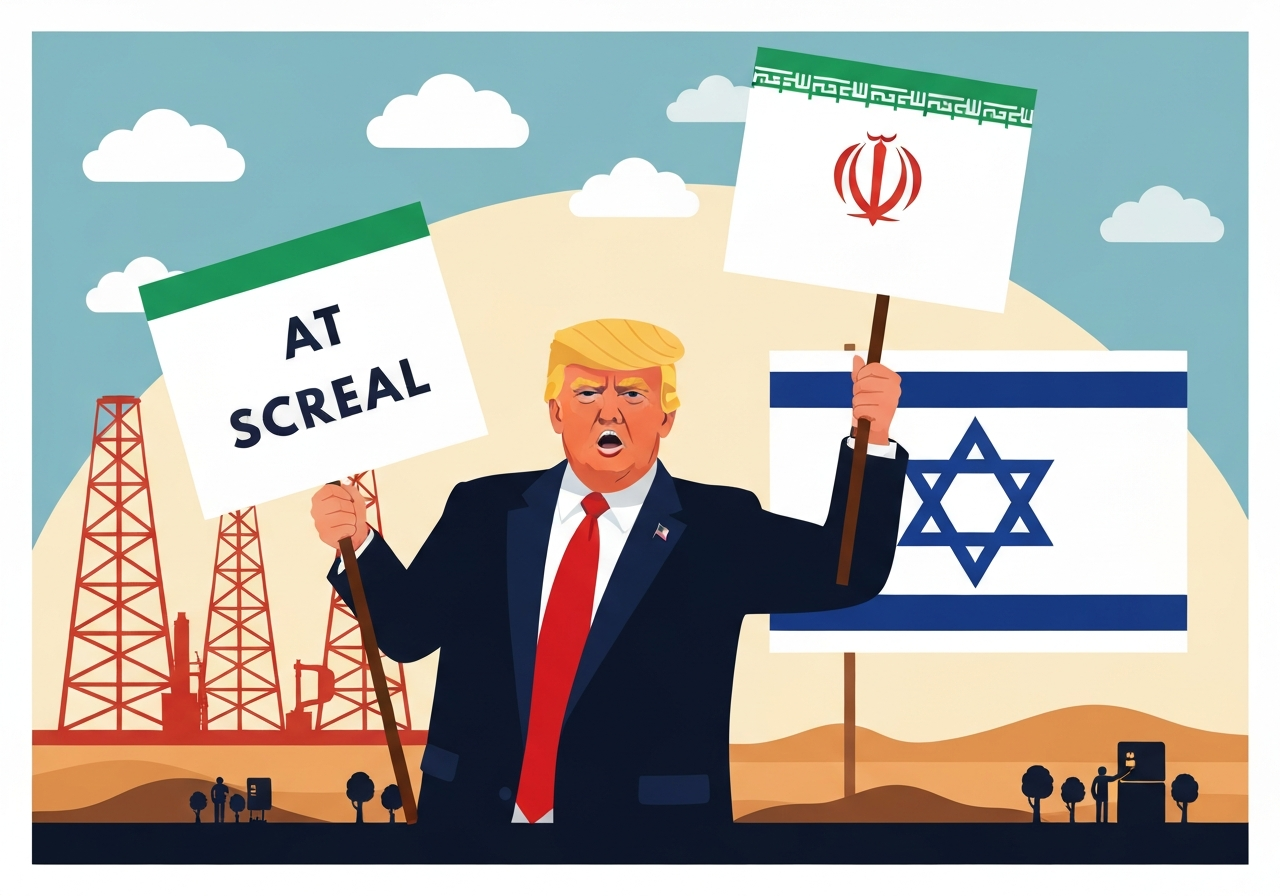
On March 19, 2026, President Donald Trump said he told Israeli Prime Minister Benjamin Netanyahu that he opposed an Israeli attack on one of Iran’s largest offshore gas fields, a strike that rattled energy markets and intensified questions about U.S.-Israeli coordination. The exchange occurred as Mr. Trump met Japan’s prime minister, Sanae Takaichi, in the Oval Office; he also posted on Truth Social saying the United States did not take part in the operation. Israeli officials, by contrast, told reporters that U.S. officials were briefed before the strike, underscoring competing narratives between the allies in a conflict entering its third week. European diplomats told reporters the operation fits a broader Israeli logic aimed at undermining Iran’s revenue and leadership, a strategy some describe as seeking to precipitate ‘state collapse.’
Key Takeaways
- The strike hit one of Iran’s largest offshore gas fields on March 19, 2026, disrupting regional energy markets and prompting sharp price volatility in oil and gas trading rooms.
- President Trump publicly said he told Prime Minister Netanyahu, “I told him don’t do that,” and suggested the Israeli leader “won’t do that” again, signaling presidential disapproval.
- Three Israeli officials briefed on the operation said U.S. officials were informed in advance; the White House’s public statements and the president’s social posts left the extent of U.S. involvement ambiguous.
- The fighting in the region was entering its third week as of March 19, 2026, with cross-border strikes and counterstrikes affecting energy and civilian infrastructure across the Persian Gulf.
- European diplomats quoted anonymously say Israel appears to be pursuing a campaign to cut Iran’s principal revenue streams and to target senior political and military figures.
- Market observers reported immediate price and supply-chain anxieties after the attack, reflecting how energy infrastructure has become a frontline in the broader conflict.
Background
The strike on March 19 occurred amid an escalating conflict between Israel and Iran-backed forces that began in early March 2026 and had by then reached a third week. Energy infrastructure has been repeatedly discussed as a strategic pressure point: targeting production and export facilities can crater state revenue and complicate military logistics. Israeli policymakers have privately signaled that reducing Iran’s ability to finance proxies and state operations is a central objective of their campaign. U.S. officials have publicly disavowed large-scale strikes on civilian energy assets, citing the risks of regional escalation and global market disruption.
Diplomatic relations between Washington and Jerusalem have long involved both cooperation and tension over Iran policy. Previous U.S. administrations balanced deterrence, sanctions and diplomacy; some Israeli strategists argue that more direct action is needed to degrade Tehran’s capacities. At the same time, Washington has security commitments across the Persian Gulf and must weigh the risks to commercial shipping, allied bases and global energy supplies. Those competing priorities have produced different operational instincts inside the alliance as the current hostilities unfolded.
Main Event
Officials and witnesses reported that an Israeli operation struck one of Iran’s major offshore gas platforms on March 19, causing material damage to the facility and immediate market concern. The attack prompted multiple retaliatory or precautionary moves across the Persian Gulf, with state and nonstate actors exchanging strikes or warnings in the days that followed. Israeli spokespeople framed the operation as part of an effort to degrade Iran’s fiscal and operational capacity, while U.S. public statements emphasized that American forces were not participants in the strike.
President Trump, speaking in the Oval Office before a bilateral meeting with Japan’s Sanae Takaichi, said he had spoken to Mr. Netanyahu and told him not to carry out the attack, adding that the Israeli leader “won’t do that” again. On Truth Social, the president reiterated that the United States did not take part, a post that contrasts with Israeli accounts that Washington was briefed. That divergence has fueled immediate debate in diplomatic and intelligence circles about how much prior notice was given and what, if any, tacit approvals were involved.
European diplomats who spoke. on condition of anonymity told reporters they saw the strike as consistent with an Israeli calculation that dismantling Iran’s revenue sources and targeting its leadership might produce systemic collapse. Israeli officials have long used the phrase “state collapse” in internal strategy discussions, which signals an escalation from tactical strikes to efforts intended to erode regime capacity. The effect on regional energy flows, however, has been concrete: traders and governments moved to reassess supply risk and contingency stock releases.
Analysis & Implications
The immediate implication is practical: attacks on large energy installations materially increase systemic risk for global oil and gas markets. Even if physical damage is localized, the perception of vulnerability spurs price spikes, insurance premium rises and rerouting of tanker traffic, with knock-on effects for inflation and energy-dependent industries. Policymakers in Europe, Asia and North America must now judge whether to tap strategic reserves, adjust sanctions enforcement, or accelerate diplomatic de-escalation to stabilize markets.
Strategically, the episode reveals a divergence in objectives between Israel and the United States. Israel appears prepared to accept higher regional friction to reduce Iran’s financial and command capabilities. The United States, publicly at least, is signaling restraint aimed at preventing a broader conflagration that could draw in extra-regional powers and threaten merchant shipping. That misalignment complicates allied planning: cooperation on intelligence and contingency logistics can coexist with disagreement over effect and timing.
Politically, the U.S. president’s public critique of an ally’s strike is notable for its rarity and consequence. Such statements can constrain future Israeli operations that depend on plausible deniability or close coordination, and they create friction in bilateral consultations. If the disagreement persists, it could push Israel to act more independently or to seek different partners for intelligence-sharing, changing the architecture of regional security cooperation.
Comparison & Data
| Item | Known Fact |
|---|---|
| Date of strike | March 19, 2026 |
| Target | One of Iran’s largest offshore gas fields |
| Conflict duration at time | Entering third week (early March 2026 start) |
| Public U.S. stance | President said the U.S. did not participate; administration described approaches as coordinated |
The table summarizes the verified, reportable facts currently available. It does not attempt to quantify market price moves or damage estimates because public, corroborated figures were not released by officials at the time of reporting. Analysts caution that such figures often lag initial reports and are revised as assessments and on-site inspections proceed.
Reactions & Quotes
Official and diplomatic reactions were mixed, illustrating how the same event can be framed differently by actors with distinct priorities.
“I told him don’t do that,” the president said, later adding that Mr. Netanyahu “won’t do that” again.
President Donald Trump (reported remarks)
That public rebuke came alongside a Truth Social post where the president said the United States ‘did not participate,’ a line that contributed to confusion about the depth of U.S. involvement.
U.S. officials were briefed before the operation, according to three Israeli officials familiar with the matter.
Israeli government briefers (officials)
Those Israeli accounts indicate prior notification, a common practice between allied militaries, but they stop short of describing U.S. operational participation. The discrepancy between the Israeli briefers and the White House’s public posture has prompted immediate diplomatic queries.
“The recent operations appear aimed at choking revenue and removing key leaders,” said European diplomats, characterizing the strikes as consistent with an Israeli strategy to pressure Iran’s governing structures.
European diplomatic officials (anonymous)
European diplomats framed the attack as part of a broader campaign logic, but their comments were offered on condition of anonymity and thus reflect assessments rather than formal positions.
Unconfirmed
- Precise extent of U.S. notification or involvement in operational planning remains disputed; Israeli briefers say there was notification, while the president’s public remarks suggested otherwise.
- Comprehensive damage estimates to the gas platform and long-term production losses have not been publicly released and remain subject to on-site verification.
- Attribution of subsequent regional strikes or counterstrikes to named state actors is not fully corroborated in open-source statements as of this report.
Bottom Line
The March 19 strike on a major Iranian offshore gas field has become a flashpoint that exposes a potentially widening tactical and strategic gap between the United States and Israel. For Washington, the priority appears to be limiting escalation that could imperil global energy supplies and draw in additional powers; for parts of the Israeli government, diminishing Iran’s revenue and command infrastructure is worth accepting higher short-term risk. That divergence complicates allied planning and raises the cost of future covert or deniable actions.
Going forward, expect diplomatic pressure for clearer crisis coordination mechanisms, faster and more transparent damage assessments, and potential market interventions to stabilize prices. If miscommunication continues, allied frictions could make regional escalation more likely rather than less, with consequences for energy markets, civilian populations and the broader security architecture of the Middle East.
Sources
- The New York Times — U.S. newspaper (news)