
Lead
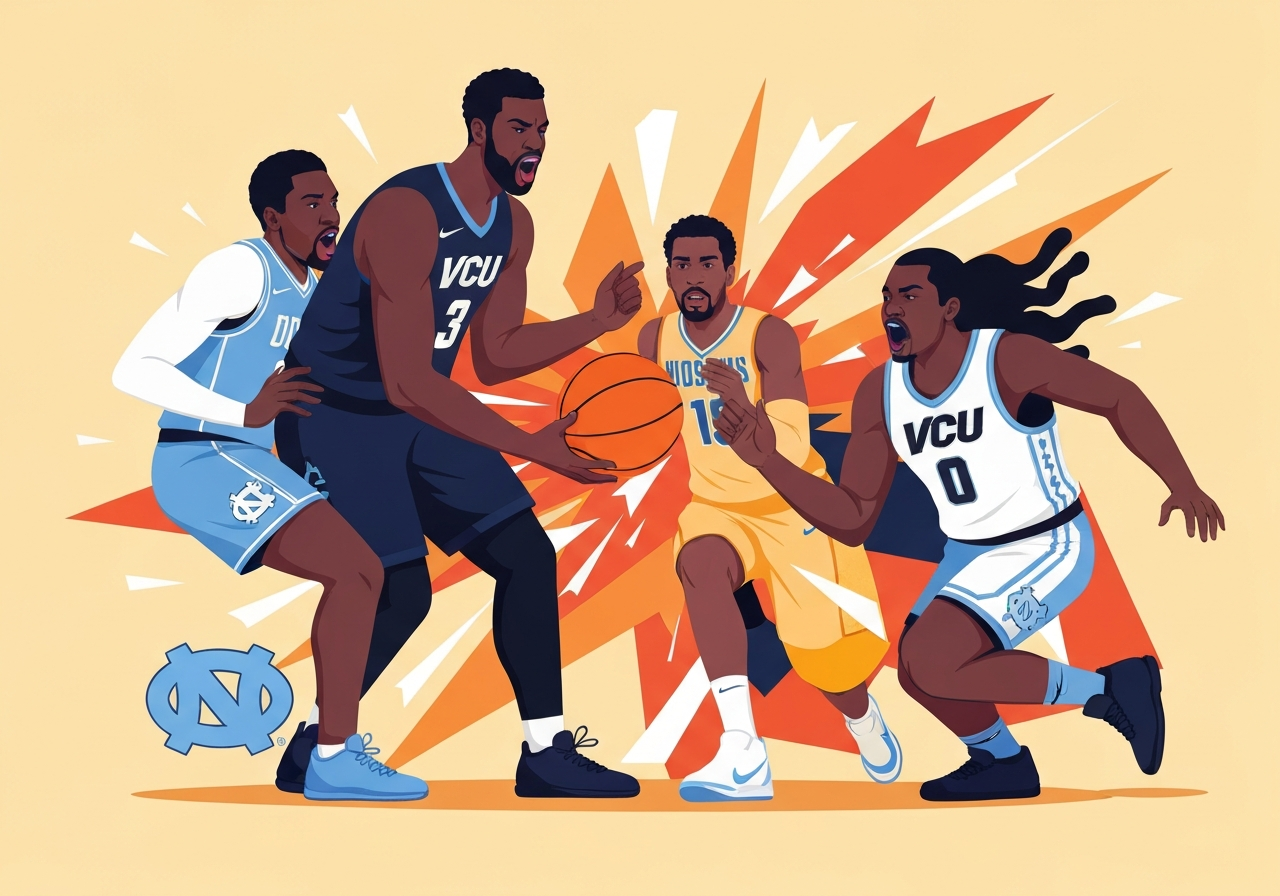
On Mar. 19, 2026 in Greenville, N.C., 11th-seeded VCU erased a 19-point second-half deficit to defeat sixth-seeded North Carolina 82-78 in overtime. Terrence Hill Jr. finished with 34 points, including a stepback 3 with 15 seconds left in OT that gave VCU the lead. Henri Veesaar scored 26 points and grabbed 10 rebounds for the Tar Heels, who lost the game after star Caleb Wilson was ruled out for the season. VCU improves to 28-7 and advances to face either No. 14 Penn or No. 3 Illinois in the second round.
Key Takeaways
- Final score: VCU 82, North Carolina 78 in overtime on Mar. 19, 2026 in Greenville, N.C.
- Terrence Hill Jr. scored 34 points, shooting 7-of-10 from 3-point range and contributing 20 of his points after halftime.
- VCU trailed by 19 points with about 15 minutes remaining before mounting the comeback to tie with 11 seconds left in regulation.
- Henri Veesaar finished with 26 points and 10 rebounds for UNC; Caleb Wilson was out for the season.
- VCU shot 62% from the field in the second half and hit 7 of 10 three-pointers in that period.
- The 19-point comeback is the largest in the NCAA tournament since Nevada’s 22-point rally in 2018 and is tied for the seventh-largest comeback in tournament history.
- Nyk Lewis scored 16 points for VCU and hit two late free throws to seal the victory.
Background
VCU entered the NCAA tournament as an 11 seed at 28-7, seeking its first tournament win since 2016. The program has built a reputation for aggressive defense and perimeter shooting under its recent coaching staffs, but few expected such a dramatic turnaround against a blue-blood program like North Carolina. UNC came in as a No. 6 seed with a 25-8 record, attempting to advance despite the season-ending loss of leading scorer Caleb Wilson. Wilson’s absence altered Carolina’s rotation and offensive balance; the Tar Heels leaned on frontcourt options and role players to fill the scoring void.
The matchup also reflected the volatility of March basketball: seeding reflects season performance but single-elimination play amplifies momentum swings and matchup advantages. VCU’s athletic, guard-oriented attack contrasts with UNC’s size and pick-and-roll options, particularly the effectiveness of 7-foot forward Henri Veesaar in early action. Historically, large comebacks are rare in the tournament’s first weekend, making VCU’s run notable in both program history and the larger bracket narrative. The win sends shockwaves through the regionals and reshuffles second-round expectations for teams slated to meet the Rams.
Main Event
North Carolina built a commanding lead in the first half and carried a 15-point advantage into halftime, largely because Veesaar exploited pick-and-roll and pick-and-pop chances against VCU’s interior defense. Veesaar had 13 points and five rebounds in the opening half and connected on open 3s from the top of the key, forcing VCU to adjust. Early into the second half, UNC stretched the margin to 19 with roughly 15 minutes remaining as Veesaar continued to finish inside and the Tar Heels converted open looks.
VCU’s response began with an uptick in defensive pressure and a barrage from beyond the arc, shooting 62% from the field and 7-of-10 from three in the second half. Terrence Hill Jr. led that charge, drilling multiple long-range shots and scoring 20 of his 34 points after the break to fuel the comeback. The Rams methodically cut the lead through steals, transition offense and backcourt shooting, erasing the deficit and setting up a frantic closing sequence in regulation.
The final moments of regulation were chaotic: Hill’s driving layup with 11 seconds tied the game at 75, and after a timeout North Carolina lost possession in the frontcourt with 2.4 seconds left. An attempted running 3 at the buzzer missed, sending the contest to overtime. In OT, Seth Trimble made one of two free throws to put UNC up 78-77 with 35 seconds remaining, but Hill’s stepback 3 from the top of the key with 15 seconds left put VCU ahead 80-78.
Following Veesaar’s subsequent foul with 4.2 seconds to play, he missed the first free throw and failed to convert a desperate second attempt; VCU secured the rebound and drew a foul on Nyk Lewis, who hit two free throws to clinch the 82-78 victory. The sequence underscored how momentum, shot selection and free-throw execution in the final minute determined the outcome.
Analysis & Implications
Strategically, VCU’s comeback highlighted the value of guard shooting and late-game defensive adjustments. Hill’s 7-of-10 long-range shooting after halftime forced UNC to extend defenders and opened driving lanes, while VCU’s defensive rotations generated extra possessions. Teams that can switch between perimeter pressure and disciplined half-court offense gain leverage in tournament settings where one hot scorer can flip a game.
For North Carolina, the loss raises questions about depth and adaptability without Caleb Wilson. Veesaar’s strong scoring night exposed lineup advantages early, but fatigue and turnovers late in the game undermined the Tar Heels’ finish. Coaching staffs will now face scrutiny over endgame management and whether alternative coverages or substitution patterns could have preserved the late lead.
In bracket terms, VCU’s advance reshapes the second-round matchup: the Rams will play the winner of No. 14 Penn vs. No. 3 Illinois on Saturday, a draw that favors teams comfortable defending perimeter shooters and handling pressure. The upset also shifts betting markets and analytical projections for the region, as a high-variance offensive profile like VCU’s can be both dangerous and inconsistent in deeper rounds.
Comparison & Data
| Team | Largest Deficit Overcome | Round | Year |
|---|---|---|---|
| VCU | 19 points | Round of 64 | 2026 |
| Nevada | 22 points | Round of 32 | 2018 |
The 19-point deficit erased by VCU is the biggest comeback in the tournament since Nevada rallied from 22 down in 2018 and ranks tied for seventh-largest in NCAA tournament history. That statistical context underscores how uncommon such reversals are on March 19th’s first-round stage. VCU’s second-half shooting (62% overall, 7-of-10 from three in the half) was the primary numerical driver of the comeback, while turnovers and missed free throws by UNC contributed to the collapse.
Reactions & Quotes
Local and national reaction was immediate: analysts noted Hill’s shooting as the decisive factor and flagged UNC’s late-game miscues. Team accounts and beat reporters highlighted the emotional swing for both rosters and the broader bracket implications before coaches and players provided brief statements.
“A resilient showing from VCU turned the game in the second half,”
ESPN News Services (reporting)
Observers from the Tar Heel beat emphasized the impact of Wilson’s absence on late-game execution and depth, suggesting the team struggled to replace his scoring consistency and on-ball handling. Media coverage framed the loss as part of a pattern for UNC in round-of-64 exits historically.
“UNC had early success because of interior play and open threes, but missed late free throws and turnovers were decisive,”
The Associated Press (news agency)
Fans and program accounts on social platforms reacted with disbelief at the comeback and praise for Hill and Lewis; the reaction mix included admiration for VCU’s resilience and critique of UNC’s finish. Social posts and local outlets framed the result as a signature moment for VCU’s season.
“This win gives VCU real momentum heading into the second round,”
Local beat coverage (media)
Unconfirmed
- Whether Veesaar’s late fatigue was due to minutes accumulation or game-long matchup issues remains unconfirmed pending coach comments and player availability reports.
- The long-term effect of Caleb Wilson’s season-ending absence on UNC’s rotation and recruiting implications is subject to further evaluation and not yet established.
- Predictions about how far VCU can advance beyond the second round are speculative and depend on opponent matchups and consistency from Hill and supporting shooters.
Bottom Line
VCU’s 82-78 overtime win over North Carolina stands out as one of the tournament’s most dramatic first-round upsets in recent memory, driven by Terrence Hill Jr.’s prolific second-half shooting and a concerted team defensive push. For VCU, the victory breaks a decade-long drought of NCAA tournament wins and injects momentum into a bracket that now includes a high-variance, guard-led team.
For North Carolina, the loss spotlights the roster impact of Caleb Wilson’s season-ending injury and raises questions about late-game management and depth. As the tournament progresses, both programs will face scrutiny over their adjustments: VCU to sustain efficiency against tougher defenses, and UNC to recalibrate for postseason evaluations and offseason planning.