
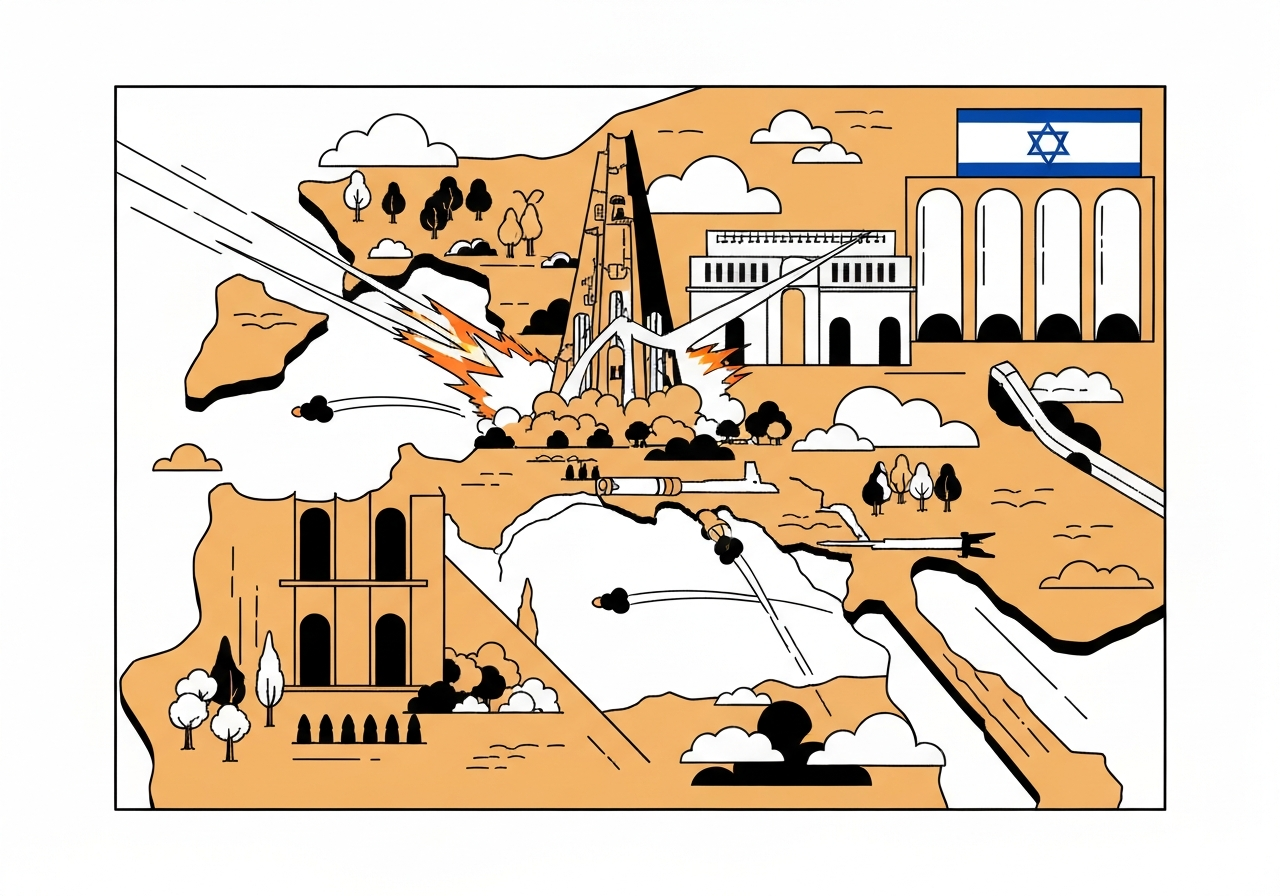
Lead: On 20 March 2026 Israel launched a fresh round of strikes on targets in Iran, days after President Donald Trump urged it not to repeat attacks on Iranian energy infrastructure. Israeli Prime Minister Benjamin Netanyahu said the assault on the South Pars gas field was carried out solely by Israel and praised co‑operation with the United States, while President Trump said he is not sending US troops to the region. Iranian state TV reported the death of an Islamic Revolutionary Guard Corps spokesperson in separate US‑Israeli strikes. The strikes have deepened a conflict that began with US and Israeli actions on 28 February and is already disrupting energy markets and regional security.
Key takeaways
- Israel carried out new strikes on Iran on 20 March 2026, including an attack Israel says hit the South Pars gas field.
- Benjamin Netanyahu told reporters Israel acted alone and claimed Iran’s uranium enrichment and ballistic‑missile capacity had been degraded after 20 days of air attacks — a claim presented by him and not independently verified.
- Iranian state television reported that IRGC public‑relations deputy Ali Mohammad Naini was killed in strikes attributed to the US and Israel on 20 March 2026.
- The broader conflict began with US and Israeli initial strikes on 28 February 2026 and, according to multiple reports, has killed thousands and spread to neighbouring countries.
- Energy markets reacted sharply: Brent crude rose as high as $119 a barrel and European gas prices spiked by about 35% after attacks on regional energy infrastructure.
- UK authorities reported at least 16 merchant ships attacked in the Gulf since the war began, while one Pakistan‑flagged vessel, the Karachi (Lorax), recently transited the Strait of Hormuz with its AIS tracker turned on.
- Several Gulf states — Bahrain, Kuwait and the UAE — reported missile or drone incidents; Kuwait’s Mina Al Ahmadi refinery shut parts of its operations after an early‑morning drone strike, with no injuries confirmed.
- President Trump reiterated on 19–20 March that he is not planning to deploy US ground forces to the Middle East in this phase of the campaign.
Background
The current high‑intensity phase follows a series of strikes that began on 28 February 2026, when the United States and Israel launched coordinated attacks against Iranian facilities. Those operations quickly escalated into a wider confrontation involving Iranian strikes on regional energy infrastructure and maritime targets. The strategic focus has included Iran’s major hydrocarbon sites and shipping routes — notably the Strait of Hormuz — a critical chokepoint for global oil and gas shipments.
Regional actors have been drawn in through missile and drone exchanges, disruptions to commercial shipping and retaliatory strikes on neighbouring states’ infrastructure. The UK Maritime Trade Organisation has reported multiple attacks on merchant vessels in the Gulf since the campaign began, and cargo traffic patterns and insurers’ risk assessments have shifted accordingly. Energy markets and central banks have watched the situation closely: sudden supply risks have already pushed Brent and European gas prices sharply higher.
Main event
Early on 20 March 2026, Israeli forces launched a new wave of strikes on Iranian targets described in Israeli military statements as infrastructure associated with what they called the “Iranian terror regime.” Israeli officials said one of the targets was the South Pars gas field, a major source of natural gas production shared between Iran and Qatar. Netanyahu publicly framed the operation as unilateral and credited cooperation with the United States while asserting that the strikes had weakened Iran’s strategic capacities.
Donald Trump, asked about the widening campaign, told reporters he was not planning to deploy US ground troops to the region, saying: “I’m not putting troops anywhere.” That position, he and White House aides say, limits US direct ground involvement even as Washington supports military operations and intelligence sharing. Washington has also discussed sanctions relief and other diplomatic tools in parallel, with some suggestions reported that parts of Iranian oil sanctions might be revisited to stabilise markets.
Across the Gulf, states reported incoming missiles and drone incidents. Bahrain, Kuwait and the United Arab Emirates said they were dealing with missile or drone attacks in the hours before the Eid al‑Fitr sundown. Kuwait’s state oil company reported a blaze at a unit of the Mina Al Ahmadi refinery after a drone strike forced precautionary shutdowns; emergency crews were reported to be containing the fire and no injuries were initially reported.
Analysis & implications
The new Israeli strikes mark an escalation that complicates efforts to limit the conflict to a short, surgical campaign. If validated, attacks on South Pars would strike at a critical node in regional gas supply and could prolong market disruption. Energy markets are already signalling higher risk premiums: a spike in oil and gas prices raises the prospect of renewed inflationary pressure in energy‑importing economies and complicates central‑bank planning.
Politically, Trump’s refusal to commit US ground forces reduces one pathway for deeper American entanglement but does not eliminate Washington’s leverage — or its exposure. Intelligence sharing, logistics, and basing support remain potent forms of backing that can significantly affect operational tempo. For allied capitals, allowing US use of regional bases poses a diplomatic trade‑off between protecting nationals and being perceived as participating in aggression, as Tehran has warned.
Regionally, the exchange of strikes increases the risk of miscalculation. Non‑state actors and neighbouring states may be pulled into tit‑for‑tat actions, particularly around contested maritime routes. The humanitarian toll and displacement pressures will complicate any post‑conflict stabilisation. International efforts to secure shipping lanes and protect energy infrastructure will likely intensify, but so will competition among states seeking to fill supply gaps or to capitalise on new routes.
Comparison & data
| Metric | Value |
|---|---|
| Conflict start | 28 February 2026 |
| Reported deaths | Thousands (various reports) |
| Reported ships attacked (UKMTO) | At least 16 |
| Brent crude peak | $119 per barrel |
| European gas spike | ~35% |
| Bank of England base rate | 3.75% (held) |
The table summarises core, open figures cited in public statements and market reports. Sources vary in certainty: market prices are observable, while casualty totals and attributions (which party struck which target) often rely on government statements and are subject to revision. Analysts use these indicators — threat to shipping, price moves, central‑bank decisions — to assess near‑term macroeconomic risk and to model likely political responses.
Reactions & quotes
US presidential remarks have underscored Washington’s current posture. Reporters pressed Mr Trump about troop movements and he reiterated a non‑deployment stance while signalling continued US support through other means.
“I’m not putting troops anywhere.”
Donald Trump, President of the United States
In London, UK ministers defended allowing US access to British bases for defensive purposes while denying participation in offensive operations. British ministers emphasised measures aimed at protecting nationals and avoiding direct combat involvement.
“We are absolutely right to protect and defend our nationals, but we are not an active participant in offensive operations.”
Emma Reynolds, UK Cabinet Minister (quoted to Sky News)
Iranian state media described the death of an IRGC spokesperson in the strikes, a development Tehran used to underscore its narrative of being attacked by foreign powers. Independent verification of the full circumstances remains pending.
“[The strikes] show the cost of foreign aggression against Iran’s institutions and personnel.”
Iranian state television (reporting on IRGC statement)
Unconfirmed
- Claims that Iran’s supreme leader Ali Khamenei was assassinated during the early phase of the conflict have circulated online; these reports have not been independently confirmed by verified international sources.
- Netanyahu’s assertion that Iran “no longer has the capacity to enrich uranium or make ballistic missiles” after 20 days of strikes is an official claim pending independent inspection and verification.
- Precise casualty figures described as “thousands” killed are aggregated from multiple reports and remain subject to revision as independent counts and confirmations continue.
Bottom line
The strikes on 20 March 2026 mark a clear step up in a widening confrontation that began on 28 February. They threaten further disruption to global energy supplies and raise the probability of spillover into neighbouring states and commercial shipping lanes. Markets and central banks will remain highly sensitive to any new incidents that affect oil and gas flows.
Diplomatic options are constrained: major powers face the choice between deeper kinetic involvement and intensified sanctions or diplomatic pressure. In the near term, expect persistent volatility in energy markets, continued naval and air incidents in the Gulf, and sustained international efforts to both protect shipping and to seek de‑escalation channels.