
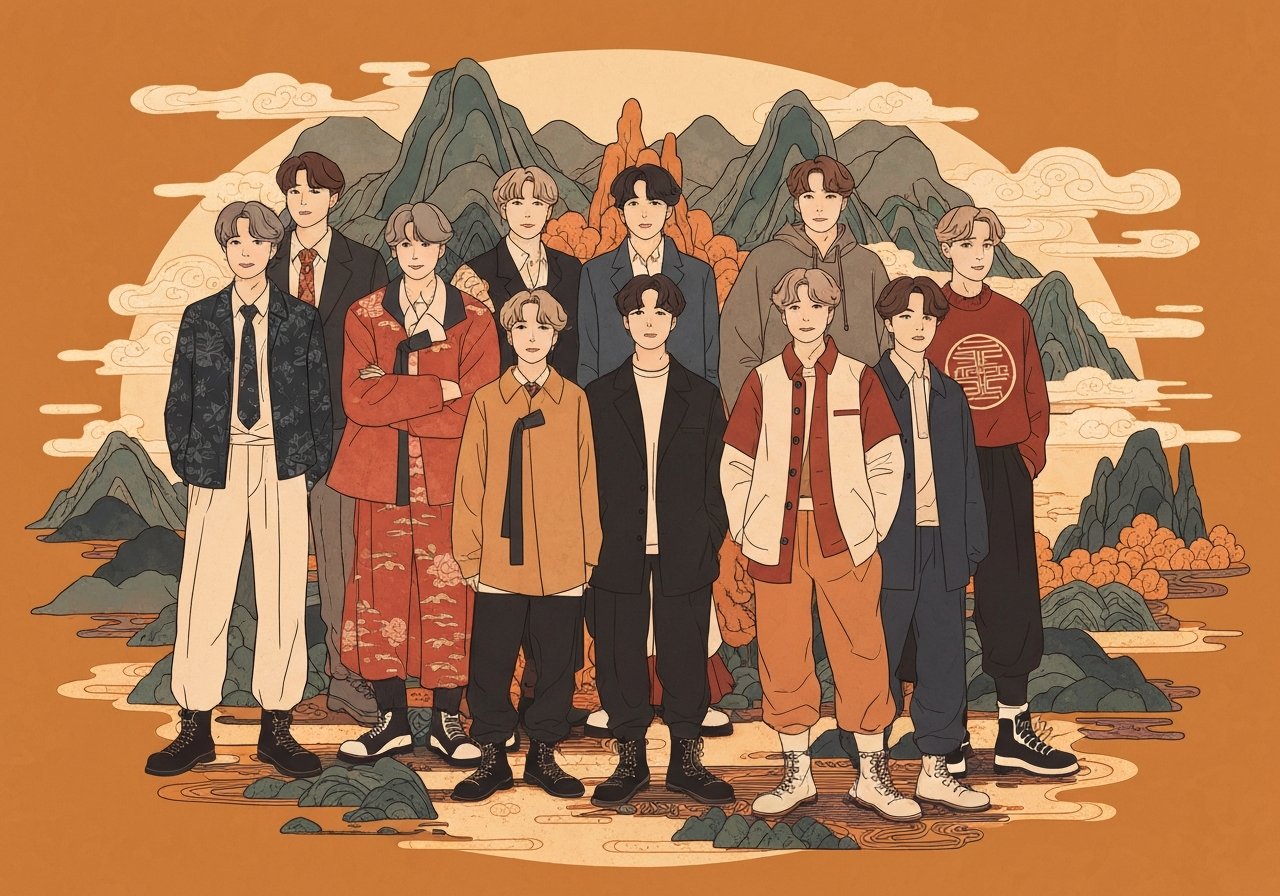
On , BTS returned with Arirang, their first full-length record in three years and nine months, blending hip-hop intensity with Korean folk motifs and wide-ranging production collaborators. The seven members — RM, Jin, Suga, J-hope, Jimin, V and Jungkook — reunited after completing mandatory military service and separate solo projects, and debuted the album live in a Netflix stream from Gwanghwamun overlooking Gyeongbokgung. Lead single ‘Swim’ anchors the record’s emotional center while the album as a whole signals an embrace of Korean heritage alongside experimental sonic moves. Early public moments around the release showed both national symbolism and clear commercial ambition for the group’s next chapter.
Key Takeaways
- Arirang was released on , marking BTS’s first studio album in 3 years and 9 months (45 months) since their prior full-length offering.
- The seven members—RM, Jin, Suga, J-hope, Jimin, V and Jungkook—reconvened after finishing mandatory South Korean military service and solo work; each member credits appear across the tracklist.
- The album spans 14 tracks and foregrounds hip-hop in the first half while shifting to more emotional and experimental textures in the second half, with notable interludes like ‘No. 29’ (1:38) featuring the Divine Bell tolling.
- High-profile outside producers credited include Diplo, Ryan Tedder, Mike WiLL Made-It, Flume, Kevin Parker (Tame Impala), El Guincho and JPEGMAFIA, among others—at least eight major outside collaborators.
- Traditional Korean references are explicit: the album title and musical motifs nod to the folk song ‘Arirang’ and the inclusion of National Treasure No. 29 underlines a deliberate link to Korea’s cultural patrimony.
- Lead single ‘Swim’ is positioned as the album’s radio-accessible anchor; the group chose not to pre-release singles, making ‘Swim’ the initial promotional focus.
Background
BTS’s return arrives after an extended interval shaped by mandatory military service for South Korean men and a period in which each member pursued solo releases and projects. That hiatus — three years and nine months by the time Arirang dropped — set high expectations among a global fanbase known as ARMY, many of whom tracked the members’ staggered discharges over the previous year. The timing of the release aligns with visible celebrations in Seoul; the group staged a Netflix-streamed performance from Gwanghwamun, a public square that frames views of the Gyeongbokgung palace and carries civic resonance.
The album’s title resurrects one of Korea’s best-known folk songs, ‘Arirang,’ whose earliest U.S. recording by Korean singers was documented with American ethnologist Alice Fletcher in 1896, signaling a long cross-cultural history. Musically, Arirang foregrounds the push-and-pull between global pop idioms—hip-hop, jersey club, rock, pop-rock—and deliberate references to national materials, such as the recording of the Divine Bell of King Seongdeok on ‘No. 29.’ Stakeholders for the record include HYBE as the managing company, a roster of international producers, and Netflix as a streaming partner for the live event; each plays a role in how the release is framed domestically and abroad.
Main Event
Arirang opens with ‘Body to Body,’ a pop-rap piece that integrates motifs from the namesake folk song and arrives as a built-for-stadium opener; RM’s commanding lines in the introduction underscore the track’s intention to translate into live spectacle. Production credits on the opening cut include Diplo and Ryan Tedder, signaling an intersection of global producers with locally rooted material. The album’s sequencing leans into a hip-hop-forward first half—tracks like ‘Hooligan’ and ‘Aliens’ emphasize rap textures and percussion experimentation—before moving into the record’s more reflective second half.
‘No. 29,’ the interlude, uses a minute-and-38-second excerpt of the Divine Bell of King Seongdeok, designated South Korea’s National Treasure No. 29, to create a tonal pivot toward the album’s introspective material. ‘Swim,’ the lead single, unfolds as a synth-forward, emotionally buoyant track positioned to be the album’s commercial focus; RM is credited as the principal songwriter on that song. Later tracks such as ‘Merry Go Round’ (produced in part by Kevin Parker of Tame Impala) and the rock-tinged ‘Normal’ expand the album’s palette, while ‘Like Animals’ and ‘Please’ offer grunge and chill textures, respectively.
Credits across the record show deep internal involvement: RM appears on nearly every track, with Suga, J-hope, Jimin, V and Jungkook contributing in varied songwriting and production roles. Outside collaborators—Diplo, Ryan Tedder, Mike WiLL Made-It, Flume, Kevin Parker, El Guincho and JPEGMAFIA—bring distinct production fingerprints that push BTS into new stylistic territories while the group’s own authorship maintains thematic continuity about identity and forward motion.
Analysis & Implications
Arirang is an unequivocal statement about identity management at a moment of reconstitution. After a prolonged group hiatus for military service, BTS uses the record to assert a hybrid posture: rooted in Korean tradition yet unafraid to experiment with global pop and underground textures. That balance has strategic implications—musically it keeps core domestic and long-time global fans engaged while offering enough novelty to appeal to newer listeners who expect sonic risk-taking.
Commercially, the decision to debut via a Netflix live stream in a politically and culturally resonant Seoul location signals a high-profile, platform-driven marketing strategy that leverages both national symbolism and global distribution. The album’s roster of outside producers suggests an intent to remain sonically competitive in U.S. and international markets; collaborators such as Diplo and Kevin Parker bring cachet that can open additional playlist and radio opportunities without erasing the group’s Korean-language and cultural specificity.
Artistically, the album’s experimental lean—jersey club beats, grunge basslines, and bell interludes—positions BTS to be read as evolving rather than repeating a formula. That stance complicates critiques that K-pop must ‘Westernize’ to succeed internationally: Arirang argues the opposite, presenting a K-pop record that invites the world to meet the band on terms that foreground Korean heritage and artistic agency. For the industry, Arirang may serve as a template for balancing local cultural claims with cross-border production partnerships.
Comparison & Data
| Metric | Value |
|---|---|
| Release date | |
| Gap since last studio album | 3 years, 9 months (45 months) |
| Tracks on Arirang | 14 |
| Named outside producers | At least 8 (Diplo, Ryan Tedder, Mike WiLL Made-It, Flume, Kevin Parker, El Guincho, JPEGMAFIA, others) |
The table above places Arirang within measurable frames: a long inter-album gap, a mid-sized tracklist, and a broad producer network. Those numbers help explain the record’s dual aims—reintroduce a united BTS while signaling stylistic breadth through external collaborators. The inclusion of a National Treasure audio sample and explicit ‘Arirang’ motifs are qualitative choices that interact with these quantitative markers to underline the group’s cultural emphasis.
Reactions & Quotes
Early reactions mixed celebration of the group’s cultural references with attention to sonic risks. Industry observers highlighted the production roster’s ambition while some fans flagged surprise at the album’s experimental turns; others praised the clear nods to Korean tradition.
‘Arirang feels like a reunion that remembers where the group came from while pointing them forward.’
Music industry analyst (comment quoted in published coverage)
HYBE and the members framed the release as both personal and collective: statements released around the launch emphasized gratitude to fans and an eagerness to begin the next chapter together. Public conversation on social platforms combined nostalgia, interpretive readings of the lyrics, and speculation about tour plans.
‘We wanted to carry the past into what’s next — sonically and spiritually.’
Quoted member statement (translated excerpt)
Unconfirmed
- Whether ‘Body to Body’ will officially open the forthcoming world tour setlist is unconfirmed; live setlists have not been finalized publicly.
- Predictions that ‘Swim’ will be a long-running radio hit are speculative until chart data and airplay reports appear.
- Specific chart targets, certification expectations, and long-term sales forecasts for Arirang have not been released and remain projections.
Bottom Line
Arirang represents a deliberate artistic reset for BTS: a record that foregrounds an active commitment to Korean musical heritage while pursuing broad, often abrasive, sonic experimentation. The album’s structure—hip-hop intensity up front, reflective and genre-mixing material later—frames a band that is both returning and evolving.
For the industry and fans, the release underscores two durable strengths: BTS’s capacity for large-scale cultural signaling (the Netflix event, the ‘Arirang’ motifs) and their appetite for musical reinvention. Over the coming weeks and months, commercial metrics and live performances will clarify how this blend of tradition and experimentation translates into charts, streaming, and stadium setlists.
Sources
- The Hollywood Reporter (entertainment journalism coverage of Arirang and track-by-track analysis)
- HYBE (official company site for management and corporate announcements)
- Netflix (streaming platform hosting the Gwanghwamun live event)