
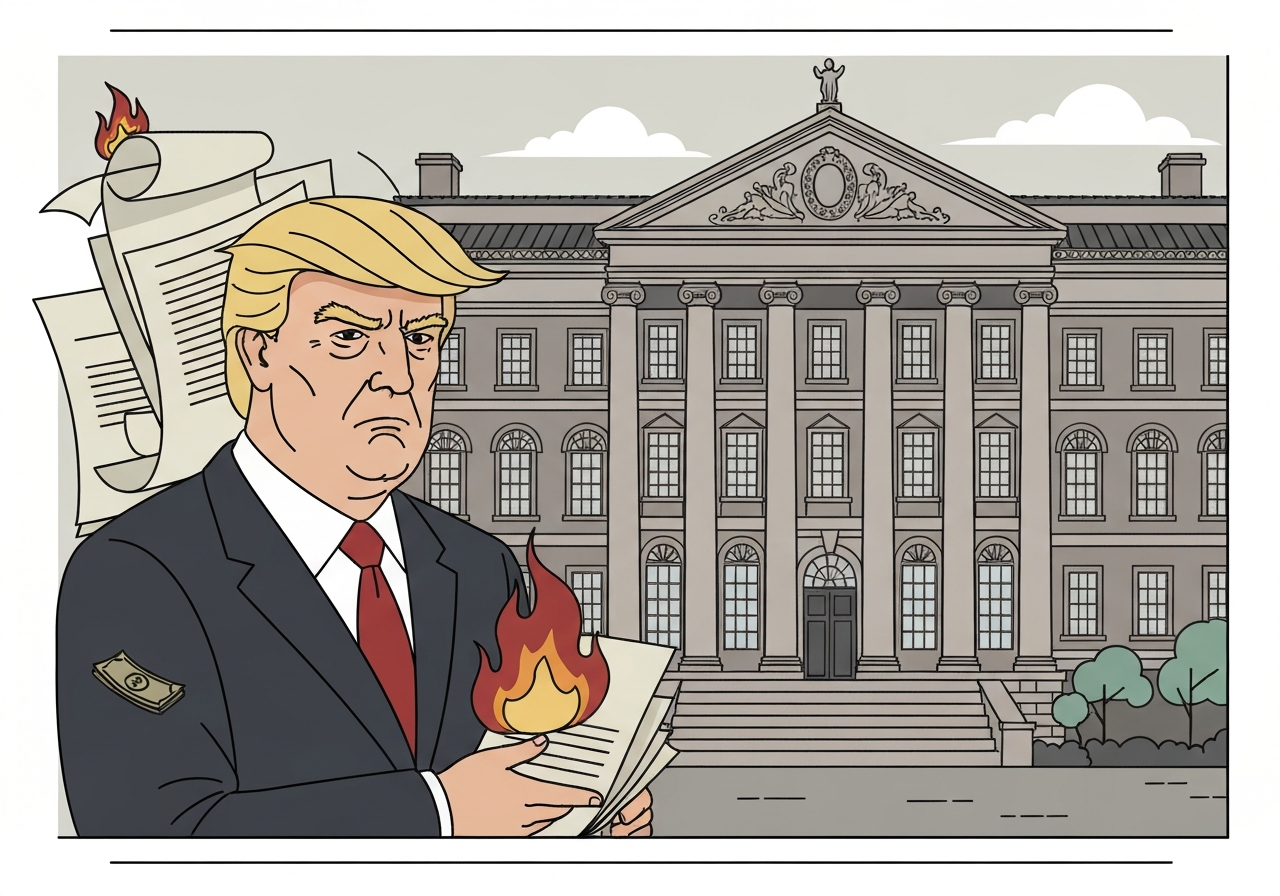
On March 20, 2026 the U.S. Department of Justice, representing the Trump administration, filed a civil suit in federal court in Boston alleging Harvard University violated the civil rights of Jewish and Israeli students and staff. The complaint accuses Harvard of tolerating antisemitic conduct and seeks to compel compliance with Title VI while pursuing recovery of billions in federal subsidies. The filing follows months of investigation and protracted settlement talks between the administration and the university, and comes more than six months after a judge blocked an earlier White House effort to cut Harvard’s federal research funding.
Key Takeaways
- The lawsuit was filed on March 20, 2026 in U.S. District Court in Boston and names Harvard University as the defendant.
- The administration alleges Harvard “turned a blind eye to antisemitism and discrimination against Jews and Israelis” and seeks enforcement of Title VI of the Civil Rights Act.
- The complaint asks the government to recover “billions of dollars” in taxpayer subsidies that the administration says were awarded to a discriminatory institution.
- This action follows a February 2026 Justice Department suit against UCLA that used similar language accusing the campus of tolerating severe antisemitic acts.
- Settlement talks had been ongoing for months before the filing, indicating both investigation and negotiation preceded litigation.
- A federal judge had previously blocked the administration’s initial attempt, more than six months earlier, to revoke federal research funding from Harvard.
Background
Over the past year the White House prioritized changing federal engagement with higher education, targeting several prominent universities over campus responses to the Israel–Gaza war and related protests. The administration launched investigations into universities it said failed to protect Jewish and Israeli students and employees, citing federal civil-rights statutes enforced under Title VI. Harvard, as the nation’s wealthiest university and a major federal research recipient, became a high-profile focus of that effort. Administrations on both sides of the political aisle have at times pressed campuses over speech, safety and nondiscrimination, but the current legal strategy centers on civil-rights enforcement tied to federal funding.
Harvard’s campus in Cambridge, Massachusetts, saw a series of protests and confrontations related to the war in Gaza, prompting university leaders to acknowledge problems and to say the institution took steps to respond. University officials have also contested the administration’s evidence and legal conclusions in public statements in the past months, arguing that disciplinary actions and safety measures were handled within university processes. Legal precedent and federal civil-rights law define the scope of Title VI enforcement by linking discriminatory conduct to federally funded programs; disputes about what constitutes actionable institutional bias are central to the litigation.
Main Event
The complaint filed in the U.S. District Court for the District of Massachusetts asserts that Harvard systematically failed to address antisemitic incidents, citing a pattern of alleged indifference. According to the suit, investigators spent months reviewing campus incidents, disciplinary records and university responses before concluding that administrative measures were insufficient to protect Jewish and Israeli members of the community. The filing demands that the court order Harvard to comply with Title VI requirements and seeks monetary relief in the form of recovered federal subsidies, described in the complaint as “billions of dollars.”
Officials for the administration framed the lawsuit as both remedial and deterrent, saying legal action was necessary after negotiation efforts reached an impasse. University leaders have previously told constituencies and the public that they recognized shortcomings during the protests and acted to improve safety and enforcement; Harvard did not immediately provide a comment after the March 20 filing. The suit marks an escalation from administrative review and funding threats to direct litigation, making the dispute a test case for how far federal civil-rights enforcement can reach within higher education.
Observers note the action comes against the backdrop of a similar case brought against the University of California, Los Angeles in February 2026, when the Justice Department alleged U.C.L.A. had tolerated “grossly antisemitic acts” and ignored pleas for help from Jewish and Israeli employees. Legal scholars say parallels between the two cases—both in language and legal theory—could shape how courts interpret institutional responsibility under Title VI in coming months and years.
Analysis & Implications
Legally, the Harvard suit tests boundaries of Title VI, which bars federally funded programs from discriminating on the basis of race, color or national origin. Plaintiffs must show that harassment was so severe, pervasive and objectively offensive that it deprived students or staff of access to educational opportunities; translating protest-related incidents into legally actionable institutional discrimination will be contested. The administration’s decision to seek billions in recovered funds raises the stakes: if a court accepts a sweeping remedy, it could reshape colleges’ exposure to funding-related penalties nationwide.
Politically, the case amplifies tensions between the federal government and elite institutions over campus governance and the limits of administrative enforcement. Supporters of the administration argue forceful federal action is needed to protect targeted communities; critics say litigation may chill campus protest and academic freedom or be perceived as politicizing civil-rights enforcement. Either outcome—court victory for the government or for Harvard—would carry significant political symbolism ahead of the 2026 midterms and beyond.
Practically, litigation creates uncertainty for students, faculty and funders. If courts permit withholding or recovery of federal research funds, universities may face immediate budgetary and contractual consequences, complicating grant-funded projects and collaborations. Conversely, if courts narrow Title VI’s reach in this context, the administration’s leverage to influence campus policies through funding threats will be diminished, potentially prompting new regulatory or legislative efforts instead of civil enforcement.
Comparison & Data
| Institution | Date Filed | Primary Allegation | Court | Remedy Sought |
|---|---|---|---|---|
| Harvard University | March 20, 2026 | Alleged tolerance of antisemitic conduct | U.S. District Court, Boston | Compel Title VI compliance; recover “billions” |
| U.C.L.A. | February 2026 | Alleged gross antisemitic acts, ignored complaints | U.S. District Court (California) | Enforcement under Title VI; unspecified remedies |
The table summarizes formal complaints and remedies the DOJ has pursued publicly. While the Harvard complaint explicitly quantifies potential recovery as “billions,” neither case yet produced a court order imposing the requested financial remedies. Analysts caution that judicial findings on institutional liability and remedy scope tend to be fact-specific, meaning outcomes could diverge despite similar allegations.
Reactions & Quotes
“The United States cannot and will not tolerate these failures and brings this action to compel Harvard to comply with Title VI, and to recover billions of dollars of taxpayer subsidies awarded to a discriminatory institution.”
U.S. Department of Justice (complaint)
“U.C.L.A. tolerated grossly antisemitic acts and systematically ignored cries for help from its own terrified Jewish and Israeli employees.”
U.S. Department of Justice (February 2026 statement)
Harvard did not issue an immediate response to the filing on March 20. Campus groups and outside observers gave mixed reactions: some advocacy organizations applauded the DOJ’s enforcement approach as necessary to protect Jewish students; others warned that litigation risks curbing protest rights and could polarize campus communities further.
Unconfirmed
- Exact total of federal funds the government seeks to recover: the complaint cites “billions,” but no precise figure has been publicly itemized.
- Whether ongoing settlement negotiations could resume or what a negotiated remedy might include remains unclear.
- The timeline for litigation and potential appeals is uncertain; court scheduling and procedural challenges could extend the case for years.
Bottom Line
The March 20, 2026 lawsuit elevates an administrative campaign into full litigation, making Harvard the highest-profile university now facing federal civil-rights claims tied to campus responses to the Israel–Gaza war. The government seeks both injunctive relief to force changes in university practices and monetary recovery of federal subsidies, a combination that raises legal and financial stakes rarely seen in campus civil-rights enforcement.
How courts interpret Title VI in this context will shape whether federal funding can be used as leverage to enforce institutional behavior during protests and politically charged campus disputes. Stakeholders—including students, faculty, funders and policymakers—should expect protracted litigation, potential appeals, and a period of heightened scrutiny on campus procedures and safety protocols.
Sources
- The New York Times — media report summarizing the complaint and context (news).