
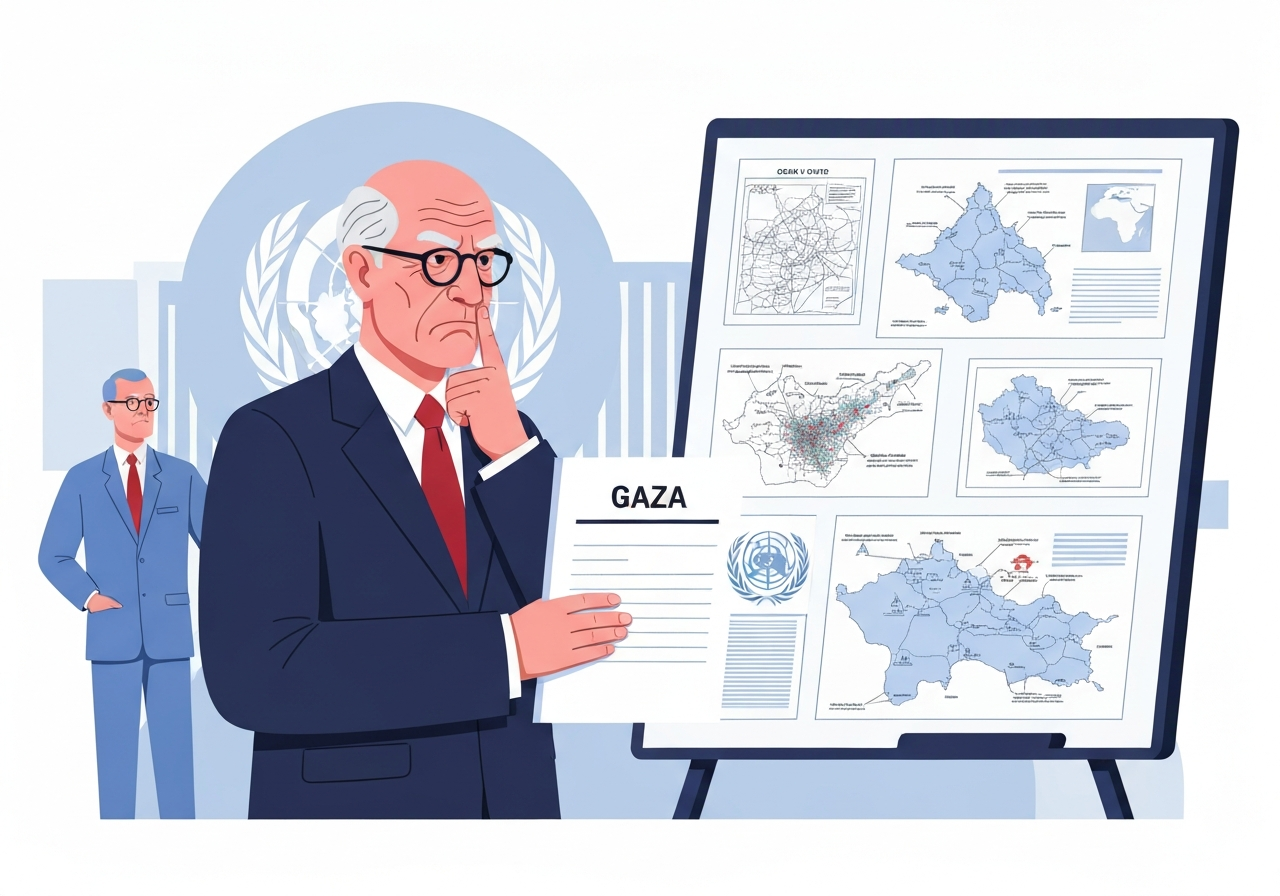
On March 16, the United Nations secretary-general, António Guterres, told reporters he is willing to cooperate with former President Donald Trump’s so-called “Board of Peace” on measures related to Gaza, but he firmly opposed the board having any role in the strategically vital Strait of Hormuz. The statement, reported by Politico, framed the UN as open to coordination on humanitarian and stabilization work in Gaza while drawing a line on direct involvement in Gulf maritime security. The distinction matters as tensions in the Middle East have elevated the risk of wider regional confrontation. Guterres’ position signals a pragmatic effort to help civilians in Gaza without endorsing extra-regional security initiatives in the Gulf.
Key Takeaways
- The UN secretary-general said on March 16 he is prepared to cooperate with Donald Trump’s “Board of Peace” on Gaza-related initiatives, according to Politico.
- Guterres explicitly rejected the idea of the Board operating in the Strait of Hormuz, emphasizing the UN’s reluctance to export that mechanism to Gulf maritime security.
- The distinction reflects competing international priorities: humanitarian relief in Gaza versus sovereignty and security concerns in the Gulf shipping lanes.
- Politico’s reporting frames the move as a selective engagement by the UN that seeks to protect humanitarian channels without deepening military or regional security commitments.
- The announcement could affect diplomatic dynamics between Washington, Gulf states and Tehran, where any external security forum in Hormuz is particularly sensitive.
- The UN’s stance preserves its role as a neutral humanitarian actor while limiting entanglement in contested regional security architectures.
Background
Former President Donald Trump has promoted a “Board of Peace” concept since leaving office; its stated purpose is to coordinate stabilization and security measures in conflict zones. The exact structure and legal authority of that board have been described in press reports as an advisory mechanism backed by private and allied networks, rather than a formal multilateral institution. The Gaza conflict has prompted international actors to propose varied emergency and stabilization responses, with humanitarian access and civilian protection at the top of many agendas.
The Strait of Hormuz is a chokepoint for global energy and trade, and any proposal to introduce new security arrangements there raises sovereignty and escalation concerns for regional states, notably Iran. Gulf Cooperation Council members have sought reassurance from Western partners since the recent deterioration of security in the region. The UN traditionally focuses on humanitarian assistance and diplomacy, and its leadership weighs engagement options against mandates and member-state consensus.
Main Event
On March 16, reporters asked UN officials about potential coordination with external initiatives tied to the Trump circle; the Politico piece says Guterres confirmed selective cooperation on Gaza while making clear he did not want such a board deployed to the Strait of Hormuz. The secretary-general framed the choice as a practical distinction: support where it aids humanitarian outcomes, and restraint where it could complicate regional stability. The public wording underscores UN sensitivity to perceptions of bias or of being drawn into security architectures that could be seen as antagonistic by Iran.
The comment arrived amid heightened diplomatic activity: states across Europe, the Gulf and Washington have been recalibrating their responses to the Gaza crisis and to regional flare-ups affecting shipping and energy routes. Gulf allies have pressed Western partners for security assurances, while also seeking to avoid direct confrontation with Iran. The UN’s delineation between Gaza cooperation and Hormuz refusal was therefore meant to reassure multiple parties simultaneously.
UN officials emphasized that any operational collaboration in Gaza would be channeled through established humanitarian and coordination mechanisms, not by substituting political or security roles traditionally reserved for member states. That public explanation aims to limit misunderstandings about sovereignty, chain of command and accountability for actions in sensitive maritime zones. The practical result is an open door for humanitarian coordination in Gaza and a closed door for the board’s extension into the Gulf.
Analysis & Implications
The UN’s selective stance is pragmatic: it accepts partnerships that can expand relief or stabilization in Gaza while avoiding endorsement of initiatives that could be construed as security alliances in the Gulf. That balancing act preserves the UN’s neutrality credentials, which are essential for humanitarian access and mediation. If the UN had signaled willingness to deploy or endorse a new security board in Hormuz, Iran would likely view it as a direct provocation, raising the risk of escalation.
For Gulf states seeking reassurance about maritime security, the UN’s refusal to back the Board in Hormuz transfers pressure back to nation-states and regional forums. Britain and other Western governments must therefore decide whether to deepen bilateral or coalition security measures, or to rely on diplomatic channels and existing naval patrolling arrangements. The UN’s position reduces the likelihood of a new internationally backed security architecture in the Strait emerging under the “Board of Peace” label.
Politically, the decision limits the Board’s reach and could slow any momentum behind private or semi-official security initiatives that lack clear multilateral endorsement. It also signals to diplomats that the UN will safeguard its humanitarian remit against being repurposed for contested security roles. Economically, avoiding an internationalized security presence in Hormuz helps to minimize immediate market shocks tied to perceptions of escalating external intervention in a key oil transit route.
Comparison & Data
| Focus Area | UN Stance (per Politico) |
|---|---|
| Gaza | Open to coordination on humanitarian/stabilization matters |
| Strait of Hormuz | Opposed to Board of Peace involvement |
The simple two-row comparison shows a clear operational boundary drawn by the UN: conditional cooperation in a complex humanitarian theater versus refusal to endorse the board in a geopolitically sensitive maritime corridor. That distinction helps explain why the UN can engage on relief efforts while resisting proposals that might require security guarantees or interstate enforcement roles.
Reactions & Quotes
UN officials framed the statement as a case-by-case approach to outside initiatives, stressing humanitarian priorities in Gaza and caution in the Gulf. The following brief remarks, as reported, capture the core positions and their intended audiences.
“I will cooperate with the Board of Peace on Gaza, but I do not want it in the Strait of Hormuz.”
António Guterres, UN Secretary-General (as reported)
The secretary-general’s comment was reported to make a clear operational distinction. Diplomats say the remark was meant to reassure Gulf states wary of unilateral security projects while affirming the UN’s continuing role in coordinating relief.
“The UN must protect humanitarian space and avoid being drawn into contested security architectures.”
UN official (paraphrase of public explanation)
A UN official briefed reporters emphasized neutral, mandate-driven engagement. The point is to maintain access to civilians in Gaza and to prevent polarization of UN operations in a way that could undermine aid delivery.
Unconfirmed
- Whether the Board of Peace has concrete plans or resources to operate in the Strait of Hormuz has not been independently confirmed.
- There is no public, verifiable document showing a formal request from Gulf states for the UN to permit Board operations in Hormuz.
- The extent of direct White House sponsorship or operational support for Board activities in the Gulf remains unclear in public reporting.
Bottom Line
The UN secretary-general’s March 16 clarification draws a deliberate operational line: cooperate where UN engagement can advance humanitarian ends in Gaza; refrain where involvement risks widening regional security disputes, as in the Strait of Hormuz. That stance balances competing diplomatic pressures and helps preserve the UN’s neutrality, a prerequisite for continuing relief and mediation work.
For Gulf states and Western partners, the UN’s refusal to extend the Board’s remit into Hormuz shifts responsibility for maritime security back to national and regional arrangements. Observers should watch whether alternative coalitions or bilateral measures emerge to fill any perceived gaps, and how Tehran responds to renewed security initiatives near its maritime approaches.
Sources
- Politico Europe — media report on UN remarks and diplomatic context (primary news source for this article).