
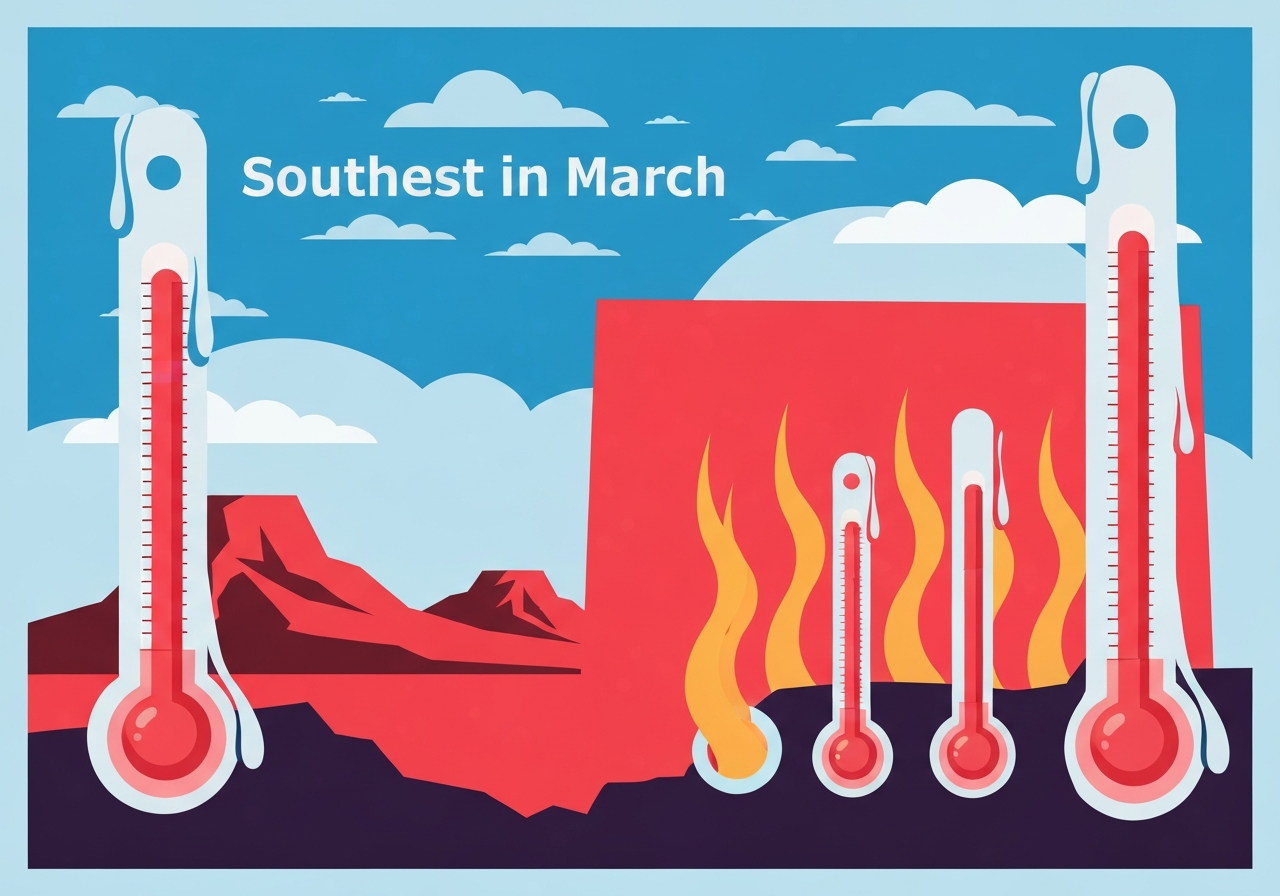
In March 2026, an early-season heat wave slammed the U.S. Southwest, shattering temperature records and producing readings as high as 112°F (44.4°C) in two Arizona communities and two Southern California locations. Scientists and attribution researchers said the scale and timing of the event — months ahead of typical summer peaks — reflect the growing influence of human-driven warming. A rapid analysis by World Weather Attribution concluded such March-level extremes would have been virtually impossible without greenhouse-gas–forced warming. Local officials and emergency managers described the event as operating outside historical expectations and straining systems designed for older climate norms.
Key Takeaways
- The heat wave reached 112°F (44.4°C) in four locations clustered within roughly 50 miles (80.5 km), breaking U.S. March temperature records.
- World Weather Attribution’s flash analysis found human-caused warming likely made this March heat “virtually impossible” in the historical record, adding an estimated 4.7°F–7.2°F (2.6°C–4°C) to temperatures.
- NOAA’s Climate Extremes Index shows the U.S. area affected by extreme weather has doubled in the last 20 years compared with two decades earlier.
- An AP analysis of NOAA data finds the U.S. is now breaking 77% more hot-weather records than in the 1970s and 19% more than in the 2010s.
- Inflation-adjusted counts and average costs of billion-dollar weather disasters in the U.S. are roughly double those of a decade ago and nearly four times those of 30 years ago, per NOAA and Climate Central records.
- Scientists classified the March heat among “giant events” with temperature anomalies up to 30°F (16.7°C) above normal for the season.
Background
The U.S. Southwest has long been vulnerable to high summer heat, but large-scale heat arriving in March represents a seasonal shift that strains preparedness systems. Communities and infrastructure in the region were built around historical weather assumptions — roughly a 100-year climatological baseline — that emergency managers say no longer reliably predict extremes. Over the past decade, climate scientists and meteorologists have documented more frequent and intense extremes worldwide, including the 2021 Pacific Northwest heat wave and the 2022 floods in Pakistan, which served as precedents for off‑season or unusually intense events.
NOAA’s Climate Extremes Index aggregates multiple kinds of extremes — heat and cold waves, heavy precipitation, drought — and indicates a widening footprint of disruptive conditions. Parallel measurements show record-breaking hot days are occurring more often in the United States now than in previous decades, and the economic toll of weather disasters has grown substantially. Attribution science, which compares observed conditions with modeled counterfactuals without human-caused warming, has developed into a near–real-time tool used by researchers to assess whether and to what degree climate change influenced specific events.
Main Event
In mid-March 2026 a persistent heat dome and warm air mass parked over the Southwest, lifting daytime highs far above typical seasonal values. Two Arizona communities and two sites in Southern California recorded 112°F (44.4°C) on Friday, according to regional weather services, marking new U.S. records for March. Local authorities issued heat advisories and closed some outdoor recreation areas; Camelback Mountain and other trails reported closures as surface temperatures and heat-index values reached dangerous levels for hikers and outdoor workers.
Urban centers saw atypical scenes for spring: open-water evaporation and unusually warm pavement surfaces increased nighttime temperatures, limiting overnight cooldown that would normally offer relief. In coastal San Francisco, residents encountered unusually warm and wet conditions in nearby areas while other parts of the Southwest baked — an illustration of how regional patterns can diverge sharply in a single season. Emergency managers said response systems were challenged because the timing cut across planning cycles built around summer peak risk.
Public-health officials warned of increased heat-related illness risk, particularly for outdoor workers, older adults and communities with limited cooling access. Some utilities monitored power demand as households and businesses turned to cooling earlier than usual, though reported outages were limited in the immediate event. Insurers and risk managers noted rising losses from extreme-weather events in recent years and signaled concerns about underwriting in repeatedly exposed markets.
Analysis & Implications
The March 2026 Southwest heat wave is illustrative of several concurrent trends: increasing baseline temperatures, more intense short-term extremes, and seasonal timing shifts that expose populations to heat when they are less acclimatized. Attribution work by World Weather Attribution found that human-induced warming increased the likelihood and magnitude of these March extremes, estimating an added 4.7°F–7.2°F (2.6°C–4°C) on top of the heat dome’s natural influence. That magnitude is sufficient to move events from uncomfortable to potentially life-threatening for vulnerable groups.
Economically, repeated large events translate into rising direct costs — damage to agriculture, infrastructure repairs, and higher emergency-service expenditures — and indirect costs, such as lost labor productivity. NOAA and Climate Central records show inflation-adjusted billion-dollar disaster counts and average costs have grown markedly, implying mounting pressure on federal, state and local budgets. Insurers’ reactions — tightening coverage or raising premiums in high-risk areas — further complicate recovery and resilience planning for municipalities and homeowners.
Policy implications are substantial: emergency response playbooks calibrated to historical seasonal norms may no longer suffice, and heat mitigation strategies (cooling centers, heat refuges, urban greening) need earlier and broader implementation. Infrastructure planning — from power grids to building codes — will increasingly require climate-informed design assumptions. Internationally, the event is one of several recent ultra-extreme phenomena that collectively signal changing risk profiles for food, health and economic systems.
Comparison & Data
| Event | Year | Noted Anomaly | Region |
|---|---|---|---|
| Southwest March heat | 2026 | Up to 112°F / +~30°F above March norms in places | U.S. Southwest |
| Pacific Northwest heat | 2021 | Temperatures exceeded regional records; B.C. warmer than Death Valley | Pacific Northwest |
| East Antarctica anomaly | 2022 | ~81°F (45°C) warmer than typical for the region | East Antarctica |
| South Asian heat wave | 2023 | Extreme heat with high humidity | South Asia |
The table places the March 2026 event alongside other high-profile extremes of recent years to show a pattern of rare, high-impact anomalies. Scientists classify the March event as a “giant event” when anomalies exceed roughly 16°C (30°F) above seasonal norms — a threshold seen in several of the listed examples. Those comparisons help frame both the rarity of each event in historical terms and the emerging pattern of more frequent large anomalies.
Reactions & Quotes
Researchers and emergency professionals responded with both alarm and calls for accelerated adaptation.
“This is what climate change looks like in real time: extremes pushing beyond the bounds we once thought possible.”
Andrew Weaver, University of Victoria (climate scientist)
Weaver’s comment frames the event as part of a continuing series of record-breaking extremes rather than an isolated anomaly; he and peers emphasize that such patterns are now recurring features of a warming world.
“It’s really hard to even keep up with how extreme our extremes are becoming — it’s changing our risk and putting more people in risky situations.”
Bernadette Woods Placky, Climate Central (chief meteorologist)
Climate Central’s meteorologists highlighted how rapid shifts complicate preparedness, especially when extremes arrive outside typical seasonal windows and catch communities unprepared.
“We were operating outside the historical playbook more and more. That assumption is starting to break.”
Craig Fugate, former FEMA director (emergency management official)
Fugate’s reflection underscores that infrastructure and policy frameworks built on past climate averages may no longer be reliable guides for future risk management.
Unconfirmed
- Precise local heat-related casualty totals for the March event have not been universally compiled; official tallies are still pending in some jurisdictions.
- The long-term insurance market responses in specific counties (policy cancellations or premium increases tied directly to this event) are still being documented and vary by company.
- Details on whether any specific power-grid failures were directly caused by heat demand peaks during the event remain under review by utilities and regulators.
Bottom Line
The March 2026 Southwest heat wave is both a record-setting weather event and a case study in how human-caused warming alters seasonal risk. Attribution work and multiple datasets indicate that such extremes are becoming more frequent, more intense, and sometimes shifted in season — stretching emergency response, health systems and economic resilience.
Communities, planners and insurers face a choice: accelerate adaptation measures (expanded cooling access, updated building and grid standards, revised hazard maps) or accept mounting societal and fiscal costs as extreme events keep exceeding historical expectations. For readers and decision-makers, the key takeaway is that early‑season extremes are now part of the risk landscape and require earlier, climate-aware preparation.
Sources
- Associated Press — Records shattered as summer heat hits Southwest in March (news)
- World Weather Attribution — Flash analyses and event attribution (research consortium)
- NOAA Climate Extremes Index (U.S. government dataset)
- NOAA National Centers for Environmental Information — Billion-Dollar Weather and Climate Disasters (U.S. government dataset)
- Climate Central — climate research and communication (nonprofit research organization)