
Lead
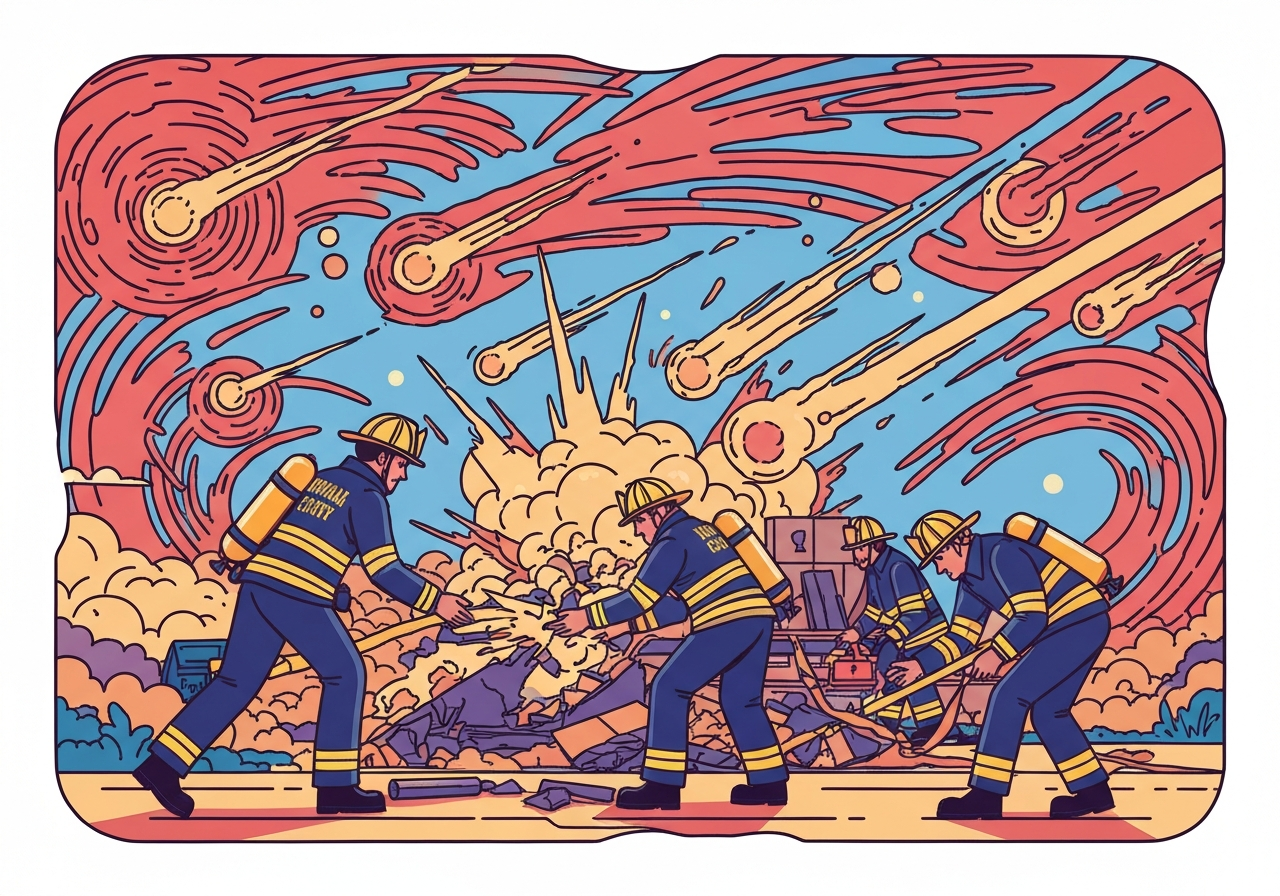
On March 22, 2026, Brenham Fire Department units responded to calls of a possible explosion near Highway 50 and Wiedeville Road in Brenham, Texas. Crews canvassed the scene but reported finding no physical evidence of an explosion. The initial dispatch followed multiple reports across southeast Texas describing a bright flash, a loud boom and, in some accounts, a green streak falling from the sky. Officials have not confirmed a cause, and social media speculation that a meteor was involved circulated rapidly.
Key Takeaways
- Response: Brenham Fire Department dispatched units to Hwy. 50 at Wiedeville Road on March 22, 2026 after multiple 911 and social-media reports of an explosion.
- On-scene findings: Fire crews reported they did not locate signs of an explosion after searching the area.
- Public reports: Witnesses across southeast Texas posted accounts of a green flash, black smoke and a loud boom on social platforms.
- Meteor theory: Several online posts suggested a meteor or atmospheric entry as a possible cause; officials have not confirmed this.
- No confirmed injuries or property damage were reported to emergency services at the time of the statement.
Background
Brenham is a small city in Washington County, Texas, bisected by state and local highways that connect it to surrounding rural communities. Local emergency services maintain close ties with county and neighboring municipal responders, so reports of loud booms or flashes typically trigger multi-unit checks to rule out structural incidents or hazardous-material releases. In recent years, social media has accelerated the spread of eyewitness reports after unusual sky events, often producing numerous videos and scattered accounts before official agencies can verify details.
Meteor sightings and atmospheric phenomena occasionally produce audible shocks and bright visual displays; notable U.S. events in the past decade have ranged from harmless fireball entries to rare airbursts that cause ground damage. Authorities generally proceed by confirming physical evidence—debris, scorch marks, or structural impact—before assigning a definitive cause. In this case, Brenham crews prioritized a field search and public safety checks while advising residents to report related hazards to emergency dispatch.
Main Event
Shortly after midday on March 22, 2026, dispatch logs show multiple 911 and social-media reports originating near the intersection of Highway 50 and Wiedeville Road describing an explosion or collapsing noise. Brenham Fire Department units arrived and conducted a systematic sweep of the area, examining roadway shoulders, nearby structures and open fields for blast signatures or fire. According to the department’s public statement, crews did not locate evidence such as burn marks, debris fields or damaged infrastructure that would indicate a detonation.
Across southeast Texas, dozens of social posts and short-form videos began appearing within minutes of the event, many from communities outside Brenham. Several eyewitnesses described a green or blue flash traversing the sky followed by a sharp, thunder-like boom. Local law enforcement and emergency managers monitored incoming reports while coordinated checks were carried out to verify whether any residences or facilities sustained impacts.
By late afternoon, no hospitals had reported patients with injuries tied to the incident, and no municipal alerts indicated structural damage in the search area. Officials cautioned that while eyewitness accounts are valuable, sensory descriptions—especially in fast-moving outdoor events—can be inconsistent and sometimes conflate unrelated observations. Investigations by specialized agencies or astronomical networks can take longer when physical evidence is minimal.
Analysis & Implications
When residents report bright flashes and loud sonic booms, possible explanations include meteor (fireball) entries, controlled explosions, industrial accidents, or distant thunder amplified by atmospheric conditions. Each hypothesis carries different public-safety and investigative responses: a confirmed meteor may prompt scientific inquiry but rarely requires emergency remediation, while an explosion or industrial release would trigger hazard containment and possibly evacuations. The absence of blast evidence in Brenham tilts the immediate assessment away from a ground-based detonation.
Social platforms amplify raw eyewitness data quickly, which helps authorities locate potential incidents but also raises the risk of misattribution. Videos shared without metadata can obscure timing and location, sometimes producing a cascade of posts that appear to confirm an event that actually originated elsewhere. For emergency managers, the challenge is to balance rapid public updates with careful verification to avoid unnecessary alarm.
For scientists and public-safety planners, an event like this highlights the value of cross-referencing eyewitness reports with instrumental records: infrasound networks, satellite sensors, regional seismometers and astronomical fireball reporting systems can corroborate atmospheric entries. If corroborated, a meteor event can yield useful data about entry trajectory and energy; if not, investigators must continue searching for terrestrial causes. Either outcome underlines the need for coordinated communication between responders, meteorologists and the public.
Comparison & Data
| Reported Phenomenon | Public Reports | Official Confirmation |
|---|---|---|
| Bright flash / green streak | Multiple social posts across southeast Texas | Unconfirmed |
| Loud boom | Numerous eyewitness accounts | Unconfirmed |
| Explosion damage | Initial caller concerns | No evidence found by BFD |
The table summarizes observed reports versus on-scene findings. Without physical evidence—debris, scorch marks or structural damage—official confirmation remains pending. Investigative partners that track atmospheric entries may provide additional data if sensors recorded a fireball or sonic signature.
Reactions & Quotes
“Units were dispatched to the area near Hwy. 50 at Wiedeville Road following calls reporting a possible explosion. Responders searched and did not locate signs of an explosion.”
Brenham Fire Department (official social media statement)
The department’s short post informed the community that a field search had been completed and that no blast indicators were found. That message aimed to reassure residents while acknowledging the ongoing uncertainty about the cause.
“I saw a green flash fall across the sky and then heard a huge boom a few seconds later.”
Local resident (social media eyewitness)
Eyewitness comments like this circulated widely and drove follow-on reporting, but they illustrate how immediate accounts can vary in detail and accuracy until corroborated by instruments or physical traces.
Unconfirmed
- That the observed flash and sound were caused by a meteor; no instrumental confirmation has been released.
- Any specific origin point, trajectory or energy estimate for a potential meteor entry; these require multi-source data to determine.
- Reports of black smoke indicating ground impact; responders found no corroborating evidence at the scene.
Bottom Line
Brenham Fire Department responded to reports of a possible explosion near Hwy. 50 and Wiedeville Road on March 22, 2026 and, after a field search, found no evidence of a blast. The absence of physical damage reduces the likelihood of a ground-level explosion but does not by itself confirm an atmospheric event such as a meteor entry.
Social-media accounts describing a green flash and loud boom have generated strong public interest across southeast Texas. For a definitive determination, investigators will need to cross-check eyewitness reports with sensor records, satellite data and any available video metadata. Residents should rely on official updates from emergency services and scientific agencies as the inquiry proceeds.
Sources
- KBTX — Local television news report summarizing BFD’s statement and eyewitness accounts (media).
- American Meteor Society Fireball Reports — Crowd-sourced and expert-verified reporting portal for atmospheric fireball events (scientific/monitoring).