
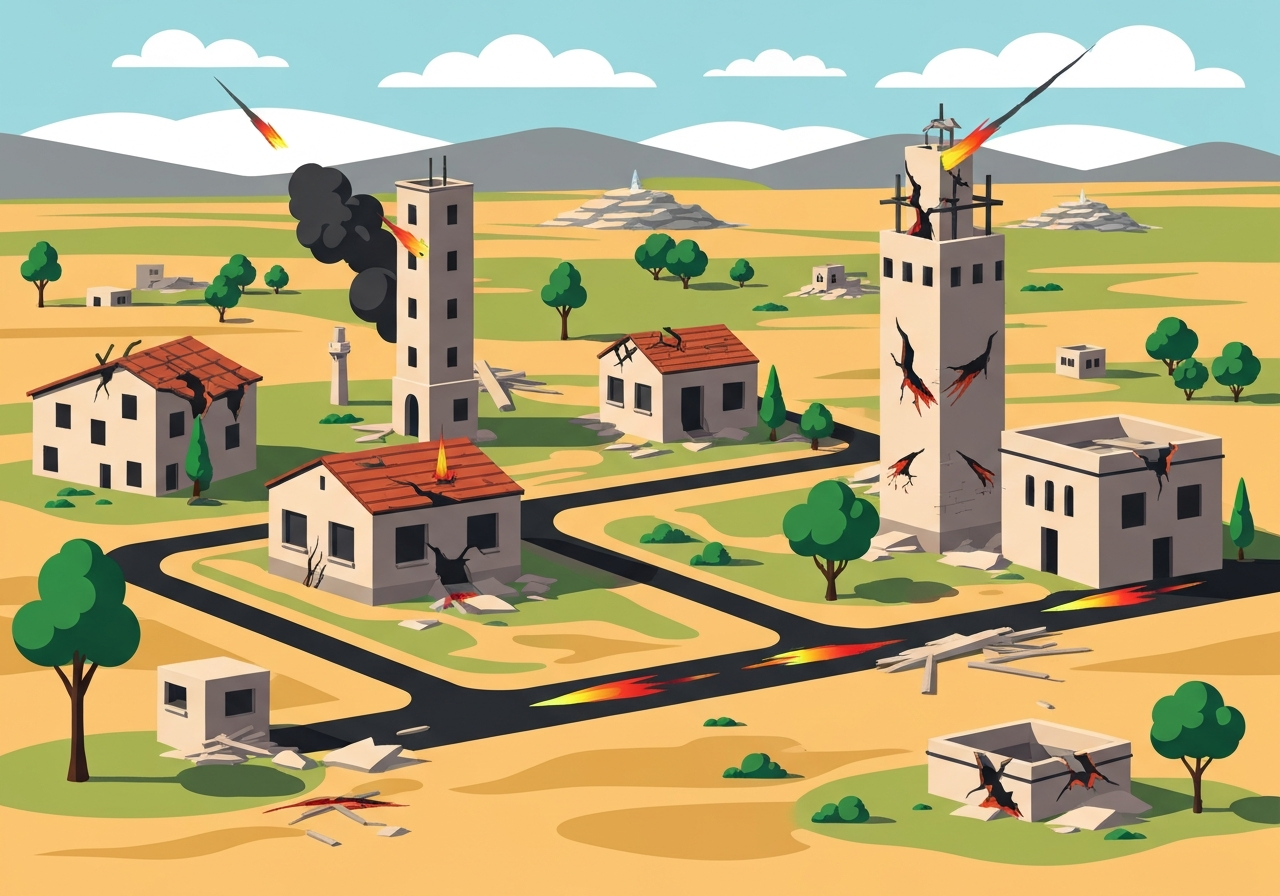
On Saturday, 21 March 2026, Iran launched missile strikes on the southern Israeli towns of Dimona and Arad, wounding at least 180 people and causing significant damage in both urban centres. Iranian state media framed the attacks as retaliation for an alleged assault earlier that day on Iran’s Natanz nuclear enrichment complex. Israeli authorities reported 116 wounded in Arad, including seven in serious condition, and 64 wounded in Dimona, with one in serious condition; emergency services described multiple collapsed and damaged residential buildings. The International Atomic Energy Agency (IAEA) said it has seen no indication of damage to the Shimon Peres Negev Nuclear Research Center at Dimona and detected no abnormal radiation readings.
Key Takeaways
- At least 180 people wounded in the strikes: 116 in Arad (7 serious) and 64 in Dimona (1 serious), according to Israel’s Ministry of Health.
- Several residential buildings in Dimona and the centre of Arad sustained heavy damage; a three-storey building in Dimona reportedly collapsed and multiple fires broke out.
- Iran characterised the strikes as a response to an attack on Natanz earlier the same day; Tehran reported no radioactive leakage from Natanz.
- The IAEA reported no signs of damage or abnormal radiation at the Dimona research centre and said it is closely monitoring the situation.
- Israeli air-defence systems engaged incoming missiles but, officials said, interceptors failed to stop several ballistic warheads weighing hundreds of kilograms.
- Since the exchange of strikes began, Iran has reported more than 1,500 killed in US-Israel operations, including over 200 children, according to Iranian state media.
- Israeli forces said they struck a research and development site at Malek Ashtar University in Tehran, alleging links to weapons development.
Background
The strikes come amid a widening cycle of attacks and counterattacks between Iran and Israeli forces that entered a more intense phase in late February 2026. Officials and state media in Tehran and Jerusalem have traded accusations over a series of incidents, including reported strikes on nuclear-related sites. Dimona is home to the Shimon Peres Negev Nuclear Research Center, a facility that has been central to Israel’s nuclear programme since the late 1950s and remains a focal point in regional security calculations.
Israel maintains a policy of deliberate ambiguity about its own nuclear arsenal, a posture that has shaped regional deterrence dynamics for decades. Iran, for its part, has sought to signal retaliation when its installations—most notably the Natanz enrichment complex—are attacked or sabotaged. International actors such as the IAEA have repeatedly urged restraint around nuclear sites to prevent an escalation that could risk radiological incidents.
Main Event
According to the Israeli Ministry of Health, emergency teams treated and evacuated dozens of civilians after missile impacts in both cities on Saturday evening. Arad bore the brunt of casualties, with 116 wounded and extensive damage concentrated in the city centre. In Dimona, first responders reported multiple residential buildings destroyed, at least one three-storey collapse and numerous shrapnel injuries; a 10-year-old child was among the wounded.
Israeli military spokespeople said air-defence batteries were engaged during the assault but that some interceptors failed to stop ballistic missiles, allowing warheads weighing “hundreds of kilograms” to strike. Fire services described multiple fires and heavy structural damage at several impact sites. Witness video footage authenticated by reporters showed large explosions and smoke plumes in Dimona following the impacts.
Iranian state television described the strikes as a direct response to what Tehran said was an attack on Natanz earlier that day. Tehran reported no radioactive release from Natanz, and an unnamed Israeli official cited by news agencies denied Israel’s responsibility for the Natanz incident; the Israeli military has not issued a full public account of that specific allegation.
Analysis & Implications
The strikes mark a notable escalation because they directly targeted towns adjacent to Israel’s principal nuclear research complex, raising the diplomatic and safety stakes. Even though the IAEA reported no abnormal radiation, the proximity of strikes to nuclear infrastructure increases the risk of miscalculation and could prompt international calls for tighter safeguards and de-escalatory measures.
Operationally, reports that some interceptors failed to stop ballistic warheads point to strains on air-defence systems or the use of tactics and payloads that challenge current intercept capabilities. If confirmed, those gaps could prompt Israel to accelerate procurement or operational changes, and may also lead to wider regional investments in missile and air-defence systems by other states watching the conflict.
Politically, Tehran’s choice to strike towns rather than exclusively military sites signals a calibrated effort to restore perceived deterrence after repeated attacks on Iranian facilities. Analysts suggest Iran seeks to narrow the credibility gap between its rhetoric and capabilities, aiming to deter further strikes while avoiding a direct campaign to destroy Israel’s key infrastructure—though the risk of further escalation remains.
Comparison & Data
| Location | Wounded | Serious | Notable damage |
|---|---|---|---|
| Arad | 116 | 7 | Extensive city-centre damage |
| Dimona | 64 | 1 | Multiple residential collapses |
| Since start of exchanges | 4,564 evacuated to hospitals | 124 hospitalised (1 critical, 13 serious) | Widespread civilian displacement |
This table summarises the immediate human toll and damage reported after the strikes on 21 March 2026 and the cumulative hospital evacuations since the start of the recent round of exchanges. The figures for wounded and hospitalised come from the Israeli Ministry of Health; Iranian casualty totals referenced in official Tehran media relate to earlier strikes attributed to US-Israeli operations and should be read as state-reported figures.
Reactions & Quotes
Israeli political and military leaders described the assault as a grave challenge to national security and vowed continued pressure against Iranian capabilities. Prime Minister Benjamin Netanyahu called the evening “difficult” and framed ongoing operations as necessary to prevent Iran from advancing threats.
“It was a difficult evening for Israel,”
Benjamin Netanyahu, Israeli Prime Minister (statement)
The IAEA emphasised the need to avoid military activity near nuclear installations and said its monitoring has not detected abnormal readings, while urging restraint in public statements and military operations around such sites.
“Maximum military restraint should be observed, in particular in the vicinity of nuclear facilities,”
Rafael Grossi, IAEA Director General
Iranian analysts and officials framed the strikes as a deliberate tit-for-tat step aimed at restoring deterrence after repeated attacks on Iranian nuclear facilities and infrastructure.
“Tehran wants to reduce the gap between words and actions,”
Abas Aslani, Centre for Middle East Strategic Studies (analyst)
Unconfirmed
- Responsibility for the alleged attack on Natanz earlier on 21 March 2026 remains disputed; Iran blames US and Israel, while an unnamed Israeli official quoted denial to the press—independent verification is lacking.
- The precise extent and technical nature of the damage at Natanz have not been independently corroborated; Iranian statements reported no radioactive leakage but full assessments may take time.
- Claims about specific weapons components developed at Malek Ashtar University and their direct linkage to strikes are asserted by Israeli military statements but are not independently verified in open-source reporting.
Bottom Line
The March 21 strikes represent a significant and risky broadening of the conflict dynamic between Iran and Israel, bringing populated towns and a major nuclear research centre into direct view of precision missile strikes. While the IAEA reports no abnormal radiation so far, the proximity of attacks to sensitive facilities raises the potential for accidental radiological harm or rapid escalation.
Policymakers and regional actors face a narrow window to reduce the risk of further tit-for-tat strikes that could spiral beyond current bounds. Monitoring by international agencies and diplomatic channels will be critical in the coming days to verify claims, prevent miscalculations and protect civilian populations near strategic facilities.
Sources
- Al Jazeera — news article reporting on the strikes and on-the-ground details.
- International Atomic Energy Agency (IAEA) — official statements and monitoring updates regarding nuclear facilities (official).
- Associated Press — reporting that included an unnamed Israeli official’s quoted denial of responsibility for the Natanz incident (news agency).