
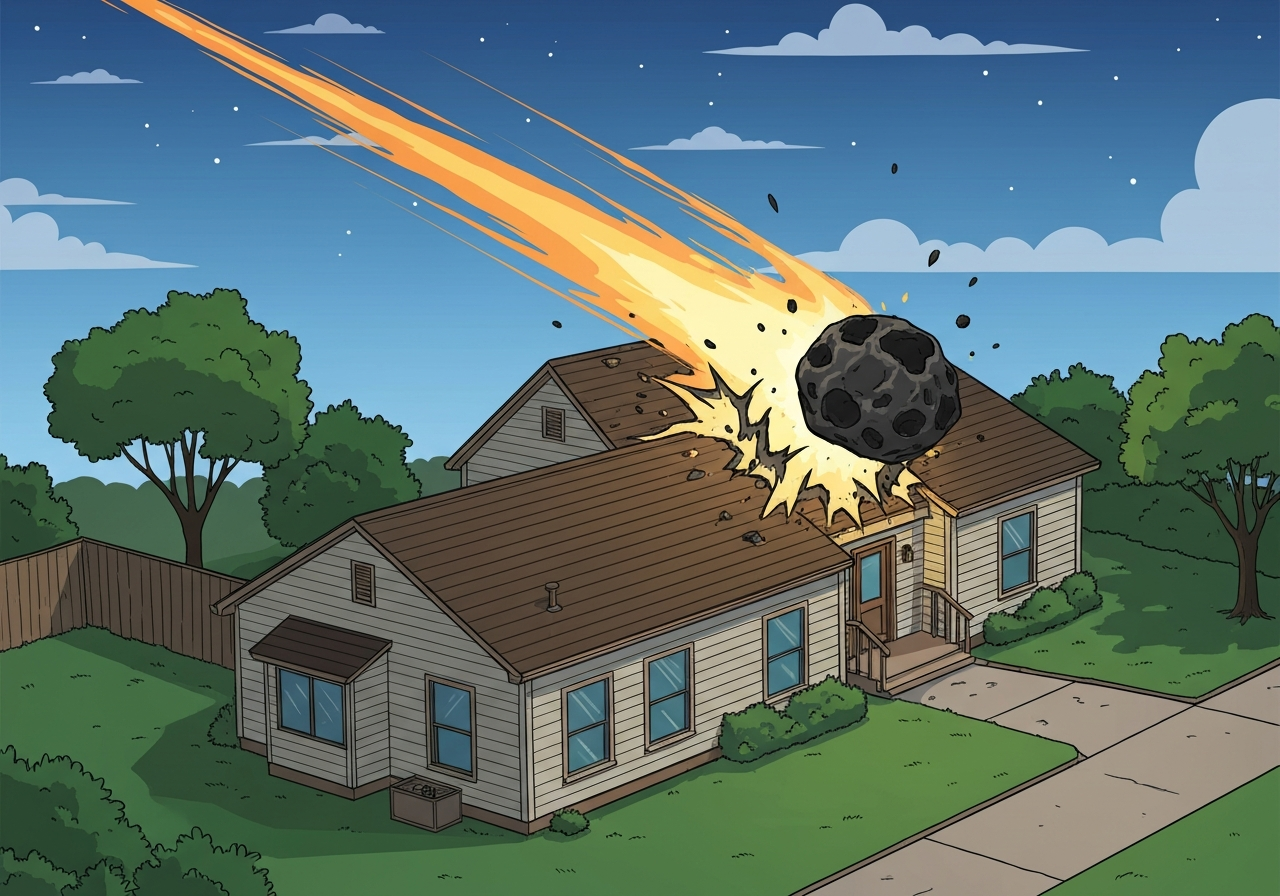
On the evening of Saturday, March 21, 2026, residents in suburban northwest Houston reported a bright fireball and loud booms as fragments from a suspected meteor broke apart overhead and one piece struck a house. Neighbors and local firefighters responded after a hole appeared in a ceiling and a rock was found inside the home. NASA confirmed the sighting and provided trajectory and fragmentation data, while Doppler weather radar indicated debris falling across parts of northern Houston. No serious injuries were reported in initial local accounts.
Key Takeaways
- Event timing: The fireball was visible about 4:40pm local time on Saturday, March 21, 2026, according to eyewitnesses and NASA data.
- Meteor trajectory: NASA reported the object became visible ~49 miles above Stagecoach (northwest of Houston) and traveled southeast at ~35,000 mph.
- Fragmentation altitude: The meteor broke apart roughly 29 miles above Bammel, just west of Cypress Station, producing a pressure wave and sonic booms heard locally.
- Estimated size and mass: NASA’s initial analysis estimated the object at about 3 feet in diameter and weighing roughly 1 ton before breakup.
- Ground effects: Doppler weather radar and local reports indicate meteorite fragments landed between Willowbrook and Northgate Crossing; one piece reportedly penetrated a house ceiling.
- Local reports: Residents in Bridgeland and Dickinson heard thunder-like noises or saw a small ball of fire; a Spring-area resident reported a ceiling hole and a rock inside her home.
- Context: The Houston event follows recent high-profile meteors, including an Ohio fireball that produced a widely felt sonic boom days earlier.
Background
Meteor sightings, atmospheric breakups and occasional ground impacts are rare but documented phenomena. Small meteors routinely enter Earth’s atmosphere; most disintegrate at high altitude. Larger objects that survive fragmentation and reach lower altitudes can produce shockwaves and, on uncommon occasions, deliver fragments to the surface. Authorities typically coordinate between local fire departments, state agencies and federal partners such as NASA to assess risk, locate fragments and, when appropriate, collect specimens for analysis.
Houston’s greater metropolitan area has the infrastructure and dense population that make such events highly visible and potentially hazardous. Local emergency responders initially considered routine explanations — including debris from aircraft — before federal tracking data clarified an atmospheric fireball. Past episodes elsewhere in the United States, including a notable Ohio event and a 2025 Atlanta house impact, have established protocols for investigation and public communication when meteorites are suspected.
Main Event
Residents reported bright light and explosive sounds on Saturday afternoon and evening. A Spring-area resident, Sherrie James, told local reporters that her grandson found a hole in the ceiling and a stone inside the home; she later called the fire department to report the damage. Fire crews first investigated and relayed initial possibilities, then received corroborating reports of a meteor over northern Houston.
NASA on X (formerly Twitter) published trajectory data indicating the object became visible about 49 miles above Stagecoach and traveled southeast at approximately 35,000 miles per hour. The agency reported the meteoroid fragmented about 29 miles above Bammel, west of Cypress Station, producing a pressure wave consistent with the booms many residents described. Radar signatures later showed probable meteorite echoes between Willowbrook and Northgate Crossing.
Local eyewitnesses described clear skies accompanied by thunder-like detonations. In Bridgeland, resident Wendy Camardelle Heppner told a television outlet the sound resembled thunder despite clear weather; a Dickinson resident, Shylie Troquille, reported seeing a small ball of fire in the sky that disappeared quickly. Local fire and law enforcement units responded to property reports and secured the scene while investigators and scientific teams prepared to search for fragments.
Analysis & Implications
The NASA size and mass estimate — roughly a 3-foot diameter object weighing near 1 ton — places this meteoroid in the category that can produce recoverable meteorites but not cause large-scale damage. Fragmentation at altitudes around 29 miles dissipates much of the initial energy, though the resulting pressure wave can generate audible booms and, on rare occasions, send smaller fragments to the ground.
For local authorities, the priority is establishing whether the object that struck the home is a meteoritic fragment and whether any fragments pose further hazard to residents. Confirmatory analysis requires chain-of-custody recovery, laboratory tests (including mineralogy and isotopic assays) and coordination with scientific institutions. If confirmed, recovered pieces will be valuable for research and will be handled according to state and federal guidelines for meteorite finds.
On a wider scale, consecutive high-speed fireballs over U.S. population centers in a short time frame highlight the growing role of coordinated observation networks and public reporting. Doppler radar, infrasound arrays and optical sensors together improve detection and localization, enabling faster public advisories and recovery operations. The economic and safety impacts are typically limited for events of this size, but they do punctuate the need for clear communication from officials during similar transient events.
Comparison & Data
| Event | Estimated Mass | Diameter | Speed | Notable Effect |
|---|---|---|---|---|
| Houston (Mar 21, 2026) | ~1 ton | ~3 ft | ~35,000 mph | Fragmentation at ~29 miles; ceiling strike reported |
| Ohio (days earlier, 2026) | ~6 tons | ~2 m | ~45,000 mph | Sonic boom heard across multiple states |
| Atlanta (Aug 2025) | very small | ~cherry-tomato size | unknown | Small fireball penetrated a home; later confirmed meteorite |
These comparisons place the Houston object below the Ohio event in mass and destructive potential but above extremely small micrometeorites. The table clarifies why the Houston event produced audible booms and recoverable fragments without broader structural damage.
Reactions & Quotes
“My grandson found a hole in the ceiling and then I saw the rock — I thought it looked like a meteor,”
Sherrie James (Spring-area resident)
James’ observation prompted the homeowner to notify firefighters, who then engaged local investigative resources. The initial on-scene assessment was later supplemented by NASA tracking data that narrowed the event’s timeline and path.
“Eyewitnesses in Texas observed a bright fireball today … Current data indicates the meteor became visible at 49 miles above Stagecoach,”
NASA (official statement on X)
NASA’s summary supplied key altitudes, speed and fragmentation details that helped local teams prioritize searches where radar indicated ground echoes. Federal data also framed the incident for media and public safety messaging.
“It sounded like thunder, but clear skies,”
Wendy Camardelle Heppner (Bridgeland resident)
Such reports of loud booms from multiple neighborhoods are consistent with a mid-to-high altitude fragmentation event creating a pressure wave that can be heard across a broad area.
Unconfirmed
- Whether the rock recovered inside the Houston home is definitively a meteorite remains unconfirmed pending laboratory analysis.
- The full ground strewn-field and total mass of surviving fragments have not been fully cataloged or publicly released.
- Any potential insurance claims or property assessments tied to the strike are still being processed and their outcomes are not yet available.
Bottom Line
The March 21, 2026 Houston fireball was a high-speed meteoroid that fragmented in the upper atmosphere, producing audible booms and at least one reported house impact. NASA’s rapid data release narrowed the event’s path and supported radar-based searches for fragments, but scientific confirmation that recovered material is extraterrestrial requires laboratory testing.
For residents, the immediate risk from this particular event appears limited, though the incident underscores the importance of public reporting and rapid interagency communication. In the coming days authorities and researchers will aim to recover fragments, verify their origin, and publish findings that place the Houston event in the growing dataset of near-Earth meteoroid interactions.
Sources
- The Guardian (news reporting)
- NASA (official statement on X/social media)
- KHOU11 (local television reporting)