
Lead
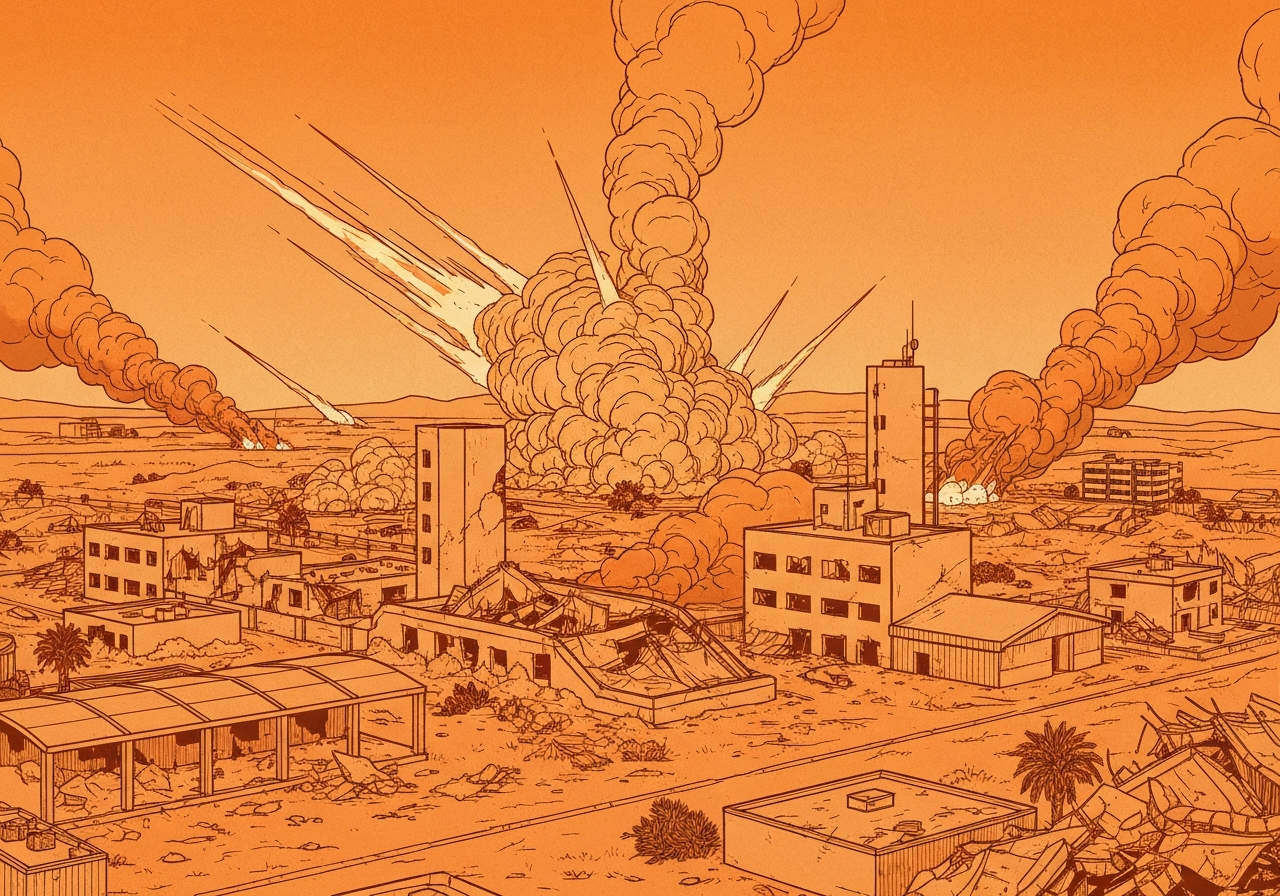
On March 22, 2026, Iranian ballistic missile strikes struck southern and central Israel — most notably the desert town of Arad and nearby Dimona — leaving at least 115 people injured and damaging multiple apartment buildings. The salvo punctured parts of Israel’s air-defense umbrella, producing widespread alarm among residents and prompting an IDF inquiry into interception failures. Authorities said no fatalities resulted directly from the Arad and Dimona impacts, though separate fighting in the north and falling interceptor debris caused additional casualties. The strikes also reignited concerns about operations near nuclear sites and the broader regional escalation.
Key Takeaways
- At least 115 people were reported injured on March 22, 2026, across Arad and Dimona after Iranian ballistic missiles struck populated areas.
- Israel reported no deaths from the Arad/Dimona impacts; separate northern hostilities, including a Hezbollah artillery strike in Misgav Am, killed one man.
- The IDF said it intercepted a large share of the incoming projectiles but acknowledged failures that allowed some missiles to hit their targets.
- Israeli officials cited an overall degradation of Iranian missile volumes — claiming an 80–90% drop in firepower and a 92% interception rate — while warning that single surviving ballistic rounds remain lethal.
- Iranian state media asserted the strike targeted the Dimona nuclear site in retaliation for an attack on Natanz; the IDF said it was unaware of that Iranian claim.
- The IAEA reported no abnormal off‑site radiation readings after the strikes and urged restraint around nuclear facilities.
- Falling debris from interceptor interceptions in Tel Aviv caused up to 15 injuries, underscoring secondary risks even where interceptors functioned.
Background
The strikes occurred amid a broader U.S.-Israeli campaign of military actions and reciprocal Iranian counterattacks that have unfolded over recent weeks. Israel has experienced relatively few domestic fatalities from that campaign until now, with official tallies showing 14 killed in Israel since the conflict began, compared with heavy losses reported inside Iran and Lebanon. For context, Red Crescent figures published on March 6 recorded at least 1,230 deaths in Iran, and Lebanese government figures show more than 1,000 dead amid fighting with Hezbollah.
Israel has invested heavily in layered air defenses over decades, designed to defeat rockets and missiles launched by groups such as Hezbollah and Hamas and to reduce civilian casualties. Those systems have been tested repeatedly in past rounds of cross-border exchanges, giving the public and military confidence in interception rates. Yet ballistic missiles — which travel at high speeds and follow different trajectories from short-range rockets — pose distinct technical challenges to interceptors. The renewed salvo on March 22 therefore tested both hardware and command-and-control procedures at a critical moment.
Main Event
On the afternoon of March 22, a ballistic missile strike in Arad sheared facades from adjacent apartment blocks and shattered windows across multiple blocks. Emergency services reported more than 115 injured across Arad and a separate impact in Dimona, and they treated many of the wounded for blast and laceration injuries. Local residents described a loud explosion and rapid emergency response; one resident credited an early-warning siren and his decision to shelter with preventing casualties in his household.
Dimona, the site of one of the impacts, is located close to Israel’s primary nuclear research reactor and related facilities. Iranian state outlets framed the Dimona strike as retaliation for an attack on the Natanz enrichment site in Iran, while Israeli authorities said they had no confirmation of that specific Iranian intent. The International Atomic Energy Agency (IAEA) reported no abnormal off-site radiation levels following the incidents and called for restraint near nuclear infrastructure.
The IDF said it intercepted several incoming projectiles, but officials acknowledged that some intercepts failed to prevent damage. Debris from around seven interceptions fell in populated areas, and those fragments caused up to 15 injuries in Tel Aviv, demonstrating the hazards of interceptor fall-out in dense urban zones. Separately, artillery fired by Hezbollah in the north struck a vehicle in Misgav Am, killing one man, illustrating how violence on multiple fronts continues to produce civilian harm.
Analysis & Implications
The March 22 strikes illustrate a strategic tension: Israel’s air defenses have reduced casualties over recent weeks, but they are not infallible. The IDF’s claim of a 92% interception rate and an 80–90% reduction in Iranian missile volumes points to operational progress, yet even a small percentage of failures can produce politically and socially significant outcomes when missiles hit population centers. In short, attrition of salvos lowers aggregate risk but cannot eliminate catastrophic single-event impacts.
Strategically, Iran’s ability to conduct long-range ballistic strikes even after sustained attacks on its military infrastructure signals resilient launch networks and potential use of dispersed or mobile systems. Whether Iran intends to target civilian residential areas or to aim at military or nuclear facilities remains contested; either possibility raises the stakes for escalation and for international diplomatic efforts to limit further confrontation.
The incidents near Dimona carry outsize symbolic and safety implications because of the nearby nuclear complex. The IAEA’s reporting of no abnormal radiation is an important immediate reassurance, but the mere prospect of strikes near nuclear sites elevates international concern and the likelihood of stronger third-party pressure to de‑escalate. Neighboring states and global powers will likely weigh the risks of continued strikes near such sensitive infrastructure when shaping diplomatic and military responses.
Comparison & Data
| Metric | Reported Value | Source (as reported) |
|---|---|---|
| Injuries from March 22 strikes | 115+ | NBC News reporting |
| Israeli deaths since conflict began | 14 | NBC News (official counts) |
| Iran deaths (Red Crescent, Mar 6) | 1,230+ | Red Crescent (reported via NBC) |
| Lebanon deaths (government) | 1,000+ | Lebanese government (reported via NBC) |
| IDF interception rate (claimed) | ~92% | IDF statement via media |
The table compiles key figures cited in initial reporting and official remarks. These numbers reflect statements released in the immediate aftermath and may be revised as authorities complete investigations and casualty tallies. The interception-rate figure is a military claim that underscores effective layers of defense but does not negate instances where interceptors or command decisions failed to prevent damage.
Reactions & Quotes
Senior Israeli officials visited the Arad impact zone on March 22 and framed the strike as evidence of Iranian intent to target civilians. Opposition and government figures used the visits to underscore the human impact and to rally domestic support for ongoing military measures.
“Even the best defense in the world isn’t perfect.”
Lt. Col. Nadav Shoshani, IDF international spokesperson
This remark from the IDF spokesperson was delivered at the Arad site and was accompanied by the military’s announcement of an internal probe into the interception failures. The comment acknowledged the limits of defenses while reaffirming the IDF’s broader assessment that Iranian missile salvos have been reduced in size.
“Look around you. Do you see any military sites? What they’re doing is trying to kill as many civilians as possible.”
Yair Lapid, opposition leader (speech at Arad)
Opposition leader Yair Lapid used the site visit to characterize the strikes as deliberately aimed at civilian areas, a framing that Israeli leaders from across the spectrum echoed to varying degrees. Iranian state outlets, by contrast, said the strikes were directed at Dimona’s nuclear infrastructure, a claim the IDF said it had not confirmed.
Unconfirmed
- Iranian state claims that the Dimona strike specifically targeted the nuclear reactor are reported but not independently corroborated by the IDF.
- Detailed technical causes for the interception failures — whether sensor error, interceptor malfunction or command delays — remain under investigation by the IDF.
- Casualty totals, including injuries from interceptor debris in Tel Aviv and wider tallies for the day, may be revised as emergency services finalize counts.
Bottom Line
The March 22 missile strikes in Arad and Dimona puncture a perception of invulnerability around Israel’s air defenses: layered systems can and did reduce harm overall, but individual ballistic rounds still pose a grave threat to civilians and critical infrastructure. The IDF’s public admission of an inquiry signals recognition of that vulnerability and the political need to explain how the incidents occurred.
Beyond tactical lessons for air-defense operations, the strikes carry strategic consequences. Attacks near nuclear sites raise international alarm and increase pressure on regional and global actors to push for de‑escalation. For Israelis, the episode will likely harden public and political support for continued military pressure on Iran while also renewing scrutiny of civilian-protection measures in urban areas.
Sources
- NBC News — news report summarizing events, casualty figures and official statements.
- International Atomic Energy Agency (IAEA) — official international agency statements on nuclear safety and radiation monitoring.
- Israel Defense Forces (IDF) — official military statements and public communications.