
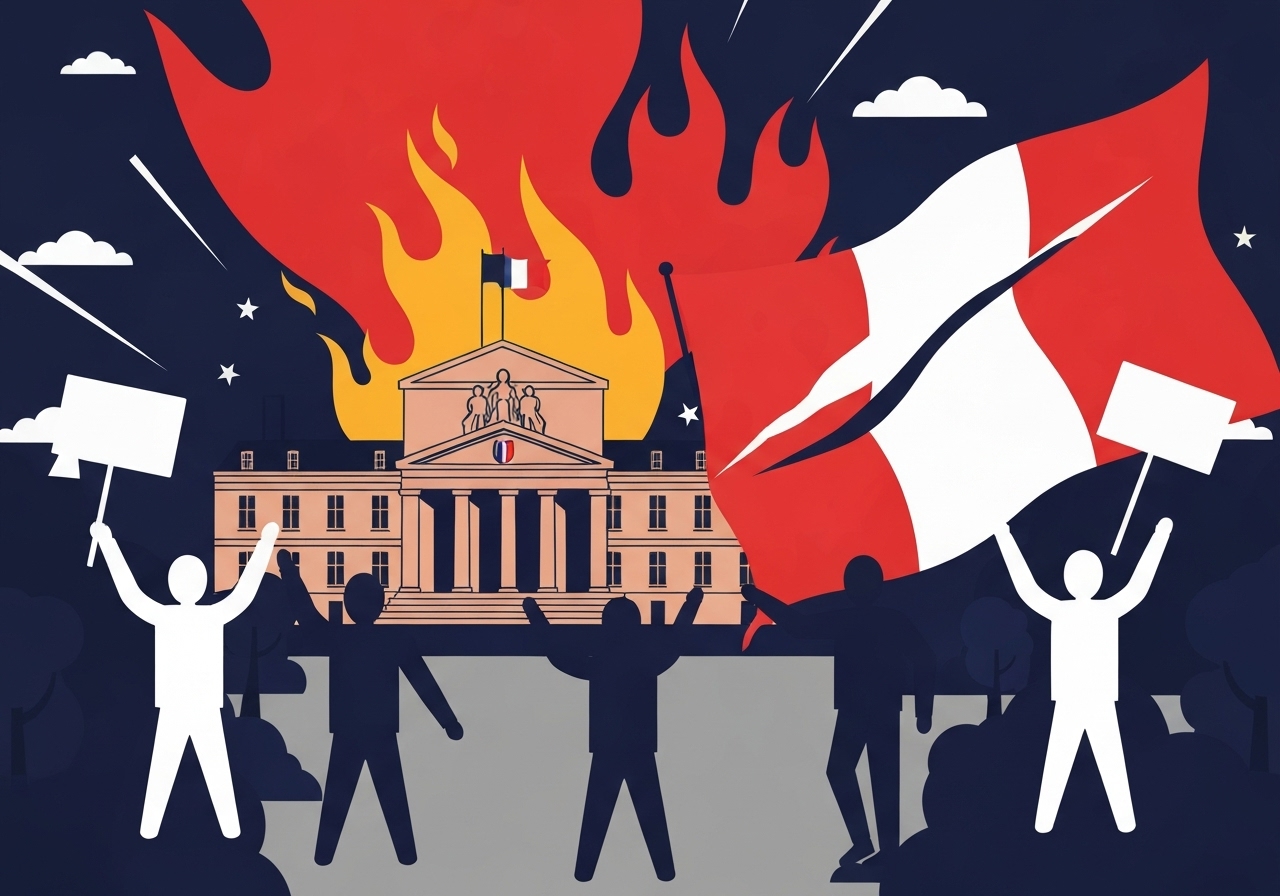
Lead: As of Sept. 8, 2024, newly appointed Prime Minister Sébastien Lecornu confronts large-scale, nationwide protests and a confirmed move by Socialist lawmakers to table a no-confidence motion. The unrest follows the collapse of François Bayrou’s fragile minority government earlier in the month and a rapid reshuffle that leaves President Emmanuel Macron searching for an unlikely centrist coalition to advance spending cuts. Protesters and opposition parties say the political reset has not addressed public concerns over austerity and governance. The immediate result is heightened uncertainty for the Élysée and a volatile parliamentary calendar.
Key Takeaways
- On Sept. 8, 2024, coverage highlighted that Sébastien Lecornu is taking office amid nationwide demonstrations against the new cabinet and its fiscal agenda.
- Socialist lawmakers publicly confirmed plans to move to oust the new prime minister, signaling a parliamentary challenge to the executive within days of the reshuffle.
- François Bayrou’s minority government fell in early September, leaving Macron without a stable parliamentary majority and increasing reliance on centrist partners.
- Macron’s strategy depends on forming a centrist alliance to pursue public spending cuts—an outcome analysts call unlikely given current partisan fragmentation.
- Observers describe political uncertainty at levels not seen since 1968, reflecting both street mobilization and elite-level disarray.
Background
The political turbulence stems from a collapsed minority administration led by François Bayrou earlier in September, creating an urgent need for a replacement prime minister who can command—or at least broker—legislative support. President Macron turned to Sébastien Lecornu in a bid to steady the ship and push through contested fiscal measures aimed at reducing public expenditure. The choice underscores Macron’s preference for a centrist solution rather than a shift toward the parliamentary left or a capitulation to hard-right demands.
France’s Fifth Republic has mechanisms for rapid government change, but those tools rely on workable coalitions or clear parliamentary majorities. In the current configuration, no single bloc offers a reliable voting base, raising the odds of repeated confidence votes, protracted negotiations, or even early elections if compromise proves impossible. Social forces—trade unions, leftist parties and street movements—have shown a low tolerance for austerity measures in recent years, increasing the political cost of any budget cuts.
Main Event
In the days after Lecornu’s appointment, protests erupted in multiple regions, bringing demonstrators into the streets to denounce what they see as an austerity-driven agenda. Large-scale rallies in regional capitals and Paris featured a mix of labor unions, left-wing parties and grassroots groups. Organizers framed the protests as a response to both the personnel change and the policy direction signalled by the new cabinet.
Parliamentary politics moved in parallel. Socialist deputies publicly committed to lodging a no-confidence motion against Lecornu’s government, a tactical move that could force a confidence vote and put the Élysée on the defensive. Without a solid centrist bloc to back Lecornu, the government risks early defeat or continued legislative paralysis.
Behind the scenes, Macron and his advisors have been engaging centrist lawmakers to assemble a working majority able to approve budget revisions. Sources familiar with the discussions describe them as difficult: many centrists are wary of being blamed for unpopular spending cuts, while hard-right and hard-left factions remain outside any prospective coalition.
Analysis & Implications
Politically, Lecornu’s immediate test is whether he can secure enough cross-party backing to survive a confidence vote and pass basic fiscal legislation. If he fails, the most likely outcomes are another reshuffle, a weakened caretaker government, or the prospect of early national elections—each with significant risks for Macron’s reform agenda. The president’s reliance on an ad hoc centrist alliance exposes a strategic vulnerability: success requires parties to accept policy costs without receiving full credit in the next electoral cycle.
Economically, uncertainty at the top of government can unsettle markets and delay budgetary decisions crucial for deficit control and investor confidence. Public spending commitments and timeline for cuts are likely to be postponed until political stability returns, which could worsen France’s medium-term fiscal trajectories if markets demand higher risk premia.
Internationally, European partners will watch closely. A protracted domestic crisis could weaken France’s voice in EU-level negotiations on fiscal rules, defense spending and energy policy. Conversely, a successful centrist patchwork that yields clear budget outcomes would reassert Paris’s credibility—though that path appears narrow and politically costly.
Comparison & Data
| Date | Coverage |
|---|---|
| Sept. 3, 2024 | Commentary on systemic uncertainty in the Fifth Republic |
| Sept. 4, 2024 | Socialists confirm plans to oust the prime minister; Bayrou’s minority government falters |
| Sept. 8, 2024 | Report: Lecornu faces nationwide protests and political tests |
The short timeline above shows how quickly events escalated in early September: within days of Bayrou’s faltering, the new cabinet faced mass mobilization and an organised parliamentary challenge. That compressed sequence leaves little time for coalition-building or public consultation.
Reactions & Quotes
Political actors and public figures responded swiftly, framing the crisis through competing lenses—legitimacy, governance, and popular consent.
Socialist representatives have said they will move to remove the government by filing a no-confidence motion, arguing the reshuffle does not change policy direction.
Socialist Party (statement reported)
Presidential aides defended the appointment as a necessary step to stabilise governance and pursue long-term fiscal discipline.
Élysée Palace (official source reported)
Protesters and union organisers described street action as an essential democratic response to austerity plans and rapid political change.
Union organisers and demonstrators (reports)
Unconfirmed
- The precise scale and geographic distribution of protests across every department remain to be independently verified.
- The timeline and final composition of any centrist alliance to back Lecornu are not confirmed and depend on ongoing negotiations.
- Claims about imminent early elections are speculative until a confidence vote occurs or the president makes a formal decision.
Bottom Line
Sébastien Lecornu’s appointment places him squarely in a high-risk role: he must navigate immediate street-level dissent while seeking fragile parliamentary support for contested fiscal aims. The lack of a reliable majority means the government’s lifespan could be short unless fast, pragmatic deals are struck to neutralise a no-confidence effort.
For President Macron, the episode underscores the limits of centrist engineering in a fragmented political landscape. The coming weeks will determine whether France moves toward a negotiated compromise that stabilises policy-making or toward deeper instability that could reshape the domestic political map.
Sources
- Politico Europe — Media reporting and analysis (Sept. 2024)