
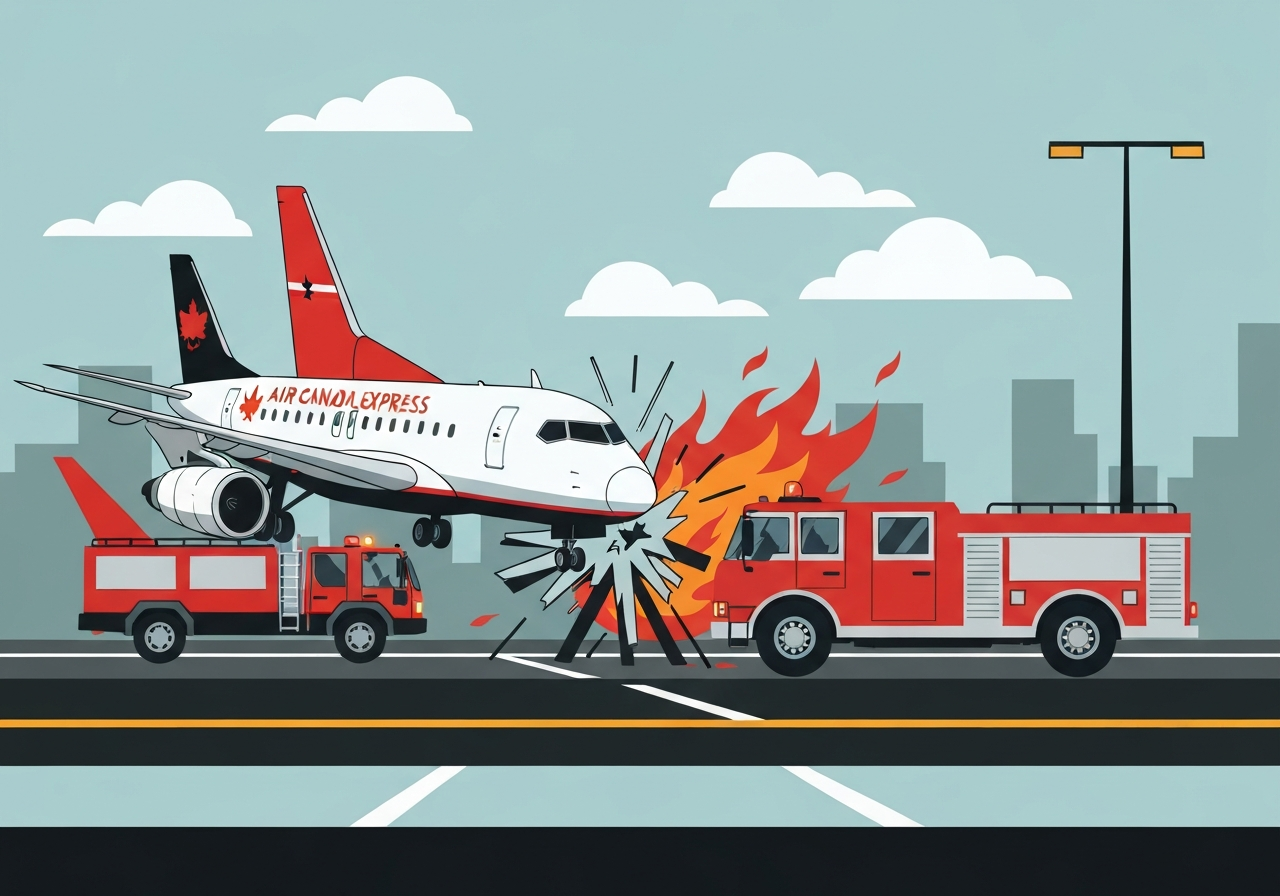
Lead: On March 23, 2026, at about 23:40 local time, an Air Canada Express CRJ-900 operated by Jazz Aviation struck a Port Authority firefighting vehicle on Runway 4 at New York’s LaGuardia Airport, killing at least two people and injuring others. The collision forced an immediate airport closure and the diversion or return of incoming flights as emergency crews responded. Authorities activated full emergency protocols while the Federal Aviation Administration issued a ground stop for LaGuardia departures and the National Transportation Safety Board dispatched investigators to the scene.
Key Takeaways
- Two people were confirmed dead after the Air Canada Express flight AC8646 struck a ground vehicle on Runway 4 at LaGuardia on March 23, 2026.
- At least 13 people were taken to hospital, including 11 passengers and two first responders, according to broadcaster ABC.
- There were 76 people on board AC8646, including four crew members, per Jazz Aviation’s preliminary passenger list.
- Flight-tracking data from Flightradar24 indicates the CRJ-900 struck the vehicle at about 24 mph (39 km/h) during landing.
- The Port Authority closed LaGuardia and the FAA issued a ground stop; initial closure notices extended through 05:30 GMT and possibly until 18:00 GMT.
- The NTSB dispatched a “go team” to investigate the collision and gather evidence at the site.
Background
LaGuardia Airport, located in the Queens borough of New York City, is one of the region’s busiest short-haul hubs; the Port Authority reported it served 33.5 million passengers in 2024. The airport has faced operational stressors in recent months, including weather disruptions and longer security waits reportedly linked to staffing impacts from a federal funding lapse. Airport runways and ramp areas involve constant vehicle movement—ranging from maintenance to rescue and firefighting units—creating scenarios where coordination and clearances are critical.
Regional airlines such as Jazz Aviation operate CRJ-900 aircraft on behalf of Air Canada for short-haul routes like Montreal–New York. U.S. aviation oversight is shared among agencies: the FAA manages immediate operational control and notices to airmen, while the independent National Transportation Safety Board investigates accidents to determine probable causes and safety recommendations. High-profile U.S. aviation accidents in recent years, including a January 2025 collision near Washington, DC that killed 67 people, have kept scrutiny on ground and air procedures.
Main Event
Shortly after 23:40 on Sunday, March 23, 2026 (03:40 GMT Monday), flight AC8646 was landing on Runway 4 when the Jazz Aviation-operated CRJ-900 made contact with a Port Authority aviation rescue and firefighting vehicle that was en route to a separate incident. Port Authority officials said the firefighting truck was driving along the runway when struck; images released by agencies showed a rescue vehicle on its side near the runway.
Jazz Aviation’s preliminary roster listed 76 people aboard, including four crew members. Emergency responders immediately evacuated passengers and treated injured people at the scene before transferring at least 13 individuals to hospitals. First responders also reported injuries among on-scene personnel; two first responders were among those hospitalized, according to ABC.
The FAA implemented a ground stop for departures to LaGuardia and the Port Authority announced the airport was closed to facilitate rescue, medical care and a thorough investigation. LaGuardia’s web updates and FAA notices showed arriving flights diverted to alternate airports or returned to origin while the closure was in effect, and authorities warned the closure could remain for many hours.
Analysis & Implications
This collision raises immediate questions about runway access controls, radio communications and the procedures governing emergency vehicle movement during concurrent airport operations. Runway incursion—any unauthorized presence on a runway—is a known hazard; when an emergency vehicle is deployed to an incident while other aircraft are landing or taking off, strict coordination is required between air traffic control, vehicle operators and airport operations staff.
Operationally, the incident will prompt review of sequence and timing protocols for dispatching rescue vehicles, the effectiveness of ground radar and visual monitoring, and whether automated alerts could reduce risk. Airlines and airports sometimes face competing priorities during incidents: rapid response to a reported ground event versus ensuring active runways are clear. Investigators will examine voice recordings, vehicle logs, radar and surveillance footage to reconstruct timelines and identify any procedural lapses.
Economically and logistically, extended closures at LaGuardia have ripple effects across the Northeast air network, increasing delays, diversions and passenger disruptions. Extended investigations may also affect Port Authority operations and could prompt regulatory reminders or directives from the FAA addressing ground-vehicle procedures at busy airports. Any safety recommendations from the NTSB could require policy changes or additional training for airport rescue and firefighting units nationwide.
Comparison & Data
| Metric | Value |
|---|---|
| Passengers on AC8646 | 76 (including 4 crew) |
| Confirmed fatalities | 2 |
| Injured and hospitalized | At least 13 (11 passengers, 2 first responders) |
| Estimated strike speed | About 24 mph / 39 km/h (Flightradar24) |
| LaGuardia annual passengers (2024) | 33.5 million |
The table summarizes reported figures from Jazz Aviation, broadcaster ABC, Flightradar24 and Port Authority data. These numbers will be confirmed or refined as investigators process manifest records, medical reports and vehicle telemetry.
Reactions & Quotes
Airport and federal agencies issued immediate operational notices and statements while first responders continued rescue and medical efforts.
“The airport is currently closed to facilitate the response and allow for a thorough investigation,” the Port Authority said in a public statement indicating emergency protocols were activated.
Port Authority of New York and New Jersey (official statement)
Federal agencies emphasized the role of the NTSB and FAA in the next phases of the inquiry, with officials stressing fact-gathering before assigning cause.
“We have sent a go team to the scene to investigate the collision and assist with the on-site review,” the NTSB said, noting investigators will analyze flight and vehicle data.
National Transportation Safety Board (investigative authority)
Local emergency management advised the public to expect disruptions around Queens and to use alternate routes as response operations continued.
“Expect cancellations, road closures, traffic delays & emergency personnel near LaGuardia—use alternate routes,” New York Emergency Management posted to social platforms.
New York City Emergency Management (local authority)
Unconfirmed
- Initial media reports suggested the firefighting vehicle was en route to a different incident; full confirmation of that secondary incident and its timeline is pending.
- Details about whether any air traffic control clearance was issued to the ground vehicle at the time of the collision have not yet been publicly released.
Bottom Line
The collision between Air Canada Express flight AC8646 and a Port Authority firefighting vehicle at LaGuardia on March 23, 2026, resulted in at least two deaths, multiple injuries and a major operational disruption at a key New York airport. Immediate priorities are medical care for the injured, scene safety and preserving evidence for investigators as the FAA and NTSB seek to determine the sequence of events and contributing factors.
In the coming days, expect investigators to release timelines and preliminary findings that could influence airport ground procedures and emergency dispatch protocols. For travelers and regional operators, the incident reinforces the operational risk of simultaneous ground and air activity at congested airports and may trigger regulatory or procedural changes depending on the investigation’s outcomes.