
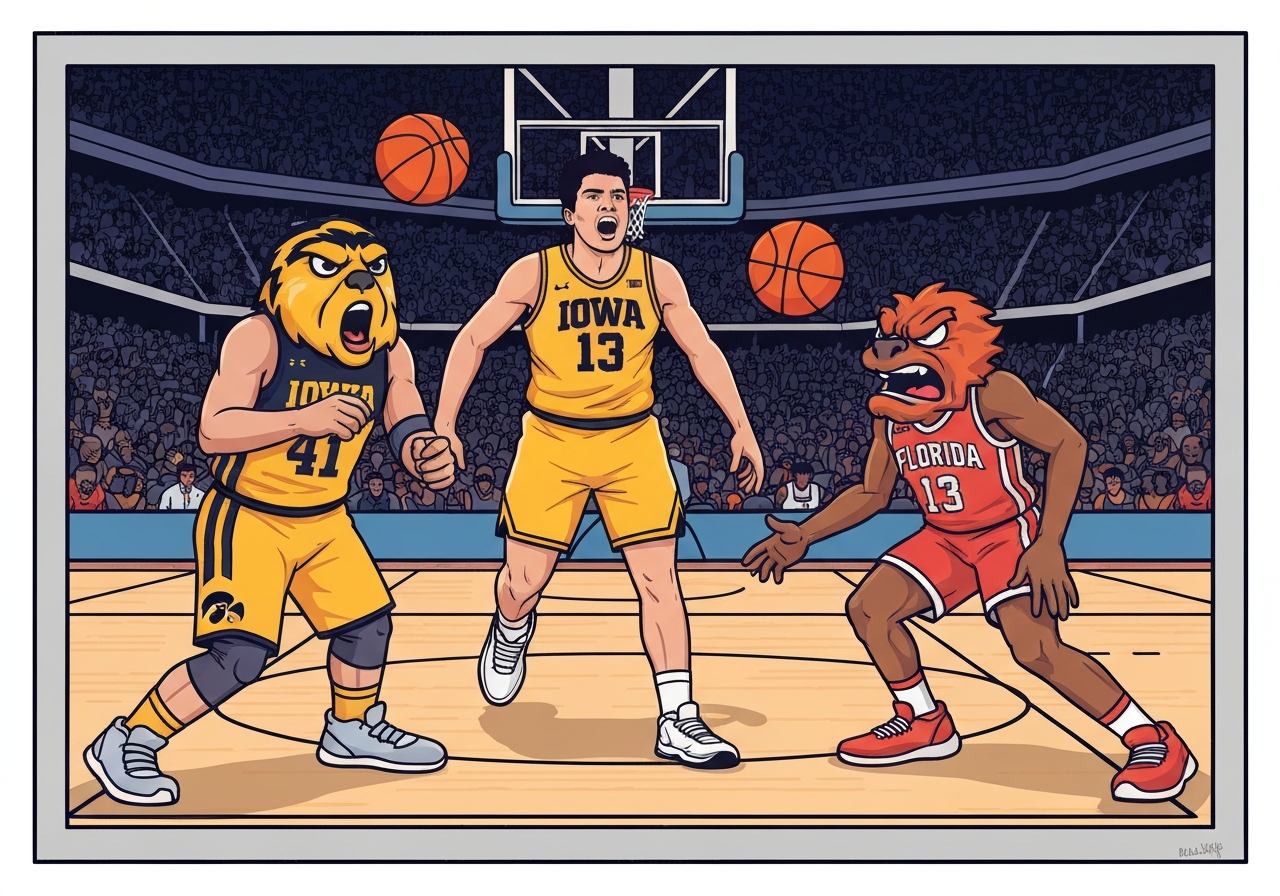
In a shock finish that closed out the NCAA Tournament’s opening weekend, No. 9 Iowa edged No. 1 Florida 73-72 to eliminate the defending champions. The Hawkeyes rallied from a second-half deficit of as many as 12 points and took the lead on a corner 3 by Alvaro Folgueiras after a quick inbounds sequence. Florida had tied the game on two Isaiah Brown free throws with under 10 seconds remaining but failed to get a final shot off after a turnover on the last possession. The result ends Florida’s bid to repeat and punctuates a weekend notable for few upsets, strong Big Ten showings and high-profile prospects exiting early.
Key Takeaways
- Iowa defeated No. 1 Florida 73-72 in the second round; Alvaro Folgueiras hit the game-winning 3 after an inbounds sprint by Bennett Stirtz.
- Florida briefly led 72-70 following two Isaiah Brown free throws with under 10 seconds left but lost possession on the final possession, failing to attempt a shot.
- Head coaches reacted with praise and disappointment: Florida’s Todd Golden called it “a tough way to go out,” while Iowa’s Ben McCollum highlighted his squad’s resilience.
- The Big Ten will send six teams—Illinois, Purdue, Michigan, Michigan State, Nebraska and Iowa—to the Sweet 16, its largest total since 1975.
- Several top NBA prospects left early: Kansas (seed No. 4) fell 67-65 to St. John’s on a buzzer layup by Dylan Darling; Darryn Peterson averaged 24.5 points across two games and logged 36.5 minutes per contest.
- BYU’s AJ Dybantsa scored 35 in a first-round loss to Texas, removing another projected top pick from title contention.
- The first weekend saw relatively few surprises: seven of the top eight men’s seeds remain, and the lowest remaining seed in the men’s bracket is No. 11 Texas.
Background
Florida entered the tournament as the South Region’s No. 1 seed and as the reigning national champion. The program had been attempting a repeat—something it last achieved in 2006–07—and was one of only two teams in the 21st century with recent back-to-back titles, alongside Connecticut’s consecutive championships in 2023 and 2024. As a top seed, the Gators began the weekend with high expectations from fans and bracket pools alike.
Iowa arrived in the second round as a No. 9 seed with a reputation for disciplined defense and late-game poise under coach Ben McCollum. The Hawkeyes’ path through the bracket relied on balanced scoring rather than a single superstar, and their roster structure allowed them to rally from midsecond-half deficits. The matchup was also framed by broader tournament narratives: conference strength, the influence of NIL on roster construction, and the pressure on highly touted NBA prospects to perform in a brief, high-stakes window.
Main Event
The game’s final minutes produced the decisive sequence. After Florida took a 72-70 edge when Isaiah Brown sank two free throws with fewer than 10 seconds remaining, the Gators’ defense failed to track Iowa’s inbound guard Bennett Stirtz. Stirtz sprinted the length of the court and found Folgueiras in the right corner, where the forward drilled a go-ahead 3-pointer to put Iowa up 73-72.
Florida’s last possession broke down under pressure. Guard Xaivian Lee drove under the rim but encountered heavy traffic and threw a desperation pass that became a loose ball as the clock hit zero, meaning Florida did not get a final shot attempt. The sequence underscored both Iowa’s hustle on transition and Florida’s inability to execute under intense, end-of-game circumstances.
Postgame, Florida coach Todd Golden acknowledged the defensive lapse and the narrow margins that decide tournament outcomes, calling the finish “a tough way to go out.” Iowa coach Ben McCollum praised his players’ persistence, saying the group embodied resilience and the competitive habits he’s prioritized while building the program. On-court emotion alternated between elation for Iowa and stunned silence among Florida supporters.
Analysis & Implications
Iowa’s victory immediately removes a clear favorite from title conversation and reshapes projections for the South Region. The upset opens the bracket by eliminating a program that other teams were preparing to meet as a presumed benchmark, and it injects momentum into Iowa’s run heading to the Sweet 16. For Florida, the loss raises questions about late-game execution and whether the rotation can sustain postseason intensity against disciplined defensive squads.
The wider tournament picture points to conference strength shifting toward the Big Ten this season. With six Sweet 16 slots claimed, the league demonstrates depth and balance across multiple programs. That concentration of remaining teams could affect seeding considerations and the perceived difficulty of potential Final Four paths, giving the Big Ten a strategic advantage in matchups where familiarity and scouting depth matter.
On the player-evaluation side, the weekend was consequential for NBA prospects. Darryn Peterson’s two-game sample (21 points in the Kansas loss; 24.5 ppg average reported across two games) and AJ Dybantsa’s 35-point outing in a first-round loss will be parsed by scouts, but small sample sizes and opponent quality complicate straightforward draft projections. Early exits can both preserve an injured player’s spotlight or amplify concerns about consistency—teams and analysts will weigh those factors in upcoming evaluations.
The opening weekend also reignited debate over NIL’s effects on competitive balance. With relatively few Cinderella runs, some commentators will argue that NIL-heavy programs should produce more volatility, while others note that coaching, depth and matchup fit remain dominant determinants of single-elimination outcomes. Expect intensified coverage and analysis on NIL only insofar as it can be empirically linked to roster changes or competitive outcomes.
Comparison & Data
| Category | Count / Detail |
|---|---|
| Big Ten teams in Sweet 16 | 6 (Illinois, Purdue, Michigan, Michigan State, Nebraska, Iowa) |
| Top-eight seeds still alive (men’s) | 7 of 8 |
| Lowest remaining seed (men’s) | No. 11 Texas |
| Notable buzzer finishes | Kansas 67–65 loss to St. John’s on Dylan Darling layup |
The table shows the dominant statistical storylines: strong Big Ten representation and a surprisingly chalky men’s bracket. While individual upset narratives still exist—such as Iowa over Florida and St. John’s over Kansas—the overall balance favors higher seeds advancing, at least through the first two rounds.
Reactions & Quotes
Florida’s coach reflected on the sequence that decided the game and on the broader sting of an early exit for a returning champion.
“We weren’t able to take it and they knocked it down, so credit to them for that. Just a tough way to go out.”
Todd Golden, Florida head coach (postgame press conference)
Iowa’s coach framed the result as validation of a long-term culture rebuild and praised the players’ competitive character.
“They fight. They compete. They stick with it. They exemplify everything that we’ve wanted in Iowa basketball.”
Ben McCollum, Iowa head coach
Unconfirmed
- Whether NIL deals directly reduced the number of upsets this weekend remains unproven; causation is not established by the early-round results.
- Long-term effects on draft positioning for players like Darryn Peterson and AJ Dybantsa are speculative after only one tournament appearance and require broader scouting context.
- Any internal Florida roster or injury issues affecting the late-game breakdown were not formally disclosed by the program at the time of reporting.
Bottom Line
Iowa’s 73-72 upset of top-seeded Florida is both a singular game story and part of a larger weekend narrative: the men’s bracket largely favored higher seeds, while the Big Ten emerged with disproportionate Sweet 16 representation. The outcome removes a favored program from title contention and hands momentum to a hungry Iowa team built around collective effort rather than a single star.
Readers should watch the Sweet 16 for matchups that test the Big Ten’s depth against other conference powers, and scouts will continue to weigh weekend performances alongside season-long tape when assessing NBA prospects. The tournament’s compressed timeline guarantees new storylines each round—expect further implications for seeding, draft chatter and NIL discourse as the field narrows.