
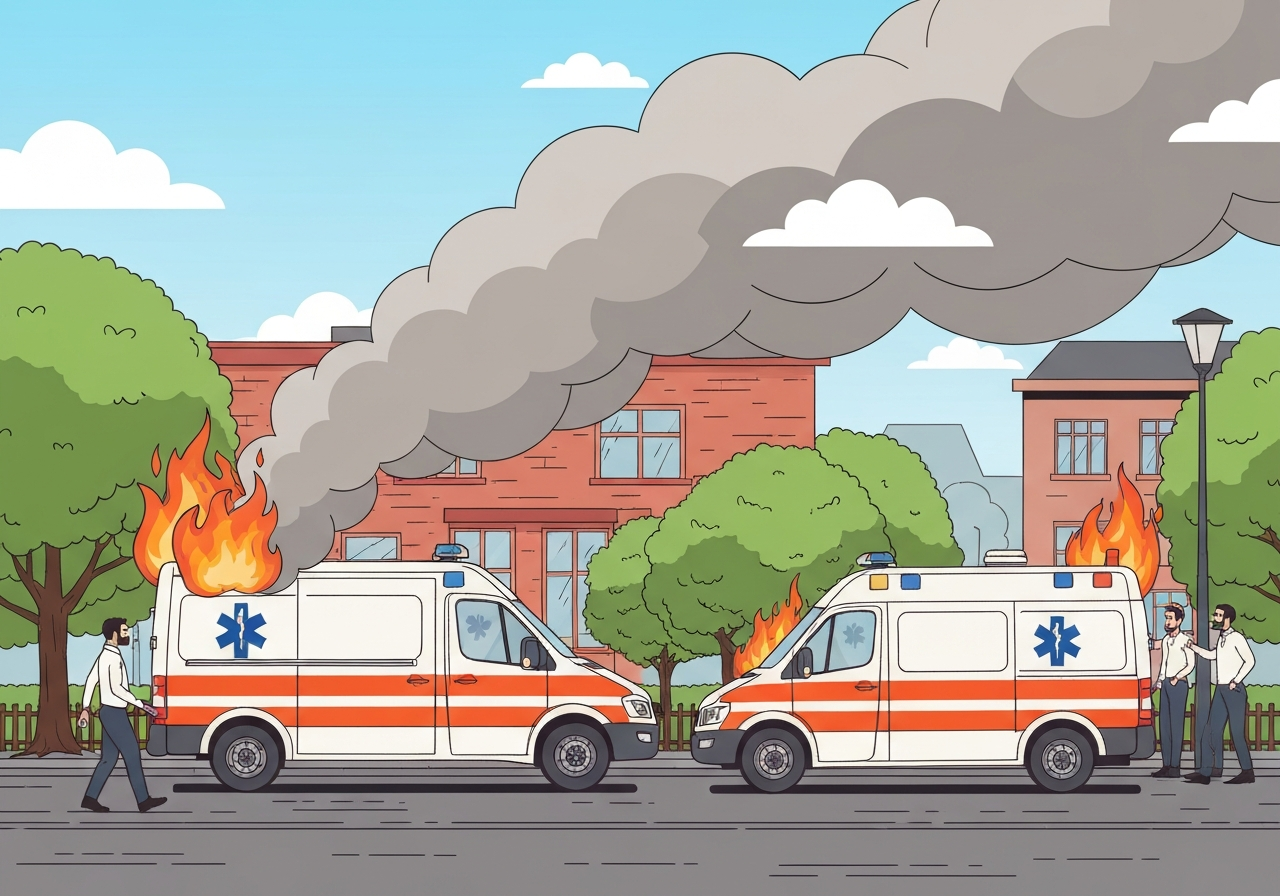
Early on Monday, March 23, 2026, four ambulances belonging to Hatzola, a Jewish volunteer emergency service, were set ablaze in Golders Green, North London. Metropolitan Police are treating the incident as an antisemitic hate crime after fires were reported at about 1:45 a.m. Fire crews extinguished the blazes and no injuries were reported. CCTV footage shows three people pouring an accelerant on vehicles and leaving the scene, and detectives say inquiries are under way.
Key Takeaways
- Four ambulances owned by Hatzola were deliberately set on fire in Golders Green on March 23, 2026; firefighters extinguished the fires and there were no injuries.
- The Metropolitan Police were called at about 1:45 a.m.; dozens of firefighters responded and the scene was declared safe after the blazes were put out.
- Police say CCTV captured three suspects pouring an accelerant onto the vehicles before igniting them; no arrests had been made at the time of reporting.
- The force is investigating the attack as an antisemitic hate crime and is assessing a claim of responsibility posted on Telegram.
- Prime Minister Keir Starmer publicly condemned the attack and said antisemitism has no place in Britain.
- Security analysts noted the video claim was linked by a monitoring group to an Iran-aligned multinational militant collective, a characterization under review by police.
Background
Golders Green is a residential district in North London with a significant Jewish population and active communal institutions. Hatzola is a volunteer-run emergency medical service that provides first response and ambulance cover for Jewish communities across London; its vehicles are frequently parked in communal areas when not on call. In recent months there have been a series of violent and threatening incidents targeting Jewish organizations in Europe and the United States, raising concerns about a spike in antisemitic attacks tied to geopolitical tensions.
British authorities have increased protective measures for places of worship and community centers following those incidents, and local police maintain liaison with Jewish communal leaders and volunteer responders. Hate-crime investigations in the capital are handled by specialist teams within the Metropolitan Police, who also work with counterterror and national security units when there is a potential cross-border element. Community resilience efforts include rapid reporting protocols and coordination with volunteer services such as Hatzola to reduce operational disruption after incidents.
Main Event
Police said they received a call just before 1:45 a.m. on March 23 and that fire crews arrived to find multiple ambulances on fire in a street in Golders Green. Officers and firefighters worked to extinguish the flames; the Met’s statement reported no casualties and damage confined to the vehicles. Investigators described CCTV footage showing three individuals approaching the parked ambulances, using a liquid accelerant and then igniting the vehicles before leaving on foot.
Detective Chief Superintendent Luke Williams outlined the evidence at a briefing, saying detectives were treating the incident as an antisemitic hate crime and were following a number of lines of inquiry. He confirmed no arrests had been made and appealed for witnesses and private CCTV or doorbell footage from nearby homes and businesses. The Met said forensic teams were at the scene to gather physical evidence and to examine the vehicles for traces of the accelerant and ignition sources.
Meanwhile, a video posted on Telegram claimed responsibility for the attack; the Met said it was assessing the claim as part of its investigation. Open-source monitors, including a private research firm that tracks extremist communications, described the group posting the video as an Iran-aligned multinational militant collective, though police cautioned that attribution remained under review. Community leaders said Hatzola operations were disrupted temporarily while replacement vehicles and logistical support were arranged.
Analysis & Implications
The targeting of emergency-response vehicles marks a troubling escalation: ambulances serve a civic and humanitarian role and attacks on them can undermine community confidence in public safety. If the crime is confirmed as antisemitic, it fits a pattern of abuse and targeted violence that community organizations and security services have warned about since earlier incidents across Europe and North America. The symbolic impact is large because Hatzola is widely recognized for lifesaving work and its volunteers include local residents who are trusted first responders.
Operationally, damage to multiple vehicles reduces service capacity and forces reliance on backup arrangements, stretching both Hatzola and local NHS ambulance resources during periods of high demand. The incident may prompt a review of parking practices, vehicle security, and coordination with police to protect volunteer responders and critical community infrastructure. Local authorities and the charity sector often face difficult trade-offs between visibility for rapid response and the need to reduce exposure to targeted attacks.
On a wider level, the reported video claim and disputed group attribution could influence diplomatic and security conversations if investigators find links to transnational actors. Attribution of hate crimes to foreign-aligned groups complicates responses because it may involve international intelligence sharing and cyber-monitoring. For now, investigators are prioritizing evidence-gathering and local witness testimony while national agencies monitor any potential broader network activity tied to the claim.
Reactions & Quotes
This was a shocking attack on people who serve the community; it will be treated with the utmost seriousness.
Keir Starmer, Prime Minister (paraphrased)
We are treating this as an antisemitic hate crime and following several lines of inquiry, including CCTV and forensic evidence.
Det. Chief Supt. Luke Williams, Metropolitan Police (paraphrased)
Hatzola volunteers said their priority is to restore full response capacity while cooperating with police to assist the investigation.
Hatzola spokesperson (paraphrased)
Unconfirmed
- The identity and broader affiliations of the group claiming responsibility on Telegram remain unverified by police.
- Motives beyond antisemitic intent reported by investigators have not been established publicly and are under review.
- The full number of individuals involved and whether the suspects acted alone or as part of an organized cell has not been confirmed.
Bottom Line
The arson attack that damaged four Hatzola ambulances in Golders Green on March 23, 2026, is being investigated as an antisemitic hate crime and has prompted condemnation from political leaders and community groups. The immediate priority for police and Hatzola is identifying suspects, preserving service capability, and reassuring a community that relies on volunteer emergency responders.
In the coming days investigators will seek corroborating evidence for the Telegram claim, examine forensic traces from the vehicles, and gather witness material. Policymakers and community leaders will likely press for strengthened protective measures for communal infrastructure and clearer protocols to shield volunteer services from targeted attacks while maintaining emergency readiness.
Sources
- The New York Times — international news reporting
- Metropolitan Police — official police statements and press releases
- Site Intelligence Group — security research and extremist communications monitoring