
Lead
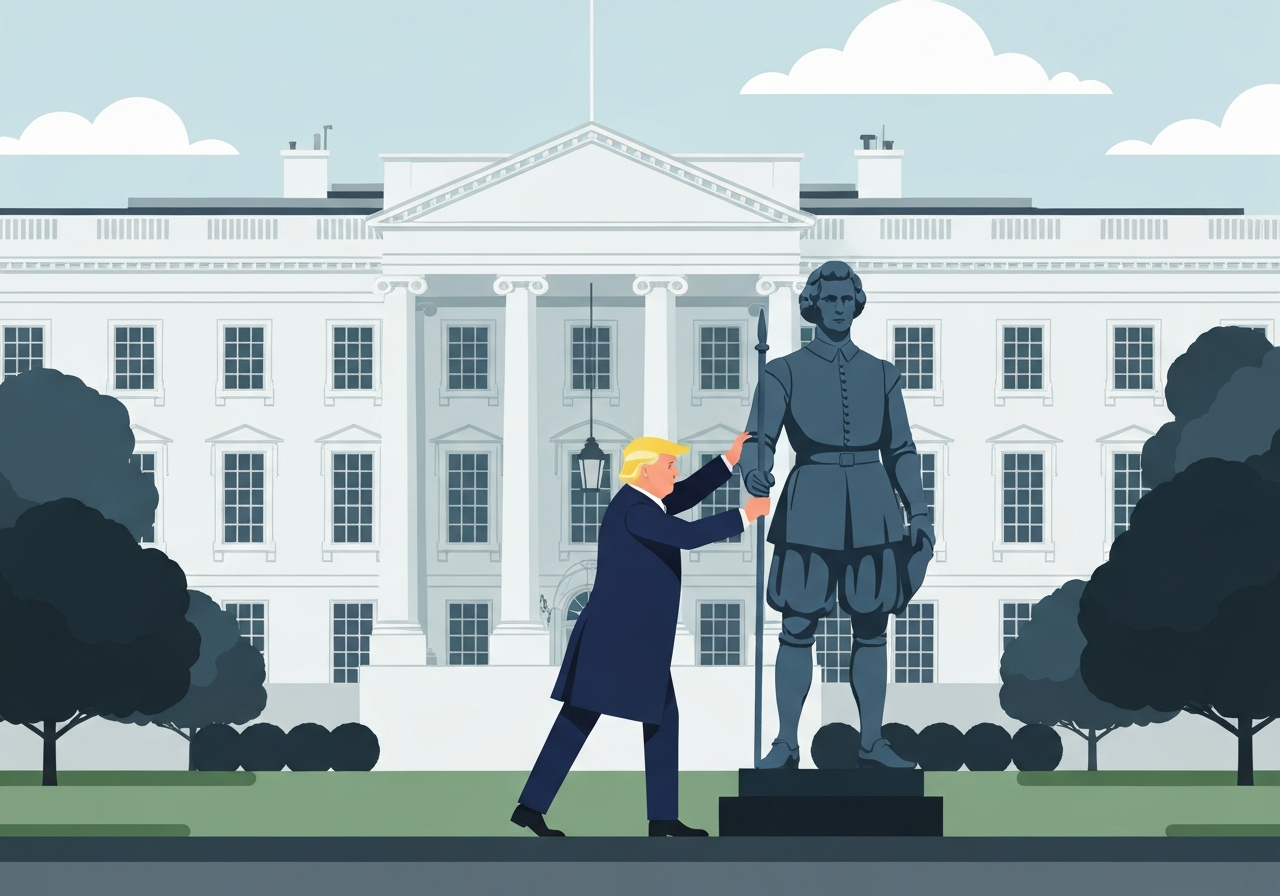
President Donald J. Trump had a 13ft, one‑ton statue of Christopher Columbus placed on the grounds of the White House on Pennsylvania Avenue outside the Eisenhower Executive Office Building on October 13, 2025. The sculpture is a 2022 replica made from fragments of a Baltimore monument that protesters toppled and threw into the city’s inner harbor on July 4, 2020. The statue’s pedestal carries an inscription noting the 2020 destruction, its 2022 reconstruction and its rededication by President Trump on October 13, 2025. The move has reopened debates over public memorials, historical memory and the federal role in commemorating contested figures.
Key Takeaways
- The statue is 13 feet tall and weighs approximately one ton, installed on Pennsylvania Avenue outside the Eisenhower Executive Office Building on October 13, 2025.
- The figure is a 2022 replica reconstructed from shattered pieces retrieved from Baltimore’s inner harbor after the original was torn down on July 4, 2020.
- The pedestal inscription reads: “Destroyed July 4, 2020 … Resurrected 2022 … Rededicated by President Donald J. Trump, October 13, 2025.”
- The Conference of Presidents of Major Italian American Organizations owns the statue and loaned it to the federal government for display.
- The White House posted that Columbus is a “hero” and the president wrote to Basil Russo calling Columbus the “original American hero.”
- Columbus never reached the continental United States, arriving closest in present‑day the Bahamas; his voyages between 1492 and 1504 are linked to slavery and the violent subjugation of Indigenous peoples.
- Several U.S. jurisdictions have moved to replace Columbus Day with Indigenous Peoples Day amid renewed scrutiny of Columbus monuments.
Background
Monuments to Christopher Columbus have long been focal points for competing narratives about American origins. For generations some Italian‑American groups have celebrated Columbus as an emblem of national pride and immigrant achievement, while many Indigenous leaders and activists have criticized commemorations as glorifying colonial violence. The 2020 wave of anti‑racism protests saw a number of statues removed or toppled across the United States; in Baltimore a Columbus monument was pulled down and thrown into the city’s inner harbor on July 4, 2020.
In the years since 2020, communities and local governments have weighed whether to remove, reinterpret or relocate monuments that honor colonial figures. Several municipalities have officially replaced Columbus Day with Indigenous Peoples Day to recognize the harms associated with European colonization. At the federal level, commemorative choices have been less frequent, but a display on White House grounds signals a national‑level endorsement that can shape public memory and policy debates.
Main Event
On October 13, 2025, the Trump administration placed a 13ft, one‑ton statue on federal grounds, citing the reconstruction made in 2022 from fragments of the Baltimore monument. The work was loaned by the Conference of Presidents of Major Italian American Organizations; the president sent a letter to the organization’s leader, Basil Russo, praising Columbus and announcing the rededication. The White House posted on X describing Columbus as a “hero,” and officials framed the installation as honoring a figure they view as foundational to U.S. history.
The statue stands outside the Eisenhower Executive Office Building along Pennsylvania Avenue, a visible location adjacent to the White House complex. Security and placement choices for the display were managed by federal authorities given the site’s high profile. The installation has already drawn reactions across the political spectrum from community leaders, historians and activists, with events and statements expected in the coming days.
Local and national debate centers on whether the display constitutes a permanent federal memorial or a temporary loaned exhibit; officials from the Conference of Presidents have said they loaned the statue to the federal government. The inscription on the pedestal explicitly references both the 2020 destruction and the 2022 reconstruction, language intended by supporters to frame the display as a restoration rather than a new monument.
Analysis & Implications
The placement of a Columbus statue on White House grounds represents a deliberate symbolic choice with political consequences. Memorials on federal property carry an elevated status: they shape national narratives and can influence how history is taught and commemorated. By situating the replica at the executive complex, the administration is advancing an interpretation of Columbus as a founding heroic figure, which will likely harden divisions about public memory of colonial-era violence.
For supporters—especially some Italian‑American organizations—this act affirms a long‑standing cultural symbol and a response to what they view as erasure. For Indigenous groups and many historians, the move risks validating a sanitized account that downplays enslavement, displacement and mortality linked to early European voyages. The debate is not merely symbolic: it can affect funding priorities for cultural institutions, influence local jurisdictional decisions about monuments, and contribute to the national curriculum conversations.
Internationally, the decision could draw attention from governments and diasporic communities that view Columbus differently. It may also reframe diplomatic cultural outreach: commemorative gestures by the U.S. president often ripple abroad and can become points of contention with countries or communities that suffered colonial legacies. Practically, the installation could trigger protests or legal challenges if local actors contend the display contravenes federal or municipal policies governing commemorative exhibits.
Comparison & Data
| Event | Date | Detail |
|---|---|---|
| Original Baltimore monument toppled | July 4, 2020 | Removed by protesters and thrown into Baltimore inner harbor |
| Replica reconstructed | 2022 | Built using recovered fragments from the harbor |
| Rededication at White House grounds | October 13, 2025 | 13ft, one‑ton statue placed outside Eisenhower Executive Office Building |
The compact table above traces the statue’s trajectory from removal to reconstruction and federal display. The sequence—destruction in 2020, rebuilding in 2022 and rededication in 2025—underscores how contested monuments can have iterative public lives. Readers should note that the table records event dates and descriptive details drawn from reporting and the statue’s own inscription; it does not measure public opinion or legal status.
Reactions & Quotes
Supporters framed the installation as a restoration of heritage and decried the 2020 toppling as iconoclasm. Community leaders who back the display emphasized cultural pride and the use of recovered fragments in reconstructing the work.
“He was the original American hero and one of the most gallant and visionary men to ever walk the face of the Earth.”
President Donald J. Trump (letter to Basil Russo)
Opponents, including Indigenous organizations and many historians, highlighted Columbus’s connections to violence and enslavement, arguing that honoring him on federal grounds erases those harms.
“ushered in a wave of devastation: violence perpetrated against native communities, displacement and theft of tribal homelands, the introduction and spread of disease”
Joe Biden, Columbus Day proclamation, 2021
The White House’s social post described Columbus as a “hero,” signaling the administration’s public positioning; that language has already been cited by supporters and criticized by detractors in media coverage and social platforms.
“Columbus is a hero, and President Trump will ensure he is honored as such for generations to come.”
White House post on X (official account)
Unconfirmed
- Whether the statue will remain on federal grounds permanently or be returned to its owners at a later, unspecified date remains unannounced.
- Specific security, maintenance and insurance arrangements for the loaned statue have not been publicly disclosed.
- Comprehensive polling data on national public reaction to this specific installation is not yet available.
Bottom Line
The placement of a Columbus statue on White House grounds is a high‑visibility act that amplifies deep, unresolved disputes over how the United States commemorates its past. For supporters it represents restoration and cultural affirmation; for critics it is a federal endorsement of a figure associated with colonial violence. The decision is likely to sharpen legislative, civic and cultural battles over monuments, school curricula and public ceremonies in the months ahead.
Observers should watch for practical follow‑ups: whether the installation is temporary or permanent, forthcoming federal guidance on loaned displays, and local demonstrations or legal challenges. The episode illustrates how material symbols—statues, plaques and inscriptions—remain potent instruments in shaping national memory and politics.