
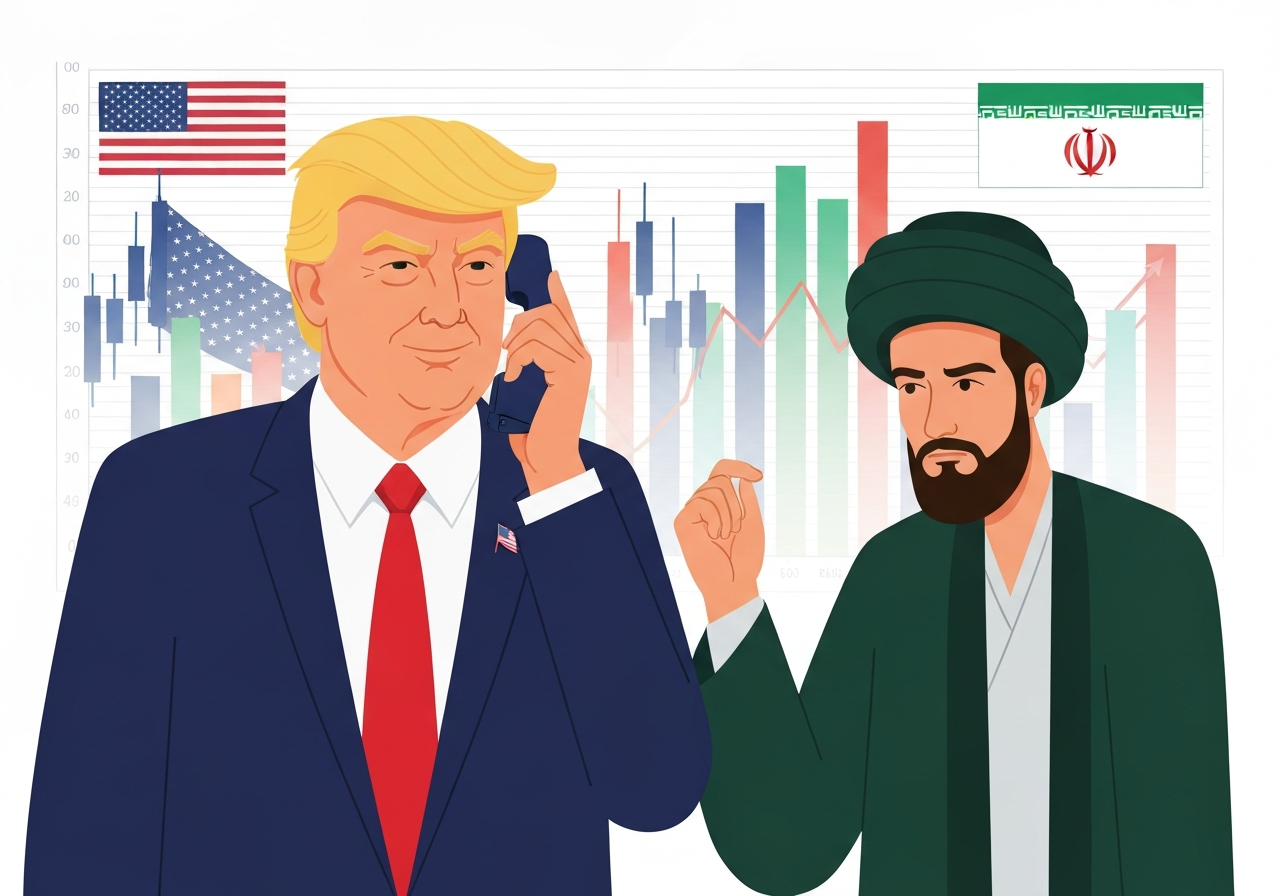
Lead: President Donald Trump on Monday, March 23, 2026, said the United States and Iran were engaged in talks and announced a five-day delay on planned strikes against Iranian power plants — a move that sent oil and equity markets higher but drew swift denials from Iranian officials. The president credited weekend discussions by envoys including Jared Kushner and Steve Witkoff with improving prospects for an agreement, while Tehran called the claim a tactic to calm markets and buy time for military preparations. The announcement came as the Strait of Hormuz, a chokepoint for roughly 20% of global crude, remained effectively closed amid the fourth week of the U.S.-led campaign against Iran. Markets initially cheered the prospect of de-escalation even as analysts and regional actors cautioned that core U.S. objectives in the campaign remain unfulfilled.
Key Takeaways
- Trump said on March 23, 2026, that strikes on Iranian power plants were postponed for five days pending further talks with unnamed Iranian officials.
- The Strait of Hormuz continues to affect global energy flows; roughly 20% of the world’s crude transits the waterway and disruptions have pushed oil and gas prices higher.
- Iran’s parliament speaker Mohammad Bagher Qalibaf publicly denied any negotiations with Washington and accused the U.S. of using “fake news” to manipulate markets.
- The U.S. announced additional force posture moves: three more amphibious assault ships and about 2,500 Marines were redeployed, adding to another 2,500 Marines redirected earlier and more than 50,000 U.S. troops already in the region.
- Nuclear watchdogs and U.S. officials estimate about 970 pounds of highly enriched uranium remain at damaged Iranian sites; Trump said the U.S. would attempt to retrieve that material if a deal were reached.
Background
What began as a limited series of strikes has entered its fourth week, with Washington framing operations against Iran as aimed at degrading missile forces, dismantling defense-industrial capacity, neutralizing naval threats and preventing nuclear breakout — plus ensuring freedom of navigation through the Strait of Hormuz. Earlier confrontations between Israel and Iran and a limited U.S. operation last June left several Iranian nuclear sites damaged; international monitors continue to estimate hundreds of pounds of enriched material remain at those locations.
The conflict has steadily taken on an economic dimension: disruption to tanker traffic through the Hormuz chokepoint has pushed energy prices higher and raised fears of supply shortages, drawing intense scrutiny from import-dependent Asian economies. Domestically, the campaign has become politically polarizing, with Democrats criticizing the administration’s strategy as needlessly destabilizing and some Republicans urging a harder line. Regional Gulf states face growing energy-security concerns even as global markets seek clarity on the conflict’s trajectory.
Main Event
In an early-morning social media post timed before U.S. markets opened, Trump said he would withhold planned attacks on Iran’s power infrastructure for five days, citing “very good” weekend talks conducted by envoys including Jared Kushner and real estate executive Steve Witkoff with unnamed, respected Iranian interlocutors. The president framed the pause as a window for diplomacy while reserving the right to act again if talks failed.
Iran responded within hours. Mohammad Bagher Qalibaf, speaker of Iran’s parliament, denied that negotiations had occurred and accused the U.S. of disseminating false information to manipulate oil and financial markets. Iran’s foreign ministry echoed that message, saying the U.S. statement was intended to depress energy prices and allow Washington time to carry out military plans.
The back-and-forth intensified market volatility: Asian markets experienced a sharp selloff earlier as Trump’s initial ultimatum approached, then rallied on his later statement. Energy traders reacted quickly to the promise of a potential de-escalation; Trump explicitly tied the outlook for oil prices to progress on talks, predicting a rapid drop if a deal materialized.
Alongside diplomacy, the U.S. continued to reinforce its military presence. The administration ordered additional amphibious ships and thousands of Marines to the region; officials also said they were weighing operations to ensure safe passage through the Strait of Hormuz. Trump insisted he had no plans for a ground invasion of Iran but repeatedly emphasized that “all options” remained on the table.
Analysis & Implications
The president’s announcement produced a classic political-military signal intended to shape markets and public perceptions: offering a carrot of diplomacy while keeping the stick of force visible. Analysts caution that such messaging can calm markets in the near term yet also risk appearing opportunistic if underlying strategic objectives remain unmet. Several of the administration’s stated aims — notably ending Iran’s ability to pursue a nuclear weapon — are not plausibly resolved within days or weeks, given the technical and intelligence challenges involved.
Militarily, a five-day pause could provide time for additional forces to arrive and for planners to refine options, an outcome some U.S. commentators flagged as consistent with a strategy of buying space to posture rather than to de-escalate permanently. For Tehran, denying talks serves both domestic signaling and regional deterrence: Iranian leaders benefit politically by portraying themselves as resisting coercion and by keeping adversaries uncertain about their red lines.
Economically, even temporary talk of talks matters. Oil markets are highly sensitive to supply risk; any credible window that would reopen the Hormuz corridor should lower risk premiums and relieve some near-term price pressure. But if the pause proves tactical — a bid to delay strikes until reinforcements arrive — price relief could reverse quickly and markets would likely price in renewed instability and insurance costs for shipping.
Comparison & Data
| Item | Figure | Context |
|---|---|---|
| Strait of Hormuz share of crude | ~20% | Percentage of global crude transiting the chokepoint |
| U.S. troop presence in region | >50,000 | Existing forces before recent redeployments |
| Additional Marines ordered | ~5,000 | 2,500 redirected earlier + ~2,500 newly redeployed |
| Estimated HEU remaining | ~970 pounds | Located at three nuclear sites damaged last June |
The table summarizes figures cited by U.S. and international sources. The troop and ship movements indicate a substantial conventional build-up; energy-flow statistics underline why global commodity markets respond quickly to geopolitical signals in the Gulf.
Reactions & Quotes
Official and expert responses were swift and polarized. The Iranian parliament speaker and the foreign ministry both dismissed U.S. claims of high-level contact.
No negotiations have been held with the US; fake news is used to manipulate the financial and oil markets.
Mohammad Bagher Qalibaf, Speaker of Iran’s Parliament (posted on X)
Trump framed the pause as a genuine opening while avoiding any firm promises.
All I’m saying is we are in the throes of a real possibility of making a deal… I’m not guaranteeing anything.
President Donald Trump, remarks before departing Palm Beach (March 23, 2026)
Security analysts noted the dual effect of calming markets while buying time for reinforcements to arrive.
It’s hard to ignore the logic inherent in the president’s own commentary, which both calms markets but also buys time for Marines to arrive.
Behnam Ben Taleblu, Foundation for Defense of Democracies (think tank)
Unconfirmed
- Whether direct, high-level negotiations between U.S. officials and Iranian representatives actually took place remains unverified beyond the president’s statement and Tehran’s denials.
- The operational plan, feasibility and legal framework for the U.S. to “take” enriched uranium from Iranian sites have not been disclosed and lack public confirmation.
- Specific Iranian target sets that would be struck in response to U.S. actions — beyond broad references to energy and desalination infrastructure — have not been independently verified.
Bottom Line
The president’s announcement created a momentary loosening of market pressure by signaling a possible diplomatic opening, but it did not resolve core strategic questions: U.S. objectives such as eliminating Iran’s nuclear capability and restoring long-term Gulf security remain unresolved. Tehran’s immediate denials and the ongoing military reinforcements suggest both sides are preserving coercive options even as they test diplomatic space.
For markets and policymakers the immediate calculus is clear: watch for verifiable, third-party evidence of talks and any concrete steps to reopen the Strait of Hormuz. If the pause is genuine and leads to verified de-escalation, energy-price risk should fall; if it is tactical cover for further force posturing, volatility and premiums on shipping and insurance are likely to return.
Sources
- The Associated Press (news report summarizing statements and regional developments)
- Carnegie Endowment for International Peace (think tank commentary and expert analysis)
- Foundation for Defense of Democracies (policy institute commentary)