
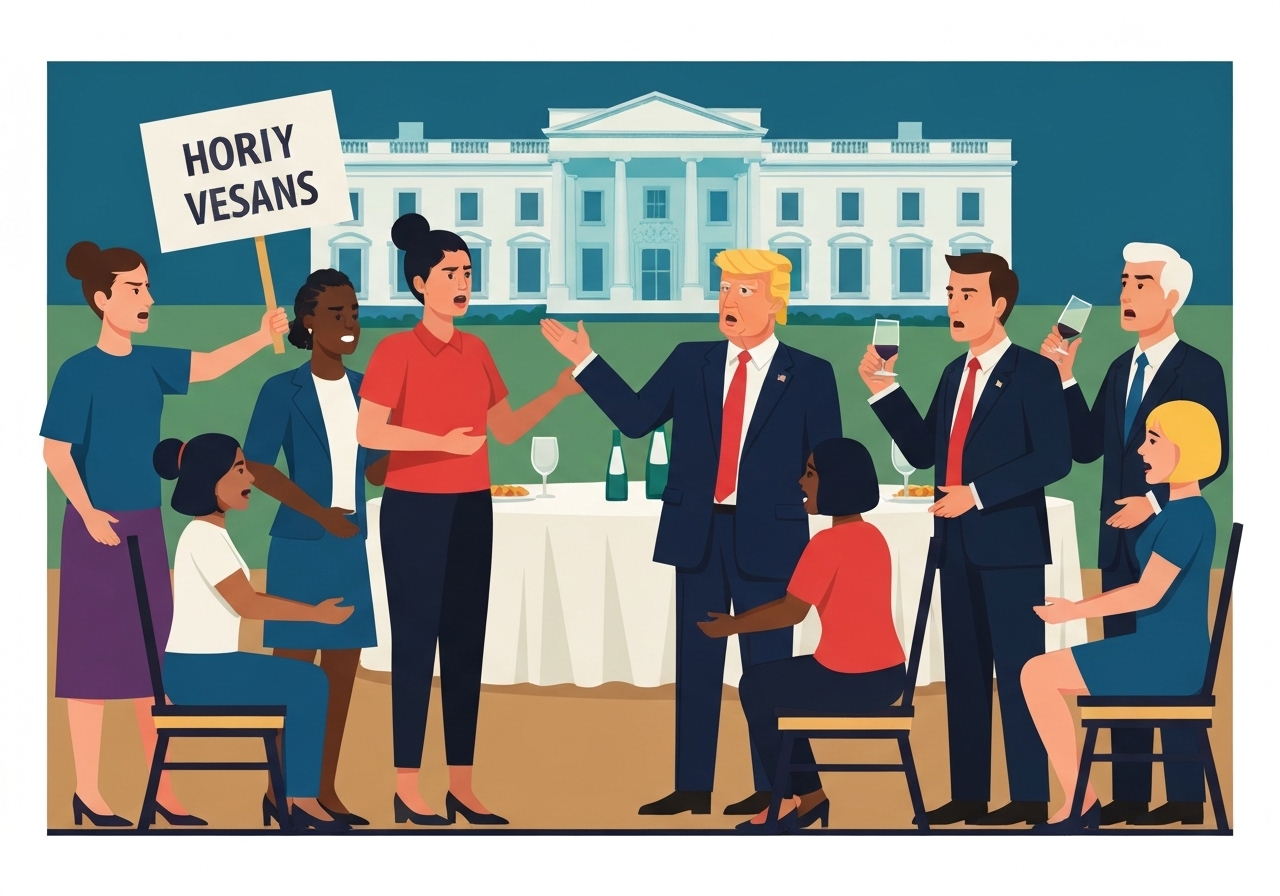
— President Donald Trump left the White House grounds for a short walk—about one-tenth of a mile—to dine at Joe’s Seafood, Prime Steak & Stone Crab in downtown Washington, D.C., and was met by protesters as he entered. Demonstrators shouted slogans including “Free D.C.” and “Free Palestine” and some called Mr. Trump “the Hitler of our time,” with videos of the confrontation spreading quickly on social media. The outing was intended by the White House to highlight a federal crackdown on crime in the capital; the president and aides framed the visit as evidence the city has become safer. The dinner included senior officials and a White House statement praising the meal, while questions remain about the enforcement tactics and the nature of recent arrests in D.C.
Key Takeaways
- On , Mr. Trump walked roughly 0.1 mile from the White House to Joe’s Seafood in Washington and was publicly confronted by protesters inside the restaurant.
- Protesters’ chants captured on social video included “Free D.C.,” “Free Palestine,” and “Trump is the Hitler of our time,” prompting wide circulation online within hours.
- The president was accompanied by Vice President J.D. Vance, Secretary of State Marco Rubio, Secretary of Defense Pete Hegseth and other aides; the White House press secretary called the food and service “phenomenal.”
- This was Mr. Trump’s first meal at a D.C. restaurant since his return to the White House in January; the nearby Trump International Hotel closed in 2022.
- The White House has deployed the National Guard to Washington (in August 2025) and has publicized increased arrest figures after declaring a crime emergency.
- Officials acknowledge many recent arrests were for minor offenses, and the U.S. Attorney’s Office in D.C. has downgraded or dismissed several cases after grand juries declined indictments.
- Mr. Trump’s brief outing follows a pattern of selective public appearances this week, including attending the U.S. Open men’s final on Sunday and announcing plans to attend a Yankees game on .
Background
Since returning to the White House in January, Mr. Trump has limited his public movements, often preferring private clubs in Florida, Virginia and New Jersey. During his first term he was a frequent visitor to the Trump International Hotel, a presence near the executive mansion until that property closed in 2022. This relative withdrawal from public spaces has made any unguarded appearance more notable, and the administration has used select outings to project policy successes.
The White House has emphasized a federal approach to crime in Washington, deploying the National Guard in August 2025 and declaring a local crime emergency. Officials have pointed to arrests as evidence of progress, but legal authorities in D.C. have had to adjust or drop cases after grand juries declined to return indictments. The tension between federal enforcement measures and local criminal-justice processes has become a recurring point of debate among city residents and legal observers.
Main Event
On the evening of , Mr. Trump and a small entourage walked from the White House to Joe’s Seafood, Prime Steak & Stone Crab to dine. As he moved through the restaurant, several patrons and protesters confronted him, with audible heckling that was captured on multiple phones and later posted online. Videos show chanting that included calls for Palestinian freedom and direct insults toward the president.
Before entering the restaurant, Mr. Trump told reporters outside that the trip symbolized the results of his crime policy, saying the city was now “as safe as anywhere in the country.” The White House framed the visit as a demonstration that the federal crackdown had reduced danger in the capital. Karoline Leavitt, the White House press secretary, later described the meal as excellent and noted the president’s companions and menu selections.
Officials at the scene emphasized the short distance from the executive mansion and the controlled nature of the outing, while the presence of senior Cabinet-level officials underscored the political weight of the event. Protesters’ chants and the quick spread of video clips turned the dinner into a broader story about public reactions to the president’s policies and visibility. Local law enforcement monitored the scene, and no major unrest was reported during the dining period.
Analysis & Implications
The optics of a president met by loud protests inside a downtown restaurant are politically significant. For an administration that has highlighted law-and-order messaging, the footage of confrontation complicates claims of broad public approval in the city’s center. Even if crime indicators have shifted, visible dissent in a contained setting can counter the intended narrative of restored normalcy.
Legally and administratively, the wave of recent arrests and subsequent downgrades or dismissals raises questions about prosecutorial strategy and the calibration between arrests and indictments. Federal and local authorities must reconcile aggressive enforcement with the evidentiary standards required for grand jury referrals. Repeated case adjustments could undermine public confidence in the administration’s crime effort or fuel criticism of politically driven policing.
Internationally and domestically, the protesters’ chants—linking local policing to broader issues like Palestine—illustrate how local events can intersect with global grievances. The president’s appearance at high-profile sporting events earlier in the week and plans for another on suggest a deliberate strategy of selective public engagement. How often the president steps into public spaces, and the reactions he provokes there, will continue to shape both news cycles and political narratives.
Comparison & Data
| Date | Event | Notes |
|---|---|---|
| Trump International Hotel closed | Removed a frequent White House–adjacent venue. | |
| Return to White House | First residence return; limited D.C. restaurant outings since then. | |
| National Guard deployed to D.C. | Part of a federally led crime initiative announced by the White House. | |
| Attended U.S. Open final | Public outing in New York with mixed public reaction. | |
| Dined at Joe’s Seafood; met protesters | Short trip (~0.1 mile) from White House; videos shared widely online. |
The table summarizes key dates and context cited in this report. It does not attempt to measure crime trends numerically because recent arrest totals and prosecutorial outcomes have varied in severity and legal disposition. Observers should treat enforcement tallies and case outcomes as separate metrics from broad safety indicators.
Reactions & Quotes
White House spokespeople presented the dinner as a controlled, successful demonstration of improved safety in the city, framing the appearance as a public affirmation of policy. They emphasized the president’s statement about safety and praised the meal and service at the restaurant. The administration’s instant messaging sought to pair optics with policy claims to reinforce a law-and-order narrative.
“We’re standing right in the middle of D.C. … Now it’s as safe as anywhere in the country.”
President Donald Trump
That quote captures the administration’s intended message, but independent observers and local officials note the distinction between arrests and sustained legal outcomes. Critics say anecdotal appearances do not substitute for systematic evidence of lasting public-safety improvement. The president’s claim will be evaluated against crime statistics and court data in the weeks and months ahead.
White House communications staff later commented on the domestic scene and the menu at Joe’s Seafood, emphasizing hospitality and the presence of senior officials. The brief public statements aimed to normalize the outing and shift immediate attention from the protest to routine presidential business. The tone and timing of the remarks were calculated to close the story quickly.
“The food was phenomenal and the service was fantastic.”
Karoline Leavitt, White House Press Secretary
That description was intended to humanize the visit and dilute the visual impact of the protest footage. Still, the juxtaposition of convivial dining and vocal dissent underscores the polarized environment in which the administration is operating. Media coverage has therefore focused on both the symbolic and substantive dimensions of the event.
Protesters at the scene and online framed the encounter as a broader expression of dissent over domestic and foreign-policy issues, using succinct, charged language to convey anger. Social-media clips amplified those messages well beyond the restaurant’s walls. The rapid spread of video gave the demonstrators a larger platform and forced a national conversation about the president’s public engagements.
“Free D.C. … Free Palestine. Trump is the Hitler of our time.”
Unidentified protesters (video)
The protesters’ chants linked local grievances to international concerns and drew immediate media attention. Whether the protesters represented organized groups or spontaneous patrons, their words became central to how the visit was reported. Authorities and political actors alike will gauge the incident’s resonance going forward.
Unconfirmed
- Whether the administration’s recent enforcement actions have produced a net, sustained reduction in violent crime across all D.C. neighborhoods remains unconfirmed pending longitudinal crime data.
- The exact proportion of recent arrests that were for minor offenses versus serious crimes is not fully documented in public statements and requires detailed case-by-case review.
- It is not confirmed whether the protesters at Joe’s Seafood were organized by an outside group or assembled spontaneously; available video and social posts do not establish formal coordination.
Bottom Line
The president’s brief, highly visible dinner inside the district crystallized competing narratives about public safety, federal authority and civic protest. For the White House, the outing was designed as a tangible demonstration that its crime policies are producing results; for critics and the demonstrators themselves, the encounter highlighted persistent opposition and the limits of spectacle-driven messaging. Media attention centered on the symbolism rather than any immediate policy breakthrough.
Going forward, the administration’s claims about safety will be tested against prosecutorial outcomes, court records and comprehensive crime statistics. Observers should watch for changes in indictment rates, case dispositions and sustained trends in violent and property crime in D.C. The frequency and reception of the president’s public appearances will also remain a barometer of political risk and public sentiment.
Sources
- The New York Times (News report)
- White House Briefing Room (Official statements and press releases)
- U.S. Attorney’s Office for the District of Columbia (Federal prosecutorial office)