
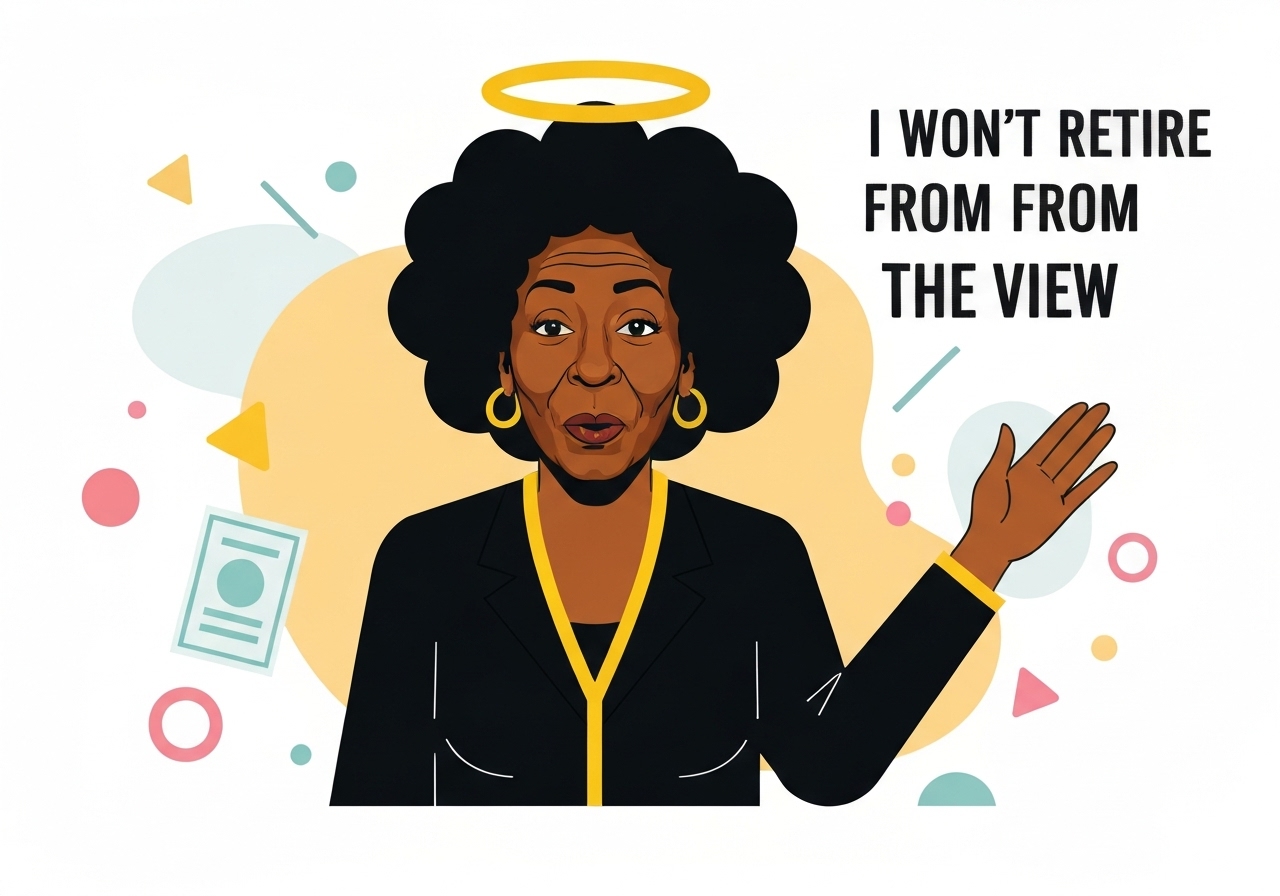
Lead: Whoopi Goldberg told Entertainment Tonight she has no plans to leave her post on The View, saying she “can’t afford” retirement after 18 seasons on the panel. The remark, delivered during an interview published Tuesday, tied her decision to continue working to personal finances rather than creative fatigue. Fellow co-host Joy Behar, who joined the program in 1997, echoed a similar impulse to keep producing and creating despite her age. The View returned for Season 29 on Monday with its full panel, underscoring the show’s continued commercial momentum.
Key Takeaways
- Whoopi Goldberg said she “can’t afford” to retire after 18 seasons on The View, citing bills as a reason to stay.
- Goldberg has been married three times and has publicly discussed preferring single life; she quipped that if one “doesn’t marry well, you got to keep working.”
- Joy Behar, 83, who joined The View in 1997, said creative people do not retire and expressed a desire to keep creating.
- The View returned for Season 29 on Monday with co-hosts including Goldberg, Behar, Sunny Hostin, Alyssa Farah Griffin, Sara Haines and Ana Navarro.
- The series has been the most-watched daytime talk show for five consecutive seasons, a key factor in its commercial viability.
- On its first post-summer segment, the panel spent about 15 minutes criticizing Robert F. Kennedy Jr.’s congressional hearing on his vaccine stance.
Background
The View debuted in 1997 as a daytime panel show blending politics, culture and personal conversation, and it has evolved into one of television’s most durable talk formats. Hosts rotate, but the mix of long-standing personalities and newer voices has helped sustain audience interest across decades. Whoopi Goldberg joined the program in 2007 and has been a visible fixture ever since, participating across roughly 18 seasons of the show. Daytime television contracts, syndication deals and residuals create a complex income picture for hosts, meaning public perceptions of celebrity wealth do not always reflect current cash flow or obligations.
Joy Behar, an original panelist, has been associated with The View since its inception and remains a prominent conservative-liberal sparring partner in discussions. The show’s commercial performance—especially its streak as the top-ranked daytime talker—has made it a valuable platform for talent and advertisers alike. At the same time, public conversations about retirement among entertainers often blend personal choice, creative drive and financial realities. Panelists’ on-air remarks about money and work therefore sit at the intersection of private finances and public careers.
Main Event
In an interview published Tuesday by Entertainment Tonight, Goldberg was asked about stepping away from The View after many seasons. She replied bluntly that retirement is not on her horizon because she cannot afford to stop working, adding a quip about marriage: “If you don’t marry well, you got to keep working.” The comment referenced her marital history—she has been married three times—and reflected both humor and a candid acknowledgment of financial pressure.
The exchange continued with Goldberg dismissing the notion that she could comfortably walk away now, saying “No, not by now. Not yet” and later, “I gotta keep paying those bills baby.” The tone combined defiance and practicality, and it stood in contrast to celebrity retirement narratives that focus solely on leisure. The clip drew attention because it linked a personal, practical rationale to a high-profile career decision in a way that was immediately relatable to many viewers.
Also speaking to Entertainment Tonight, Joy Behar framed work as an intrinsic creative compulsion rather than purely a financial necessity. Behar, 83, said creative people “don’t retire, they don’t resign, they just keep going,” signaling that the panelists view the show as both a workplace and a creative forum. The View resumed Season 29 with the six co-hosts returning, and the program quickly engaged with contentious public affairs—most notably a 15-minute critique of Robert F. Kennedy Jr.’s congressional hearing on vaccine policy.
Analysis & Implications
Goldberg’s comment highlights how retirement decisions for high-profile media figures are rarely simple status signals; they often reflect contractual obligations, ongoing income needs and the costs of maintaining a public lifestyle. Even celebrities whose names evoke wealth can face liquidity constraints, tax obligations, legal expenses or long-term financial plans that make continued employment sensible. In the media ecosystem, a star’s choice to remain active also affects production budgets, advertiser confidence and audience expectations—networks factor these dynamics into renewal and compensation discussions.
The presence of older hosts like Behar and Goldberg on a top-rated daytime show raises questions about representation, longevity and audience loyalty. Their continued visibility challenges norms about age and productivity in broadcast media, while also underscoring the commercial value of established personalities who bring reliable viewership. For the network and producers, maintaining a mix of institutional memory and fresh perspectives is part of a ratings strategy that has kept The View at the top for five straight seasons.
Politically charged segments—such as the panel’s 15-minute critique of Robert F. Kennedy Jr.’s hearing—demonstrate the program’s role in framing public debate, but they also expose the show to polarized responses. That dual function (entertainment plus civic commentary) sustains audience engagement but can complicate advertiser relations and public perception. Looking ahead, contract negotiations, potential spin-offs and the financial calculus of long-term host retention will be central to how daytime staples like The View evolve.
| Season | Status/Notes |
|---|---|
| Season 25–29 | Ranked the most-watched daytime talk show for five consecutive seasons |
| Season 29 (current) | Show returned Monday with the six co-hosts; continues to mix politics and culture |
The table above places the current season in context: the show’s recent run of ratings success helps explain why hosts remain on air and why networks invest in continuity. That commercial stability can increase bargaining power for talent but does not automatically eliminate personal financial considerations for individual hosts.
Reactions & Quotes
Before the quoted remarks, reporters framed the question around whether longtime hosts could step away; the replies that followed mixed humor and realism. The on-air exchange was brief but widely shared on social platforms, prompting commentary about money, marriage and aging in show business.
“If you don’t marry well, you got to keep working.”
Whoopi Goldberg, in interview with Entertainment Tonight
This line was offered as a wry explanation for Goldberg’s continued presence on The View. It referenced personal history without disclosing specifics of her finances and was delivered in a candid, conversational tone that resonated with many viewers.
“Creative people don’t retire, they don’t resign, they just keep going.”
Joy Behar, in interview with Entertainment Tonight
Behar’s comment framed ongoing work as an artistic imperative rather than a purely economic choice, underlining a different but complementary reason both hosts remain active. Together, the remarks emphasize how personal motive and professional identity overlap for longtime media figures.
Unconfirmed
- Precise details of Whoopi Goldberg’s personal finances and net worth were not disclosed in the interview and remain unverified.
- Specific contract terms, salaries or payout schedules for Goldberg or other hosts were not provided publicly and are therefore unconfirmed.
- Any suggestion that a single marriage would have fully financed retirement for Goldberg is speculative and not established by available facts.
Bottom Line
Whoopi Goldberg’s offhand remark about not having “married well” crystallizes a larger reality: retirement choices among public figures mix financial calculus with personal and creative motives. Her decision to remain on The View is grounded in a candid assessment of obligations and the ongoing value she places on work, while Joy Behar’s comments highlight the role of creative drive regardless of age.
For viewers and industry watchers, the episode is a reminder that visibility and success do not always equate to the freedom to exit. The View’s consistent ratings, the panel’s willingness to tackle contentious topics and the hosts’ public candor all suggest the show will remain a significant platform—and that conversations about careers, money and retirement among public figures will continue to attract attention.
Sources
- TheWrap (entertainment news) — original report summarizing Goldberg’s comments and the show’s return.
- Entertainment Tonight (entertainment news) — interview and published video clip referenced in reporting.
- ABC — The View (official network page) — program information and season details.