
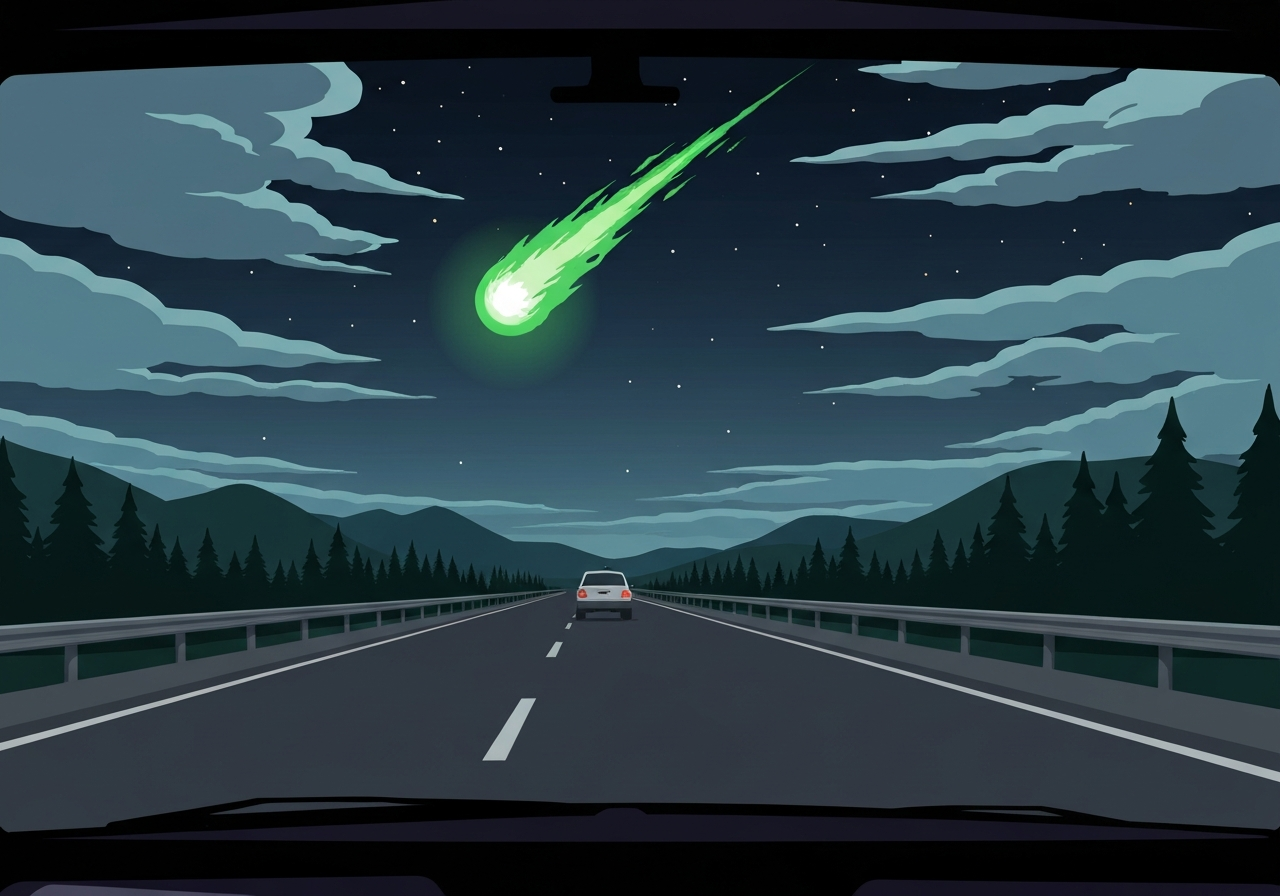
In the pre-dawn hours a bright green fireball raced across the Pacific Northwest sky and was recorded on a dashboard camera at . The recording came from southwestern Washington, roughly 20 miles (32 km) north of Portland, Oregon, and was reported by a commuter who initially mistook the flash for a lightning strike. Local museum officials identified the object as a fireball — an unusually luminous meteor — and noted its color likely reflects metal content. With multiple eyewitness reports and video, investigators may be able to trace its path, though recovery of any meteorite remains uncertain.
Key Takeaways
- The dashcam captured the event at 6:06 a.m. Monday about 20 miles (32 km) north of Portland, Oregon.
- Oregon Museum of Science and Industry (OMSI) says fireballs can be visible up to 80 miles (129 km) above Earth.
- Green coloration is often linked to magnesium and sometimes nickel in meteoroids when vaporized.
- Recent U.S. fireball events include a 7-ton meteor over Ohio last week and a meteor that broke up north of Houston traveling ~35,000 mph (56,327 km/h).
- Dashcams and doorbell cameras have increased the number of documented sightings and the chance to reconstruct trajectories.
- Recovery of surviving fragments is uncommon and typically difficult unless debris strikes a structure or road.
Background
Fireballs are the brightest class of meteors and occur when a relatively large piece of extraterrestrial rock or metal enters the atmosphere and heats to incandescence. Museums and space-education centers, like the Oregon Museum of Science and Industry in Portland, track these phenomena and offer guidance on causes, altitudes, and reporting. Over recent months the United States has seen several high-profile fireballs: one in Ohio described as a roughly 7-ton object and another that broke apart north of Houston at very high speed, producing audible booms. Growing documentation stems from the ubiquity of cameras in cars, homes and on streets, which provides more observational data than in past decades.
Scientific teams use coordinated eyewitness reports, video timestamps and sonic recordings to triangulate trajectories and estimate mass, speed and potential fall zones. Even with multiple recordings, determining whether fragments reached the ground often requires targeted searches and luck; surviving meteorites can resemble ordinary rocks and are hard to locate unless they leave clear impact evidence. Agencies such as NASA and regional museums often collaborate with amateur observers to catalogue sightings and prioritize recovery efforts when warranted.
Main Event
The dashcam owner, driving to work before sunrise, recorded a vivid green streak that crossed the sky and faded within seconds. He reported the sighting from southwestern Washington, approximately 20 miles (32 km) north of Portland, Oregon. Observers described the flash as exceptionally bright — bright enough to be compared to lightning — and unusually green in hue. Museum staff classified the sighting as a fireball, a meteor luminous enough to be visible at great altitudes and over considerable distances.
Experts say the green tint likely arises from vaporized metals: magnesium emits blue-green light when heated, and nickel can also add green tones. The early-morning darkness increased the apparent brightness and made the event visible across a wider area than a daytime passage would have been. With video and multiple reports, analysts can attempt to reconstruct the path and estimate whether any fragments survived atmospheric breakup.
Most fireballs do not deposit recoverable meteorites, and when fragments do survive, they frequently land in unpopulated terrain or resemble common rocks. Investigators will compare timestamps and sightlines from other recordings to narrow a fall corridor; if debris struck a structure or left a crater, recovery becomes far more likely. For now, observers and officials are collecting reports and footage to determine next steps.
Analysis & Implications
Scientifically, each recorded fireball is valuable: trajectory data help researchers model the pre-entry orbit of the object, estimate its original mass, and infer composition from emission spectra when available. The green color gives a preliminary clue about metallurgical content, notably magnesium and nickel, which informs classification and potential origin within the solar system. Even small, short-lived events contribute to statistical models of near-Earth object flux and fragmentation behavior in the atmosphere.
From a public-safety perspective, most fireballs pose little risk; they usually disintegrate at high altitude and leave no ground hazard. However, louder airbursts and larger surviving fragments can produce shock waves or property damage, as seen in past regional events. The recent spate of widely observed fireballs highlights both the scientific opportunity and the occasional need for emergency coordination when fragments are suspected on the ground.
For the community and amateur scientists, the proliferation of dashcams and doorbell cameras increases the chance of triangulating fireball paths and locating meteorites. This democratization of observation supports professional follow-up and can accelerate recovery attempts. Policy and funding for coordinated networks and rapid-response search teams could enhance recovery rates and scientific return from these events.
Comparison & Data
| Date | Location | Approx. mass/size | Speed | Notable effect |
|---|---|---|---|---|
| Recent Monday | SW Washington / N of Portland, OR | Undetermined | Undetermined | Bright green dashcam sighting |
| Last week | Ohio | ~7 tons | Not specified | Visible across several states; loud breakup |
| Saturday | North of Houston, TX | Undetermined | ~35,000 mph (56,327 km/h) | Disintegrated; booms reported; possible roof strike reported |
The table summarizes key recent U.S. fireball events referenced by officials and media. While some entries include mass or speed estimates, many observations lack precise pre-entry metrics until analysts combine multiple data sources. These comparisons show a range of sizes and effects — from spectacular but harmless sky flashes to breakups that produce audible shock waves and occasional property impacts.
Reactions & Quotes
Commuters and local observers shared surprise and awe at the early-morning spectacle, while museum educators emphasized its scientific value and rarity.
“It was so bright it looked almost like lightning,”
Jason Jenkins, dashcam owner
“A tiny piece of rock put on such a show — bright, green and spectacular,”
Jim Todd, OMSI director of space science education
“The disintegration produced booms heard by residents in the Houston area,”
NASA (statement on recent meteor event)
Unconfirmed
- No confirmed estimate yet of the Oregon-area fireball’s mass or pre-entry speed.
- There is no verified recovery of meteorite fragments from this sighting at the time of reporting.
- Trajectory solutions based on preliminary reports have not been published; a clear fall corridor is unconfirmed.
Bottom Line
The dashcam-recorded green fireball over the Pacific Northwest was a visually striking but not necessarily hazardous atmospheric event; its color offers a useful compositional clue while video evidence improves the chance of a trajectory reconstruction. Similar recent fireballs — including the 7-ton Ohio object and the high-speed Houston breakup — show a spectrum of outcomes, from harmless aerial displays to ground-impact incidents that require local response.
For investigators, the priority is assembling additional footage and eyewitness reports to model the object’s path and assess any chance of recoverable fragments. For the public, the episode underlines the scientific value of civilian recordings and the relative rarity of meteorites that actually reach and damage the ground.
Sources
- ABC News — national news report summarizing the dashcam sighting and related events (media).
- Oregon Museum of Science and Industry (OMSI) — museum/space-education commentary on fireball altitude and coloration (museum/education).
- NASA — official agency statements on recent meteor breakups and observed sonic booms (official agency).
- ABC13 Houston — local TV coverage referenced for the Houston-area breakup and reported roof impact (local media).