
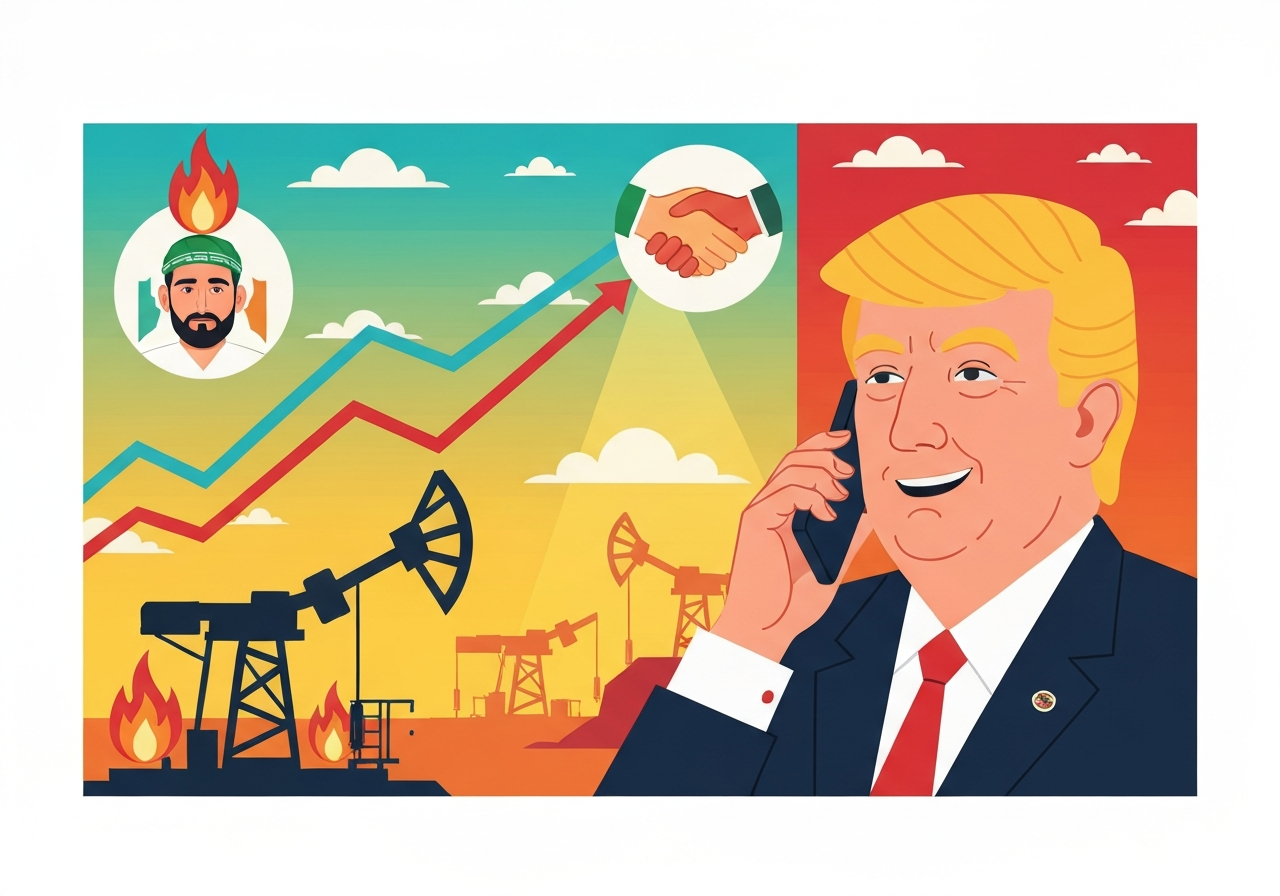
US President Donald Trump said on Tuesday that talks to end the war with Iran are underway, comments that coincided with a sharp drop in oil prices during Asian trading and were disputed by Iranian officials. Brent crude fell 6.6% to $97.56 a barrel and US-traded crude slid more than 5.5% to $87.20. The statements came amid continuing exchanges of strikes between Israel and Iran, and while some market participants took the remarks as a sign the conflict could ease, Tehran denied direct contact with Washington. Asian stock markets broadly rose as investors reacted to the prospect of reduced supply disruption risk.
Key Takeaways
- Brent crude declined 6.6% to $97.56 per barrel in Asian morning trade, reflecting renewed hopes for de-escalation.
- US-traded crude dropped more than 5.5% to $87.20 a barrel after President Trump said negotiations were “happening now.”
- Iranian officials publicly dismissed reports of direct talks with the US, calling such claims false or unverified.
- Major Asia-Pacific indices advanced: Japan’s Nikkei 225 and South Korea’s Kospi rose by over 2%, Australia’s ASX 200 gained about 1.8%, and Hong Kong and Shanghai benchmarks climbed ~1%.
- The Strait of Hormuz remains a central risk: about 20% of global oil and LNG typically transit the waterway, and disruptions have driven earlier price spikes.
- Industry warnings persist: Shell CEO Wael Sawan cautioned that Europe could face shortages next month and that prolonged disruption could keep crude above $100–$150 for years.
- Market strategists say price declines will only persist if claims of negotiations are followed by verifiable steps such as safe maritime passage from the Gulf.
Background
The current price volatility follows a series of military strikes between Israel and Iran that intensified after the US and Israel launched attacks on Iran on 28 February. Those actions prompted concerns about extended supply disruptions because Iran has effectively exercised control over parts of the Strait of Hormuz, a chokepoint through which roughly one-fifth of the world’s seaborne oil and liquefied natural gas passes. Energy markets reacted quickly: Brent briefly rose above $100 per barrel before the latest slide, reflecting heightened fears of sustained shortages.
Governments and firms have been taking precautionary measures as the conflict evolved, with some states announcing policies to ease domestic fuel pressures and multinational companies warning of downstream economic effects. Global energy traders, refiners and import-dependent economies in Asia and Europe have watched Iran’s posture closely because prolonged denial of Gulf flows would drive up costs and strain supply chains. Previous episodes of Gulf tension have shown that even the prospect of disruption can move markets sharply, often before concrete changes in physical flows occur.
Main Event
On Tuesday President Trump publicly stated that talks aimed at ending the war were taking place “now” and suggested US interlocutors were negotiating terms. He named Vice President J.D. Vance and Secretary of State Marco Rubio as being involved in the discussions, comments that markets interpreted as a signal of possible de-escalation. Trading desks in Asia responded within hours: Brent and US crude both posted multi-percent declines as investors priced in a lower risk of prolonged supply disruption.
Tehran, however, rejected the characterization of direct US–Iran negotiations. Iranian officials called reports of talks false or attempts to influence markets, underscoring a persistent gap between competing accounts. Meanwhile, the Israel Defense Forces said it had launched a “new wave of strikes” targeting Iranian infrastructure and warned of further operations; Israeli authorities also urged residents in parts of Beirut to evacuate amid strikes on Hezbollah positions, illustrating how the conflict is spilling across borders.
Media reports from Israeli outlets described a proposed US demand that the Strait of Hormuz be opened and recognized as a free maritime zone, and outlined incentives Tehran might receive — including sanctions relief — if it accepted a plan. The BBC has not independently seen the specific document referenced by those reports and is seeking verification. In markets, the immediate effect of the president’s remarks was to reduce the price premium investors had been assigning to worst-case supply scenarios.
Analysis & Implications
The sharp intraday drop in oil suggests traders now view the probability of a prolonged, severe supply shock as reduced compared with recent days. That recalibration hinges on whether verbal assurances translate into tangible changes, such as verified reopening of shipping lanes or a formal agreement limiting attacks on commercial traffic. Market commentators emphasize that prices can reverse quickly if strikes resume or if evidence emerges that passage through the Strait of Hormuz remains unsafe.
For energy-importing economies in East Asia, even a temporary easing of risk can relieve near-term inflationary pressure and support equity markets, as seen in the gains in the Nikkei and Kospi. However, structural vulnerability remains: many regional refining and shipping routes cannot be rerouted easily, and insurers may still charge elevated premiums if threats persist. Corporates reliant on steady fuel supplies — from airlines to manufacturers — face planning uncertainty until a verified, sustained reduction in hostilities occurs.
Longer-term, industry warnings highlight the asymmetric risk profile: a settled peace would likely normalize prices, but a failure to resolve the conflict could keep crude substantially above pre-war levels for an extended period, with broad economic implications. Shell’s chief executive warned of possible shortages and argued crude could remain above $100, or even approach $150, which would increase recession risks in importing economies and accelerate policy responses such as strategic reserve releases or demand-side measures.
Comparison & Data
| Indicator | Recent level | Change |
|---|---|---|
| Brent crude | $97.56 / barrel | -6.6% |
| US-traded (WTI) crude | $87.20 / barrel | -more than 5.5% |
| Strait of Hormuz transit | ~20% of global oil & LNG | Key chokepoint |
| Nikkei 225 / Kospi | each + >2% | risk repricing |
The table above captures the immediate market reaction to Tuesday’s developments. The percentage moves reflect intraday Asian trading following the president’s comments; they do not represent full-session or settlement levels. Market direction will depend on confirmation of any diplomatic progress, physical security for Gulf shipping and further military developments across the region.
Reactions & Quotes
“Talks are happening now — the other side wants to make a deal so badly,”
President Donald Trump (remarks, 2 Apr)
Trump framed his remarks as evidence that negotiators were close to a resolution; markets reacted quickly, but officials in Tehran denied direct contact, creating a contested public narrative.
“We have begun a new wave of strikes”
Israel Defense Forces (statement)
The IDF statement underscored that kinetic operations continued even as diplomatic signals circulated, reinforcing that the situation on the ground remains volatile and could still push prices higher if fighting widens.
“The market now thinks the chances of a prolonged supply disruption are less likely than before,”
Goh Jing Rong (Singapore Management University, market commentator)
Goh’s commentary reflects how quickly market sentiment can shift on public statements; he also warned the price drop requires credible follow-through to be sustained.
Unconfirmed
- Specific US–Iran negotiation terms reported by Israeli media, including the alleged document outlining concessions and sanctions relief, have not been independently verified by major outlets.
- Claims that Iranian leadership formally agreed never to pursue a nuclear weapon remain assertions by US officials and have not been corroborated by public Iranian confirmation.
- Reports that the US demanded the Strait of Hormuz be declared a free maritime zone are drawn from media accounts and lack an official, disclosed agreement as of this report.
Bottom Line
Markets reacted to President Trump’s assertion of active talks by repricing the risk of a sustained oil supply shock, sending Brent and US crude lower in Asian trading and lifting regional equity indices. The move reflects how sensitive energy markets are to diplomatic signals: statements that suggest de-escalation can prompt large swings even before facts on the ground change.
That said, the drop in prices will likely prove fragile unless accompanied by verifiable steps — for example, documented agreements, confirmed safe passage for commercial vessels through the Strait of Hormuz, or a clear reduction in strikes across the region. Investors and policymakers will watch for corroborating evidence from Tehran, third-party monitors and military channels; absent that, volatility and upside price risk could return quickly.
Sources
- BBC News (news media) — primary report summarising markets, statements and regional developments.