
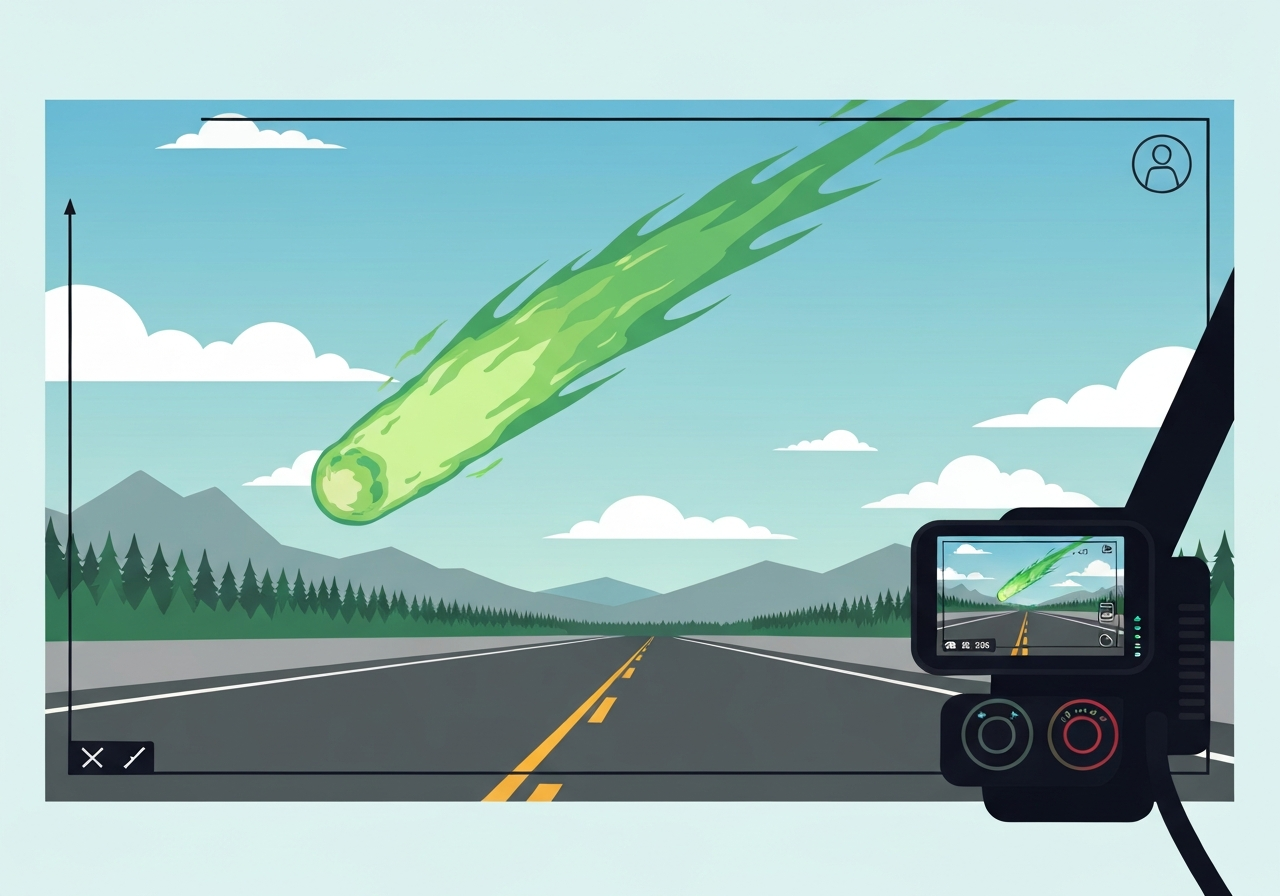
Before dawn on Monday, a bright green fireball raced across the sky over the Portland area, and a motorist’s dashboard camera recorded the event. Jason Jenkins was about 20 miles (32 km) north of Portland, Oregon, when the object flashed at 6:06 a.m.; he initially mistook it for a comet before realizing how close and intense the light was. Experts say the sight was a fireball — an unusually bright meteor visible high in the atmosphere — and early accounts suggest it was widely seen across southwestern Washington and northern Oregon. Authorities and museums are collecting videos and eyewitness reports to determine the object’s path and whether any fragments reached the ground.
Key Takeaways
- A dashcam owned by Jason Jenkins captured a vivid green streak at 6:06 a.m. Monday about 20 miles north of Portland, Oregon.
- The Oregon Museum of Science and Industry (OMSI) identifies the phenomenon as a fireball, visible up to about 80 miles (129 km) above Earth.
- Green coloration is commonly linked to magnesium vaporization in meteors; nickel can also produce green hues.
- Recent, separate events include a 7-ton meteor over Ohio last week and a meteor north of Houston on Saturday that broke apart at roughly 35,000 mph (56,327 km/h), per NASA.
- Dashcam and doorbell footage are increasingly aiding rapid reporting and possible trajectory reconstructions, though recovery of meteorites remains uncommon and difficult.
Background
Meteors that grow especially bright as they enter Earth’s atmosphere are called fireballs. Most burn up before reaching the surface, though very large pieces can survive and become meteorites. In recent weeks the United States has seen at least two high-profile fireball events: a roughly 7-ton object that crossed Ohio and produced a loud breakup, and a fast meteor over Texas that disintegrated with sonic booms reported locally.
The Pacific Northwest sighting fits into a broader uptick in reported fireballs, partly driven by the ubiquity of cameras on dashboards and homes. Institutions such as OMSI and federal agencies like NASA gather these eyewitness reports and recordings to estimate trajectories, speeds and possible fall zones. Even when a fragment survives, locating it is challenging: a surviving rock can appear indistinguishable from ordinary stones unless it creates obvious damage or leaves a clearly defined strewn field.
Main Event
Jenkins said the flash appeared like a lightning strike in its intensity and closeness, a perception the dashcam footage does not fully convey. He was driving to work in southwestern Washington when the streak crossed his windshield and was captured on video. The timing and location place the observation roughly 20 miles (32 km) north of Portland, Oregon, in pre-dawn darkness, conditions that tend to enhance apparent brightness.
OMSI’s director of space science education, Jim Todd, described the object as bright and green and noted that a single small rock can produce a dramatic display when it encounters the atmosphere at high speed. With multiple videos and sighting reports, specialists hope to triangulate the fireball’s path to estimate its trajectory and possible ground intersection. In most cases, however, the body disintegrates at high altitude and no recoverable fragments are found.
Local authorities and museum staff are cataloging reports and clips submitted by the public. If the footage and additional witnesses yield a consistent track, researchers may be able to reconstruct an approximate flight path and narrow search areas, but any on-the-ground recovery effort would depend on precise data and favorable ground conditions.
Analysis & Implications
Scientifically, fireballs provide opportunities to study small solar system bodies without the expense of a space mission. The bright emissions reveal composition clues — for example, magnesium and nickel lines that can produce green colors — and fragmentation behavior that helps model how meteoroids break up in the atmosphere. Each well-documented event enriches databases used by researchers to estimate flux rates and impact risks.
Operationally, the proliferation of consumer video has changed how quickly and accurately such events can be analyzed. Dashcams, security cameras and phones create a distributed sensor network: more vantage points raise the probability of triangulation and, in rare cases, recovery. That said, a higher volume of footage also raises verification workloads for scientists and agencies tasked with confirming events and filtering false positives.
Economically and socially, most fireballs pose no danger; the primary impacts are curiosity and short-term local disruption when sonic booms or falling debris occur. The recent Ohio and Texas episodes that produced audible booms and, in one local report, roof damage, illustrate that larger meteoroids can have tangible effects. Preparedness remains focused on reporting and scientific follow-up rather than public safety evacuations, given the rarity of damaging strikes.
Comparison & Data
| Event | Approx. mass / size | Reported speed | Noted effects |
|---|---|---|---|
| Pacific Northwest fireball (Monday) | Unknown (small) | Not yet measured | Bright green streak; dashcam footage |
| Ohio fireball (last week) | ~7 tons | Not specified | Broke apart; loud boom reported over several states |
| Houston-area meteor (Saturday) | Unknown | ~35,000 mph (56,327 km/h) | Disintegration; sonic booms and one report of roof damage (local TV) |
The table highlights contrasts in mass, speed and observed consequences. The Portland-area event appears much smaller in scale than the Ohio object but remains scientifically valuable because multiple recordings enable trajectory analysis. Officials will need time to process video timestamps, camera orientations and witness locations before producing definitive estimates.
Reactions & Quotes
“It kind of reminded me of a lightning strike because it was so bright,”
Jason Jenkins, eyewitness
Jenkins said he purchased the dashcam for routine safety and was surprised by the astronomical footage it captured. He added with bemusement that the sighting convinced him to keep the device permanently and consider buying a lottery ticket after the unusual morning.
“It was bright, it was green, it was spectacular,”
Jim Todd, OMSI director of space science education
Todd emphasized how a single small meteoroid can produce a dramatic visible display and explained that color clues like green point toward specific elements such as magnesium. He noted that coordinated reports and multiple videos improve researchers’ ability to determine the fireball’s track and the likelihood of any surviving fragments.
Unconfirmed
- No independent confirmation yet that any fragments from the Pacific Northwest event reached the ground; recovery has not been reported.
- Triangulation and a precise trajectory for the Monday fireball remain pending as analysts collect additional video and witness data.
- Reports that a meteorite struck a Houston-area roof were reported to local TV (ABC13) and have not been independently verified by federal or academic teams in public statements.
Bottom Line
The green fireball seen over the Portland area was a bright, short-lived atmospheric entry likely colored by magnesium and possibly nickel. While visually striking and of clear scientific interest, most such events do not produce recoverable meteorites; experts will need more data to say whether any piece survived this passage.
Public video — dashcams, doorbell cameras and phones — will continue to be essential to rapid analysis and, in select cases, recovery efforts. For now, the sighting stands as another reminder of how common near-Earth small-body encounters are and how consumer recordings have improved our ability to study them.
Sources
- Associated Press — news report summarizing eyewitness accounts and local museum comments (journalism).
- Oregon Museum of Science and Industry (OMSI) — space science education and expert commentary (museum/educational institution).
- NASA — federal agency statements on meteors and recent Houston-area disintegration (government/agency).
- ABC13 Houston — local television report referenced for a resident’s account of roof damage (local media).