
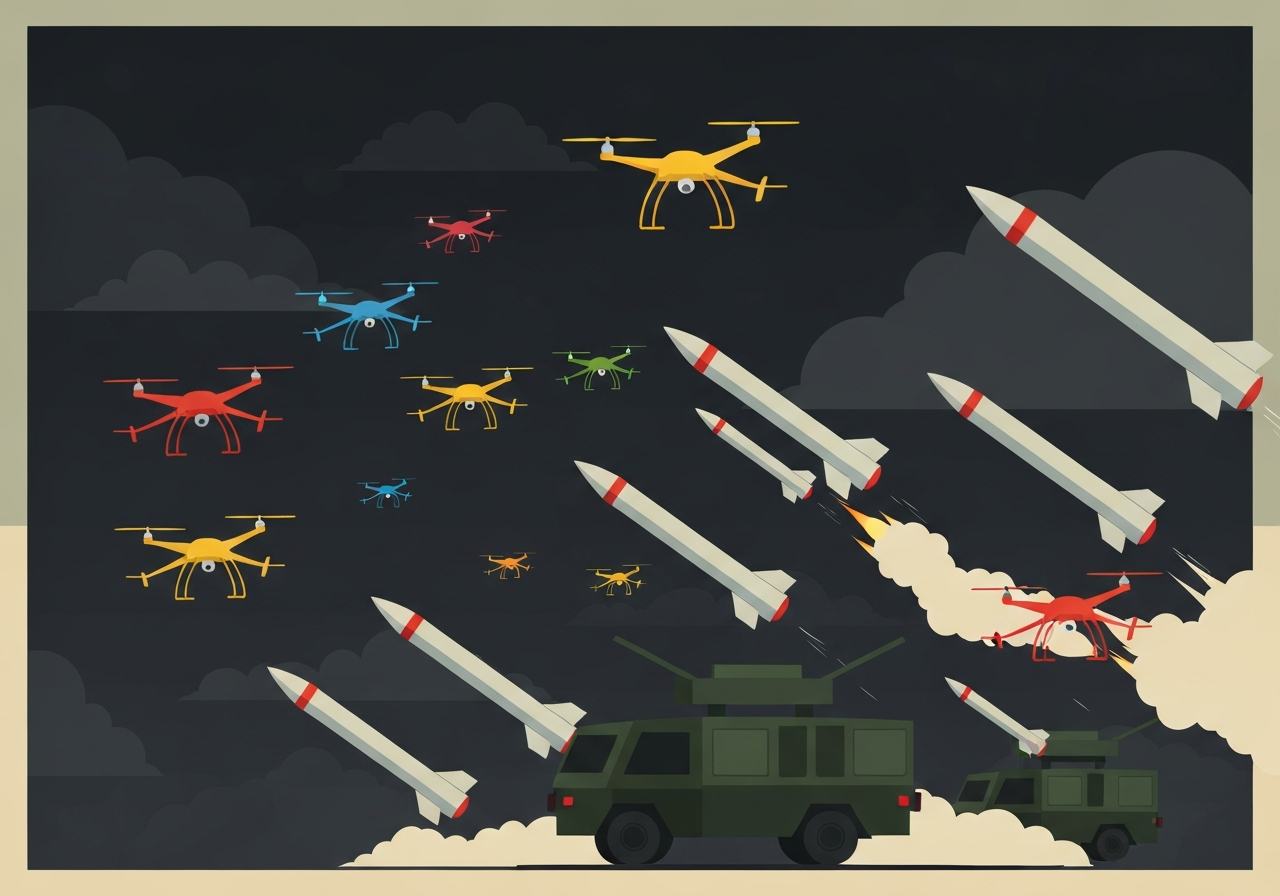
Russian authorities reported on Wednesday that air defenses intercepted 389 incoming Ukrainian drones overnight, marking what Moscow called the largest single drone assault on Russian regions and the Crimean Peninsula since the 2022 invasion began. The Russian Defense Ministry said the intercepts took place over 13 regions plus Crimea as Kyiv continues to deploy domestically developed long‑range drones. The escalation followed a near‑daylong Ukrainian‑Russian aerial exchange: Russian forces launched almost 1,000 drones and 34 missiles at Ukrainian targets a day earlier, an attack Kyiv said killed at least six people and wounded about 50. The strikes and counterstrikes coincided with a pause in U.S.‑mediated talks between Moscow and Kyiv and mounting concerns about a Russian spring offensive.
Key takeaways
- Russia reported shooting down 389 Ukrainian drones overnight across 13 regions and the Crimean Peninsula, the Defense Ministry said.
- The Leningrad region reported 56 drones downed and a fire at the Baltic port of Ust‑Luga, local governor Alexander Drozdenko said.
- The previous 24‑hour period saw Russia launch nearly 1,000 drones and 34 missiles at Ukrainian civilian areas; Ukraine reported at least six dead and roughly 50 injured.
- Ukrainian drone operations appear to be increasingly powered by domestically produced long‑range systems, according to assessments of the assault.
- Neighboring states and border regions reported stray or crashed drones but no confirmed deliberate targeting of the Baltic countries; Moldova warned of energy strain after attacks cut a key transmission line.
- UNESCO said it was “deeply alarmed” after a World Heritage site in Lviv was struck during the bombardment, highlighting risks to cultural heritage.
- The exchanges occurred amid stalled U.S.‑brokered talks and concerns Washington’s focus has shifted toward the Iran conflict.
Background
Over four years of war have produced repeated aerial strikes, artillery bombardments and cross‑border incidents that have expanded in scope and technology. Kyiv has invested in indigenous drone development to sustain strikes at longer ranges as Western weapon deliveries shape battlefield dynamics; Moscow has repeatedly emphasized integrated air defenses to blunt such threats. Since Russia annexed Crimea in 2014, the peninsula has been both a strategic hub and a frequent target in cross‑border operations, making it a focal point for air defense activity on both sides.
Diplomatic efforts have waxed and waned alongside battlefield developments. U.S.‑mediated talks between Russian and Ukrainian delegations have been intermittent; analysts say pauses in diplomacy often accompany spikes in kinetic activity. At the same time, secondary effects have emerged across neighboring countries—from stray drones touching down in the Baltic states to energy infrastructure damage in border regions—complicating regional security and civilian resilience.
Main event
Russian military statements on Wednesday credited air defenses with intercepting 389 unmanned aerial vehicles heading toward Russian territory in one overnight operation, spanning 13 regions plus Crimea. Local officials reported the greatest concentrations in the Leningrad region, where Governor Alexander Drozdenko said 56 drones were neutralized and that a fire erupted at Ust‑Luga port. Moscow described the episode as evidence of an intensified Ukrainian drone campaign using longer‑range domestic systems.
Separately, Ukrainian forces reported a missile strike on Russia’s border Belgorod region overnight that damaged energy infrastructure, Governor Vyacheslav Gladkov said, leaving some residents without electricity, water or heating. Ukrainian and Russian accounts of cross‑border actions often differ in attribution and motive; independent verification in frontline areas remains difficult. Moldova, meanwhile, urged citizens to conserve electricity after Russian strikes on Ukraine’s grid cut a key line connecting Moldova and Romania, raising concerns about wider power disruptions.
The day before the large Russian report of drone intercepts, Moscow itself launched an intense aerial operation against Ukraine, firing nearly 1,000 drones and 34 missiles across a roughly 24‑hour period and extending strikes into daylight hours. Ukrainian authorities said the barrage struck civilian areas and cultural sites, with at least six confirmed deaths and around 50 injured. UNESCO expressed alarm after reporting damage to a World Heritage site in Lviv during the attacks.
Analysis & implications
The sheer scale of both sides’ aerial activity signals a qualitative shift in the conflict: drones have become not only tactical tools for battlefield strikes but also instruments of strategic pressure on infrastructure and morale. Kyiv’s use of domestically produced long‑range drones increases its ability to strike deeper into Russian‑held areas, forcing Russia to allocate significant air‑defense resources along an extended front. Conversely, Russia’s near‑daylong drone and missile campaigns against Ukrainian infrastructure aim to degrade civilian resilience and complicate logistics ahead of any seasonal offensive.
Regionally, the incidents underline growing risks to neighboring states. Reports of stray or crashed drones in Estonia, Latvia, Lithuania and Moldova—whether accidental or not—raise the diplomatic stakes and could prompt NATO and EU partners to reassess airspace monitoring, border readiness and civil emergency planning. The incidents also illustrate how local infrastructure, such as ports and power grids, can rapidly become secondary targets with transnational consequences.
Politically, the spike in attacks during a lull in U.S.‑mediated talks has several possible interpretations: an attempt by either side to strengthen negotiating leverage, a preparatory step for a spring offensive, or a manifestation of operational tempo that outstrips diplomatic channels. International attention diverted by crises elsewhere (notably the Iran conflict) may reduce immediate pressure on Moscow and Kyiv to de‑escalate, complicating efforts to secure a ceasefire or renewed talks.
Comparison & data
| Metric | Count (approx.) |
|---|---|
| Ukrainian drones Russia says were shot down | 389 |
| Russian drones and missiles launched at Ukraine (prior 24 hrs) | ~1,000 drones, 34 missiles |
| Reported Ukrainian civilian casualties (prior strike) | At least 6 dead, ~50 injured |
These figures come from official statements and media reporting and reflect immediate post‑strike tallies; they may be revised as independent assessments are completed. The contrast between the 389 intercepts reported by Moscow and the near‑1,000 drones Russia launched at Ukraine in the previous 24 hours illustrates a reciprocal escalation in UAV and missile usage by both sides.
Reactions & quotes
Officials and international bodies issued terse, alarmed responses as events unfolded. The following quotes capture the immediate official framing.
“We shot down 389 incoming Ukrainian drones over 13 regions and the Crimean Peninsula overnight.”
Russian Defense Ministry (official statement)
The MoD framed the operation as a large defensive success and used the figures to emphasize the scale of the threat coming from Ukrainian long‑range systems. Independent verification of the full geographic spread of intercepts is limited.
“UNESCO is deeply alarmed by the damage to cultural heritage in Lviv.”
UNESCO (international organization)
UNESCO’s statement highlighted the cultural‑heritage consequences of the bombardment and called for protection of historic sites. Damage to cultural property can prompt additional international scrutiny and legal considerations.
“The drones likely didn’t target Estonia,”
Estonian officials / media
Baltic states publicly downplayed the likelihood that the stray or crashed drones were aimed at their territories, but the incidents underscored the challenge of containing an increasingly aerialized conflict near NATO borders.
Unconfirmed
- Attribution of intent: It remains unconfirmed whether particular drones were meant to strike military versus civilian targets in each reported location.
- Targeting of Baltic states: Claims that drones did not target Estonia, Latvia or Lithuania are based on initial assessments and media reports; definitive intent cannot yet be established.
- Final casualty and damage counts: Death, injury and infrastructure damage figures remain preliminary and could be revised as investigations continue.
Bottom line
The reported interception of 389 drones and the reciprocal near‑1,000 drone and missile barrage by Russia within 24 hours mark a significant intensification in aerial exchange, reflecting both sides’ increasing reliance on unmanned systems and massed strikes. The episodes raise immediate humanitarian and infrastructure concerns inside Ukraine and introduce spillover risks for neighboring states and cross‑border energy systems.
Short‑term prospects point to continued episodic escalation, particularly if either side seeks to shape battlefield conditions ahead of anticipated spring operations. International actors monitoring the conflict will likely emphasize air‑defense resilience, civilian protection and cultural‑heritage safety in any renewed diplomatic engagement.
Sources
- Associated Press (independent news reporting)
- UNESCO (UN specialized agency, official statements)
- Russian Ministry of Defence (official government statements)