
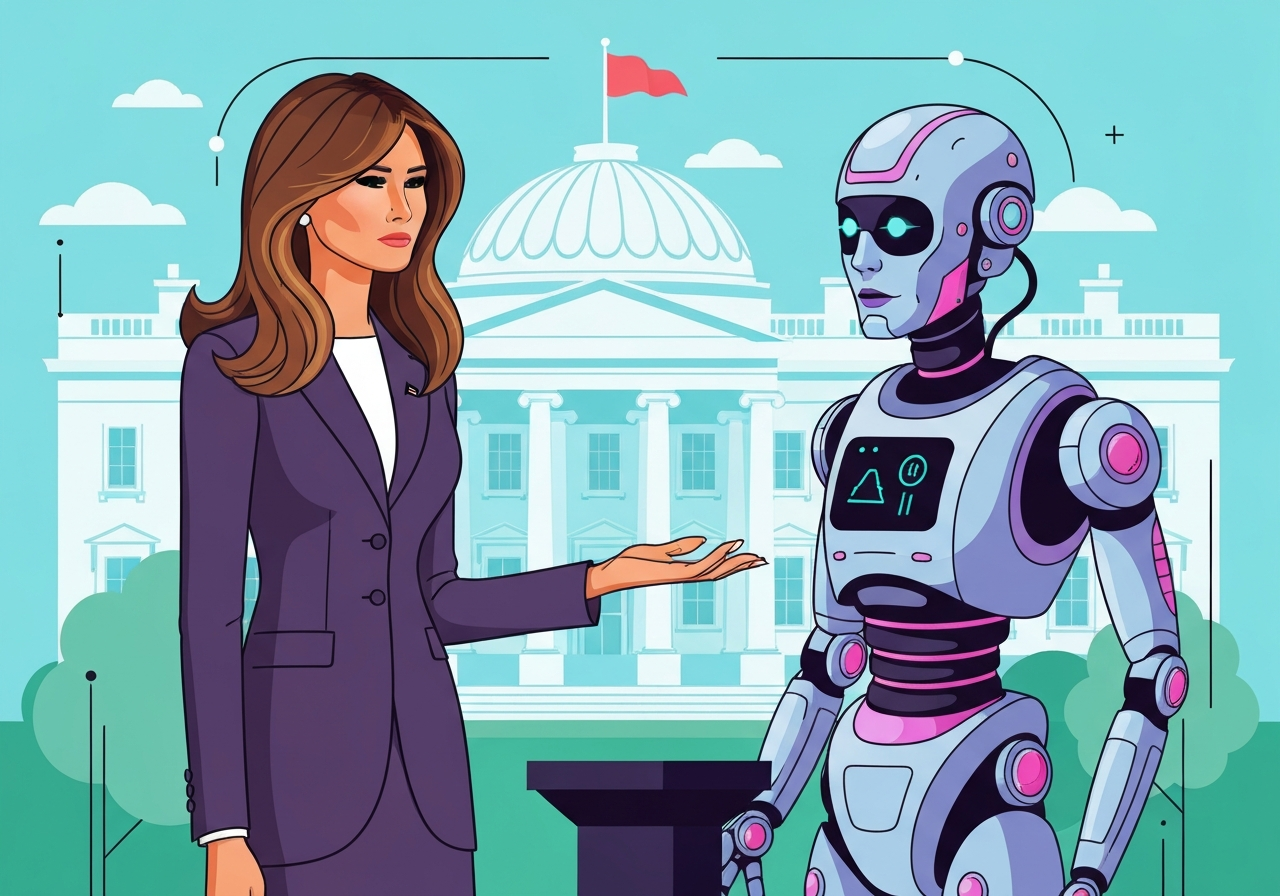
— First Lady Melania Trump attended the final day of the “Fostering the Future Together” global coalition summit in the White House East Room in Washington, accompanied by a humanoid robot identified as Figure 03. The robot, developed by Sunnyvale-based startup Figure AI, entered with the first lady, addressed the room in multiple languages and took a central position before departing along the red carpet. The summit gathered first spouses and global partners to discuss education, innovation and the role of artificial intelligence in empowering children. The robot’s appearance and brief remarks prompted immediate attention from attendees, the press and industry observers.
Key Takeaways
- Event: The Fostering the Future Together Global Coalition Summit concluded at the White House on March 25, 2026, with first spouses in attendance.
- Robotic guest: Figure 03, a humanoid from Figure AI, accompanied Melania Trump into the East Room and spoke to the assembled panel and audience in 11 languages.
- Company context: Figure AI, based in Sunnyvale, California, introduced Figure 03 in October 2025 as its third-generation consumer-oriented humanoid.
- First Lady remark: Melania Trump described Figure 03 as her “first American-made humanoid guest in the White House,” underscoring the optics of domestic robotics manufacturing.
- Industry competition: Figure AI is competing with known players such as Boston Dynamics and Tesla, as well as multiple firms in China, to develop humanlike robots.
- CEO reaction: Figure AI CEO Brett Adcock posted that he was proud to see F.03 appear at the White House, calling it a historic moment for the company.
- Policy and optics: The robot’s presence highlighted overlap between education policy conversations and private-sector robotics demonstrations.
Background
The Fostering the Future Together initiative convened international first spouses and other stakeholders to explore how education, technology and innovation can better support children globally. The White House-hosted summit placed particular emphasis on digital tools, workforce readiness and the potential of artificial intelligence to expand learning access. Conversations at the event follow a broader uptick in public-private engagement around AI in schools, where policymakers and companies increasingly intersect. Figure AI’s introduction of a consumer humanoid in October 2025 came amid a wave of startups and established firms accelerating humanoid development for domestic and commercial use.
Humanoid robots have long been a focus of both research labs and commercial startups; recent prototypes are more capable of humanlike movement and limited social interactions. The presence of a company-built humanoid in a high-profile government setting underscores a new phase in industry visibility and political signaling. For Figure AI, which markets Figure 03 for household assistance such as laundry and cleaning, the White House appearance provides immediate publicity and a chance to frame its technology within education and child empowerment narratives. At the same time, observers note that demonstrations do not equate to broad deployment in classrooms or homes.
Main Event
Melania Trump and Figure 03 entered the East Room side by side, walking along the red carpet from opposite ends of the hallway; the first lady paused at the doorway while the robot moved among panelists and positioned itself centrally. After scanning the audience, Figure 03 addressed the gathering, saying it was honored to attend the coalition’s inaugural meeting and identifying itself as built for the United States. The robot offered brief greetings in multiple languages before exiting along the same red carpet route.
After the robot’s remarks, the first lady thanked it and noted the moment as a first for her White House hosting duties, calling Figure 03 her first American-made humanoid guest in the residence. Company materials and its website describe Figure 03 as Figure AI’s third-generation humanoid intended for household assistance. CEO Brett Adcock commented on social media that the robot’s White House appearance was a historic milestone for the firm.
Attendees and journalists photographed and recorded the interaction, which lasted only minutes but dominated media coverage of the summit’s closing day. Organizers of the summit emphasize that the agenda focused on child empowerment through education and technology, not product demonstrations. Nonetheless, the robot’s public speak-and-greet moment blurred lines between a policy convening and a technology showcase, drawing attention from industry watchers and commentators.
Analysis & Implications
The visual of a humanoid robot walking into the White House alongside a first lady is a potent symbol of how quickly robotics has moved from laboratory stagecraft to public-facing demonstrations. For companies like Figure AI, such visibility accelerates brand recognition and can influence investor and consumer perceptions, especially for consumer-oriented models marketed for home use. That said, publicity does not resolve key technical, safety and cost hurdles that remain for practical household deployment at scale.
For policymakers and education advocates, the episode raises questions about the appropriate role of private-sector technology in public education initiatives. While AI-enabled tools can potentially expand personalized learning and access, they also introduce concerns about equity, data privacy and long-term labor impacts. The presence of a humanoid at a summit about children’s futures may prompt more focused debate on procurement standards, pilot program oversight and transparency around how educational AI is evaluated.
Internationally, the event signals that U.S.-based robotics startups aim to assert symbolic leadership in a field where competitors in China and other markets are also advancing. The optics of a domestically built humanoid at a high-level U.S. government venue can be read as both soft-power messaging and as an invitation for regulatory scrutiny. If demonstrations become a common staple at government events, regulators may feel political pressure to clarify rules governing autonomous systems in public and educational settings.
Comparison & Data
| Company | Representative Humanoid | Status (as of March 2026) |
|---|---|---|
| Figure AI | Figure 03 | Third-generation consumer humanoid introduced Oct 2025; public demonstrations |
| Tesla | Optimus | Development and prototype demonstrations; consumer timeline not finalized |
| Boston Dynamics | Atlas | Research and advanced mobility demos; focused on R&D and commercial contracts |
The table situates Figure 03 alongside better-known humanoid efforts. Each entry reflects public statements and demonstrations up to March 25, 2026. Direct consumer availability, pricing and regulatory approvals vary widely among companies; demonstration appearances do not equate to mass-market readiness.
Reactions & Quotes
Organizers and attendees offered mixed reactions emphasizing both the novelty and the questions raised by the robot’s appearance. Summit hosts reiterated the event’s focus on children’s education, while industry representatives highlighted innovation milestones.
“It’s fair to state, you are my first American-made humanoid guest in the White House.”
First Lady Melania Trump
The first lady’s comment framed the moment as a symbolic first for the White House; it also underscored the domestic origin of the robot as presented by company materials.
“Proud to see F.03 make history as the first humanoid robot in the White House.”
Brett Adcock, CEO, Figure AI (social media)
Figure AI’s CEO used social media to celebrate the appearance; company officials and supporters cast the event as validation of commercial progress even as critics called for sober evaluation.
Unconfirmed
- Whether Figure 03 will be deployed in schools or formal education pilots beyond publicity demonstrations is not confirmed and has not been detailed by organizers.
- Claims that Figure 03 is definitively the “first humanoid robot in the White House” are based on company and social media statements and have not been independently verified in official White House archival records.
- Specific benchmark performance—such as sustained household task reliability, pricing or mass-production timelines—remains unverified outside company materials.
Bottom Line
The Robot-and-First-Lady moment at the March 25, 2026 White House summit put a consumer humanoid squarely into the public conversation about education and technology. It highlighted the growing intersection of private-sector robotics and public policy forums, accelerating questions about how emerging machines should be evaluated and governed when presented in high-profile venues.
Readers should watch for follow-up announcements about concrete educational pilots, regulatory guidance, and independent testing results. The appearance represents a notable publicity milestone for Figure AI, but practical deployment in classrooms or homes will require sustained technical validation, policy clarity and public deliberation.
Sources
- NPR — News outlet reporting on the White House event and statements (primary coverage)