
Lead
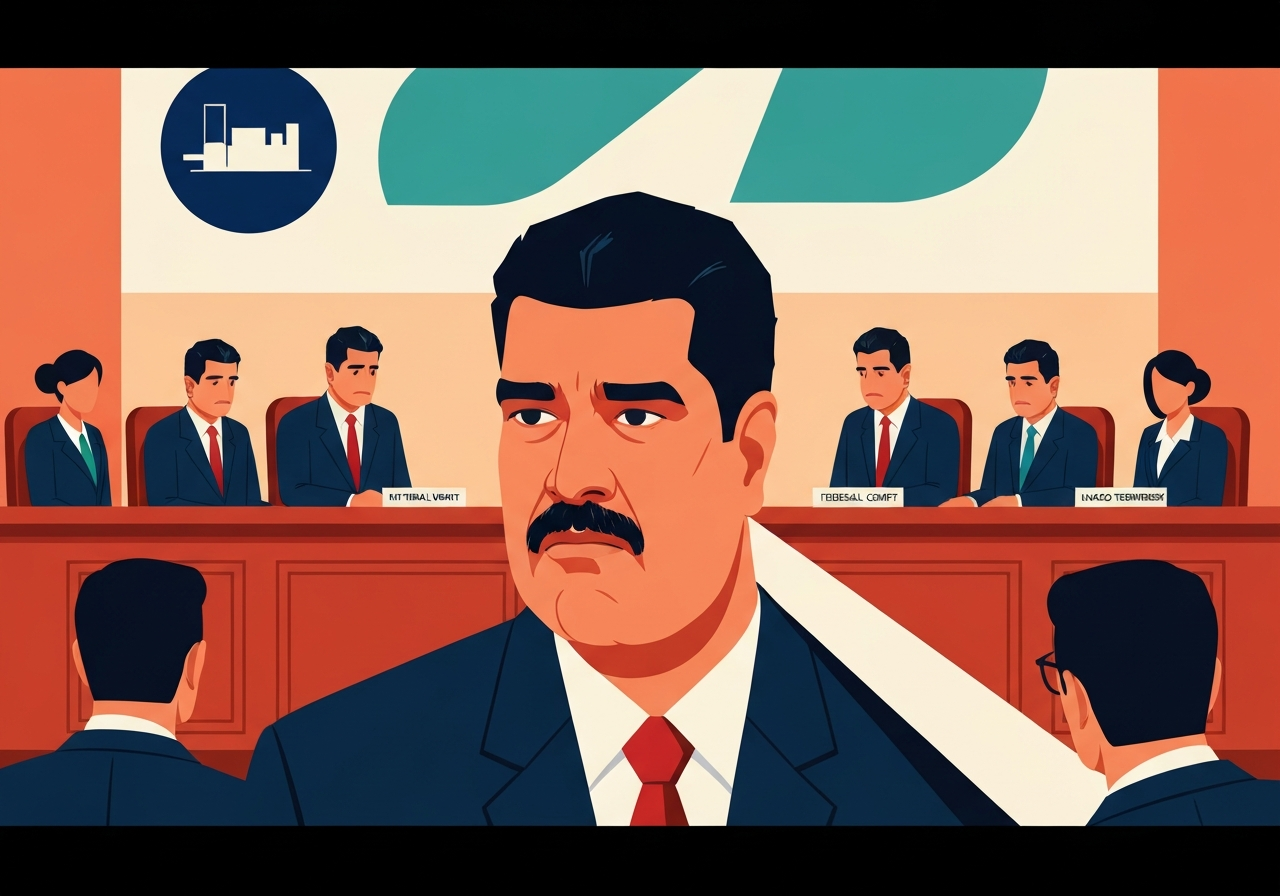
On 26 March 2026, deposed Venezuelan president Nicolás Maduro was scheduled to appear in a Manhattan federal court on charges described by prosecutors as part of a long-running “narco-terrorism” conspiracy. Maduro and his wife, Cilia Flores, were captured by U.S. special forces on 3 January in a pre-dawn raid linked to an assault on Caracas that reportedly killed 100 people; both pleaded not guilty at a 5 January arraignment. The hearing arrives amid an intense legal fight over whether Venezuela’s government may fund Maduro’s defense after a brief January waiver from the U.S. Treasury’s Office of Foreign Assets Control (OFAC) was quickly reversed. The case is unfolding in parallel with rapid political changes inside Venezuela under acting president Delcy Rodríguez.
Key Takeaways
- Maduro and Cilia Flores were captured by U.S. special forces on 3 January 2026 during an operation associated with an assault on Caracas that reportedly killed about 100 people.
- Both defendants pleaded not guilty at an arraignment on 5 January 2026; Manhattan prosecutors maintain criminal charges described as “narco-terrorism.”
- On 9 January 2026 OFAC briefly issued a waiver allowing Venezuelan government funds to be used for Maduro’s legal fees, but lawyers say the authorization was reversed roughly three hours later.
- Maduro’s legal team filed court papers on 26 February 2026 arguing the OFAC reversal deprives him of the constitutional right to counsel of his choice; prosecutors opposed dismissal in filings dated 13 March 2026.
- Experts and rights groups have reported dire conditions at the New York detention facility where Maduro is held; his son, Nicolás Maduro Guerra, told state media his father is “really well” and in good spirits.
- At home, acting president Delcy Rodríguez—in office less than three months—has removed nearly half of Maduro’s cabinet, including long-serving defence minister Vladimir Padrino López, and says she has welcomed more than 120 energy companies to Venezuela.
- The U.S. reopened its embassy in Caracas and has sent senior officials, moves that underscore shifting diplomatic engagement even as legal and geopolitical disputes persist.
Background
For years the U.S. government and other foreign actors have accused Venezuela’s Maduro administration of corruption and facilitating illicit drug trafficking; U.S. indictments framed the charges against Maduro as stemming from a government system that protected illegal activity. Tensions escalated in late 2025 and early 2026 as U.S. forces and agencies increased pressure on alleged drug-smuggling networks, including strikes on vessels described as “narco boats.” Those operations and the January raid on Caracas have prompted scrutiny from legal scholars and human-rights observers over their conformity with domestic and international law.
Venezuela has been under extensive U.S. sanctions for several years, including measures that restrict government financial flows. That sanctions framework is central to the present legal dispute because Maduro’s team says the Venezuelan state should be permitted to pay defense fees; OFAC’s brief waiver and its subsequent reversal lie at the heart of a constitutional argument about the right to counsel. Domestically, Venezuelan politics have shifted rapidly after Maduro’s capture, with acting president Delcy Rodríguez consolidating power and courting foreign energy firms at recent international events.
Main Event
The Manhattan appearance on 26 March 2026 followed weeks of procedural contention in federal court. Prosecutors allege Maduro led a corrupt, illegitimate government that used state power for decades to shield and promote illegal activity, including drug trafficking; those charges form the basis of a high-profile criminal prosecution in the Southern District of New York. After the January capture, Maduro and Flores were brought to New York and arraigned on 5 January, when they pleaded not guilty and the case moved into pretrial litigation.
Maduro’s defense has requested dismissal on constitutional grounds tied to access to counsel, arguing that an OFAC decision to rescind a permission for Venezuela to fund defense costs effectively blocks the defendant from retaining chosen attorneys. Lawyers filed a motion outlining that without a lawful source of funds from the Venezuelan government—sanctioned by the U.S.—Maduro cannot secure private counsel and would be forced to rely on court-appointed representation, a situation they say could taint any eventual verdict.
OFAC told the court in filings on 13 March 2026 that the inclusion of an authorization to use Venezuelan government funds in the earlier licenses was an administrative error. Manhattan prosecutors countered on the same date, saying it would be “highly unusual” for a sanctioned government to receive such a waiver and opposing dismissal. Meanwhile, observers familiar with the detention complex in New York describe difficult conditions for high-profile detainees, though those assessments vary by source.
Concurrently, political change accelerated in Caracas. Delcy Rodríguez, serving as acting president, has moved to replace many senior ministers and presented Venezuela to international investors as ready for renewed energy-sector engagement. Her public statements at a Saudi-funded Miami summit emphasized a prospective economic “takeoff” and highlighted outreach to more than 120 energy companies, including firms from the United States, the Middle East, Asia, Africa and Europe.
Analysis & Implications
The OFAC waiver episode raises novel legal questions about how sanctions intersect with constitutional protections. If a sanctioned state is categorically barred from funding a defendant’s legal costs while that defendant lacks personal funds, courts could be asked to resolve whether that practical barrier infringes Sixth Amendment rights. Defense counsel warned that continued OFAC interference could force court appointment of counsel at taxpayer expense or render any conviction constitutionally suspect—an argument prosecutors strongly contest.
Beyond the U.S. courtroom, the capture of a sitting head of state by U.S. forces is geopolitically consequential. The operation and its human cost—reports cite roughly 100 fatalities—have already provoked debate over the operation’s legality under international humanitarian and human-rights law. Allies and regional partners will weigh the long-term diplomatic fallout, particularly as the U.S. re-engages with Venezuela through embassy reopening and senior official visits.
Domestically in Venezuela, Rodríguez’s rapid cabinet shake-up indicates an effort to delegitimize Maduro’s inner circle and rebrand governance to attract investment. Her outreach to foreign energy firms could shift economic trajectories, but such overtures occur amid political uncertainty and sanctions that complicate commercial contracts and finance. The interplay between court outcomes, sanctions policy, and on-the-ground governance in Caracas will determine how quickly investors and partners move from expressions of interest to concrete projects.
Comparison & Data
| Date | Event |
|---|---|
| 3 January 2026 | Maduro and Cilia Flores captured by U.S. special forces in pre-dawn raid on Caracas (reported ~100 killed) |
| 5 January 2026 | Arraignment in Manhattan: both plead not guilty |
| 9 January 2026 | OFAC issues brief waiver allowing Venezuelan funds for defense, then reportedly reverses it |
| 26 February 2026 | Maduro’s lawyers file court papers claiming OFAC reversal denies right to counsel |
| 13 March 2026 | OFAC files that earlier license language was an administrative error; prosecutors oppose dismissal |
The timeline above shows the compressed rhythm of legal and political events since early January. That compression has amplified procedural stakes in the district court while intensifying diplomatic and domestic political shifts in Caracas. Observers should watch forthcoming filings and scheduling orders for precise trial timing and any interim relief regarding counsel funding.
Reactions & Quotes
Family and state media offered reassurance about Maduro’s condition while experts and rights groups raised concern about detention conditions and the legality of the raid.
“He’s really well, [he’s] strong – he’s really, really well. His spirits are really high,”
Nicolás Maduro Guerra, son (state-run media)
The statement came amid state media coverage intended to convey resilience; independent observers contrast that depiction with reports describing difficult conditions in detention. Maduro’s family message aims to maintain political support among loyalists even as the leadership in Caracas evolves.
“The inclusion in these licenses of an authorization to use funds paid by the Government of Venezuela was an administrative error,”
U.S. Department of the Treasury, OFAC (court filing)
OFAC’s characterization frames the waiver episode as bureaucratic, but defense attorneys argue the practical effect deprived their client of funding access. The dispute turned on administrative record-keeping and substantive decisions about sanctions enforcement.
“It would be highly unusual for a sanctioned government to receive such a waiver,”
Manhattan federal prosecutors (court filing)
Prosecutors used that point to oppose dismissal, arguing that permitting a sanctioned state to fund a defendant’s defense would be exceptional and inappropriate under existing policy. The court must reconcile those competing legal positions.
Unconfirmed
- The precise death toll from the January raid on Caracas is reported at about 100 but remains contested pending independent verification.
- Attributions that former president Donald Trump directly ordered the abduction are derived from political reporting and have not been conclusively established in public court records available to date.
- Characterizations of detention conditions at the New York facility are based on expert assessments and media reports; official facility statements vary and independent inspections are not publicly documented in full detail.
Bottom Line
The March 26 appearance in Manhattan is a procedural but pivotal moment in a case that ties criminal law, sanctions policy and geopolitics together. Courts will confront novel constitutional questions about access to counsel when sanctions prevent a government from paying legal fees for a defendant it wishes to defend. How judges rule on procedural motions, and whether OFAC or policymakers adjust sanction parameters, could shape the fairness and legitimacy of any future trial.
Beyond the courtroom, the episode has accelerated political realignment in Caracas: acting president Delcy Rodríguez has rapidly replaced senior ministers and courted foreign energy investors, while U.S. diplomatic re-engagement signals changing regional dynamics. Observers should follow upcoming court filings, any OFAC clarifications, and signals from international investors to gauge whether legal, economic and political shifts stabilize or further fracture Venezuela’s transition.
Sources
- The Guardian (news media)