
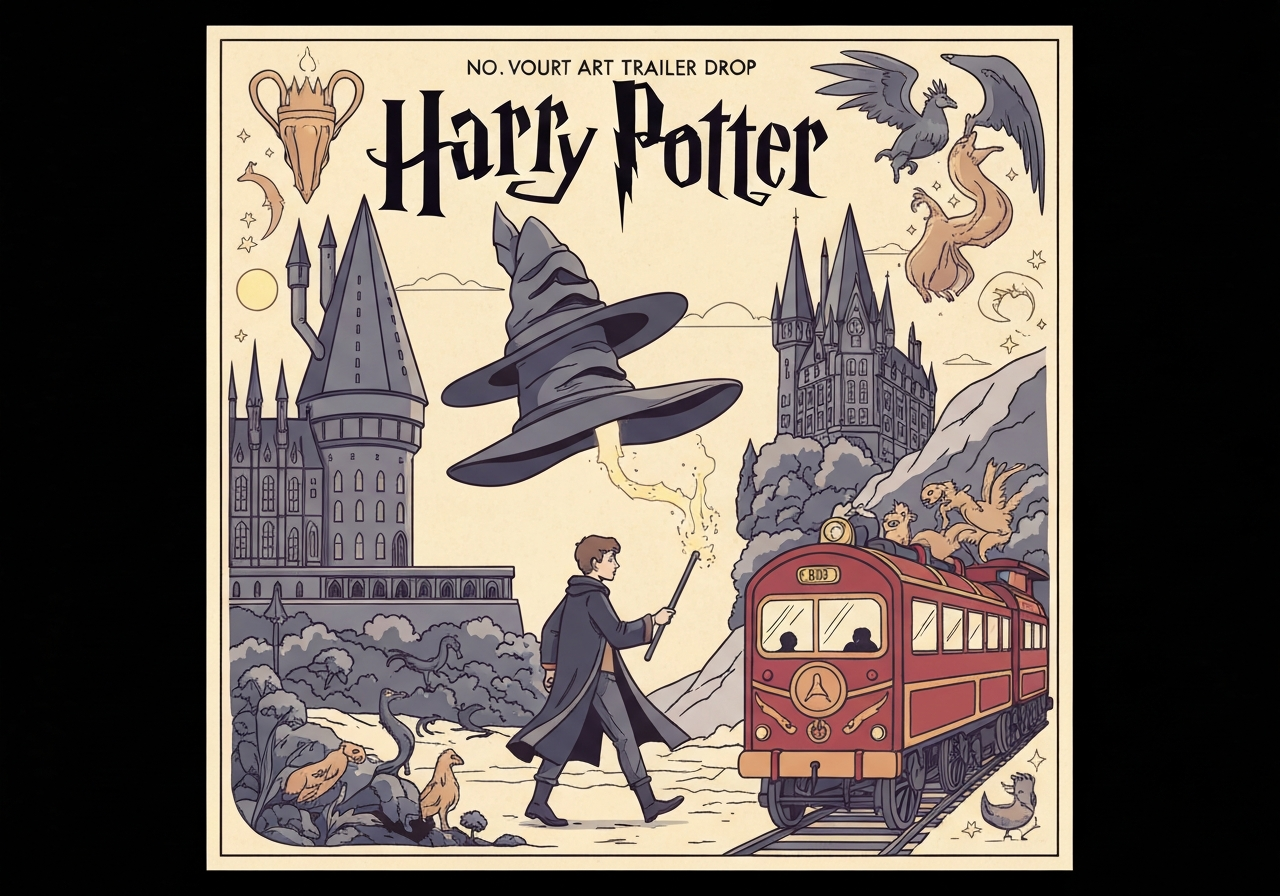
HBO Max unveiled a two-minute trailer this week for an eight-episode reboot of Harry Potter and the Philosopher’s Stone, signaling the franchise’s television return with a launch scheduled for Christmas Day 2026. The preview arrived Wednesday ahead of HBO Max’s UK and Ireland service rollout the following day and quickly sparked global online discussion. The trailer offers familiar locations — Privet Drive, King’s Cross and Hogwarts’ Great Hall — while introducing a new ensemble cast and production team. Early indicators suggest the series will preserve core story beats while updating tone, music and casting for a streaming-era audience.
Key takeaways
- The series is an eight-episode adaptation of Harry Potter and the Philosopher’s Stone set to premiere on Christmas Day 2026.
- A two-minute trailer was released Wednesday ahead of the HBO Max UK and Ireland launch on Thursday.
- Principal casting includes John Lithgow as Albus Dumbledore, Janet McTeer as Minerva McGonagall, Nick Frost as Rubeus Hagrid and Paapa Essiedu as Severus Snape.
- New leads are Dominic McLaughlin (Harry), Arabella Stanton (Hermione) and Alastair Stout (Ron); the trio are relative newcomers.
- Composer Hans Zimmer and Bleeding Fingers Music replace the film series’ association with John Williams for the score.
- Primary production returns to Warner Bros. Studios, Leavesden, north of London; actors reportedly signed on for up to 10 years.
- Unofficial reports suggest a production cost near $100 million per episode, which would surpass the original film franchise’s estimated $1.2 billion total spend.
Background
The original Harry Potter films, released between 2001 and 2011, established a global cultural franchise built on J.K. Rowling’s seven novels and a consistent cinematic aesthetic, including John Williams’ iconic motifs. Warner Bros. has since moved to reimagine the property for streaming, reflecting a broader industry shift toward long-form serialized adaptations of popular IP. HBO Max’s decision to split the narrative across episodic seasons allows the studio to adapt each novel across a full season rather than compressing material into two- to three-hour films.
Leavesden Studios, where much of the original film series was filmed, remains the production hub, offering built sets and local crew expertise that reduce logistical friction. The new production also reflects stronger competition between streaming platforms for tentpole content, with broadcasters and streamers increasingly treating franchise television as a long-term subscriber retention tool. That commercial context helps explain the reports of very large per-episode budgets and multi-year actor commitments.
Main event
The trailer opens with instantly recognizable visuals: the Dursleys’ house on Privet Drive, a cramped cupboard, and an ominous atmosphere around Harry’s early life. Montage cuts then move viewers to letter-strewn scenes, the luggage trolley at King’s Cross and the Hogwarts Express rolling through countryside vistas. The Great Hall and the Sorting Hat receive prominent, lingering shots, underlining the production’s attention to iconic set pieces.
Casting highlights dominated coverage after the trailer’s release. Established screen actors John Lithgow, Janet McTeer and Nick Frost were announced in senior Hogwarts roles, while the three students who will carry the story are largely newcomers such as Dominic McLaughlin, Arabella Stanton and Alastair Stout. The trailer frames these young actors with classic beats of discovery, wonder and the awkwardness of first-year students.
Paapa Essiedu’s casting as Severus Snape drew particular attention; images in the trailer present a stern, foreboding presence consistent with the character’s traits. Essiedu posted a brief, playful message on his social account after the announcement and has also faced racist backlash in some online circles, a reaction that has generated further discussion about representation and fan response in major franchises.
Analysis & implications
Reimagining these novels as eight-episode seasons alters pacing and character development. Where the films condensed plotlines to fit a theatrical runtime, a season-per-book model offers room to expand subplots, deepen supporting characters and restore material previously trimmed from the films. That creative opportunity makes the adaptation attractive to fans who want more fidelity to the books.
Music and tonal shifts will shape audience reception. Replacing John Williams’ motifs with Hans Zimmer’s approach signals a deliberate sonic departure meant to distinguish the new series from the films. For many viewers the score serves as an emotional anchor; changing it increases both risk and the potential to reframe the franchise for a new generation.
Commercially, reports of extremely high per-episode spending—if accurate—reflect a streaming era calculus: large upfront investment to secure long-term subscriber engagement and franchise control. Such budgets raise the stakes for quality and audience retention, but also increase financial exposure if the series fails to meet expectations or maintain subscriber momentum over multiple seasons.
Socially, casting choices have ignited conversations about continuity, legacy and diversity in beloved franchises. Longstanding fan attachments produce intense scrutiny of recasting and reinterpretation. How the production navigates those conversations—through marketing, creative decisions and community engagement—will influence public perception and box-office-equivalent viewership metrics on streaming.
| Production | Unit / Episode | Reported Total |
|---|---|---|
| HBO Max series (reported) | $100,000,000 | Varies by season |
| Original film series (Warner Bros.) | — | $1,200,000,000 (estimated total) |
The table above contrasts the reported per-episode cost for the new series with the total estimated expenditure on the original film franchise. If the $100 million-per-episode figure is correct, a single high-cost season could match or exceed budgets typical of blockbuster films, reshaping expectations for television scale and return on investment.
Reactions & quotes
The casting announcement prompted mixed online responses, from excitement about returning to Hogwarts to criticism focused on differences between the new and original portrayals. Social platforms became early battlegrounds for debate over fidelity to source material versus creative reinvention.
“We shall eat and we shall leave no crumbs. See you at Hogwarts. Professor Snape x.”
Paapa Essiedu (Instagram)
Essiedu shared a playful message on his personal account that framed his casting positively and signalled enthusiasm. The post came amid a wave of online commentary, including abusive responses that have been widely condemned by some fans and commentators.
“It feels like seeing new people living in your old home.”
YouTube user comment
A viewer comment pinned beneath the official trailer captures a common sentiment: nostalgia blended with discomfort at recasting familiar roles. Such reactions are typical when long-running adaptations revisit culturally significant properties with new creative teams and performers.
Unconfirmed
- The reported $100 million per episode figure has not been officially confirmed by HBO and remains based on media reports.
- The exact length and terms of the actors’ contracts described as “up to 10 years” have not been published by the studio.
- Details about how extensively original film sets or designs will be reused versus rebuilt are not fully disclosed.
Bottom line
The trailer signals a faithful-but-fresh approach: familiar landmarks and story beats are present, while casting, music and episodic scope mark a clear departure from the film era. For fans, the series offers the promise of deeper book-level detail; for the studio, it represents an expensive bet on long-form storytelling to sustain subscriber interest.
Key near-term checkpoints to watch are viewer response after the first season drops on Christmas Day 2026, official confirmation of production budgets from HBO, and how the creative team balances nostalgia with reinvention. Those outcomes will determine whether this revival becomes a model for franchise television or a cautionary tale about escalating costs and fan expectations.