
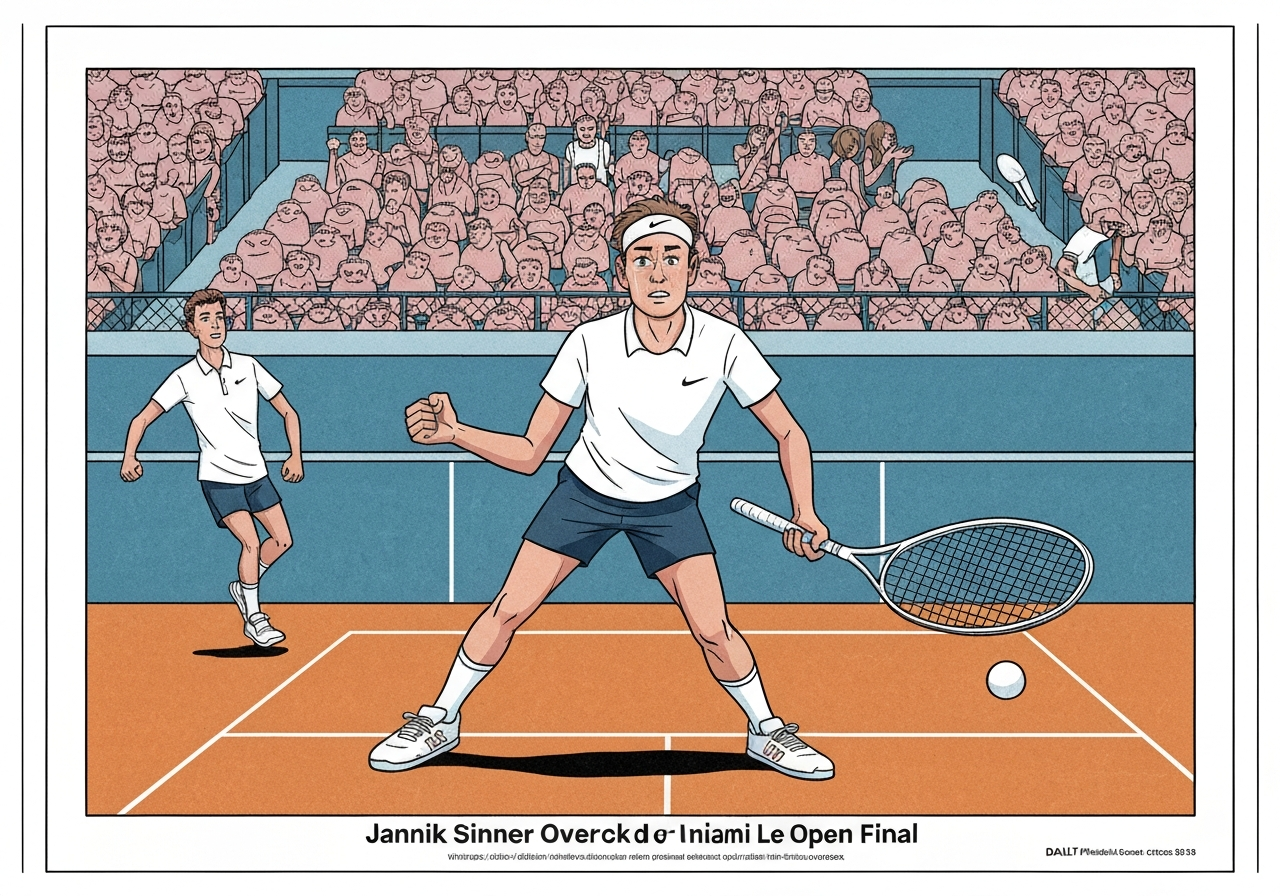
Jannik Sinner defeated Jiri Lehecka 6-4, 6-4 to claim the Miami Open title and complete the Sunshine Double, having won Indian Wells earlier in the month. The victory on the Hard Rock Stadium show court came after a stop-start day of rain delays and moved Sinner firmly into the spotlight heading into the clay-court swing. After the trophy presentation he said he planned to enjoy the moment and was considering an early return to clay — possibly including a doubles outing in Monte‑Carlo if he feels fit. Lehecka, who reached his first Masters 1000 final, praised the top players and said the loss underlined areas for improvement.
Key Takeaways
- Sinner beat Jiri Lehecka 6-4, 6-4 to win the 2024 Miami Open and complete the Sunshine Double after his Indian Wells title earlier this month.
- The final included weather interruptions; play was suspended multiple times before the match concluded on Stadium Court.
- Sinner became the eighth man to complete the Sunshine Double and the first player to achieve the pair of titles in the same season since Roger Federer in 2017.
- Lehecka reached his first Masters 1000 final; his serve was broken for the first time in the tournament during the final.
- ATP rankings shifted after Miami: Alexander Zverev moved to No. 3 following Novak Djokovic’s withdrawal; Felix Auger‑Aliassime rose above Taylor Fritz in the top 10.
- Carlos Alcaraz exited Miami in the round of 32; former pro Greg Rusedski suggested heavy scheduling may be affecting Alcaraz’s form.
- Aryna Sabalenka and the doubles team of Katerina Siniakova/Taylor Townsend also completed Sunshine Doubles in their draws this weekend.
Background
The Sunshine Double—the pair of Masters 1000 titles at Indian Wells and Miami in the same calendar year—is a rare achievement that underlines dominance across surfaces and conditions. Winning both events requires peak form over consecutive weeks, resilience to schedule strains and often successful adjustment from the desert courts to the humid, sometimes rain‑affected conditions in Miami. Sinner arrived in Florida having taken the Indian Wells crown, and his run through the draw featured consistent serving and straight‑set wins in several matches.
Miami’s final day was disrupted by episodic rain that forced multiple suspensions and rescheduling of court assignments, disrupting players’ routines and the tournament timetable. Tournament organisers repeatedly moved start times and used drying equipment to get play underway; despite delays, the two singles finalists and doubles teams resumed and completed their matches. The clay season follows immediately, with the Monte‑Carlo Masters beginning soon, which creates a quick surface change for players considering early clay appearances.
Main Event
The match opened with high intensity and an early break that set the tone. Sinner took the first set 6-4 after breaking Lehecka in the third game — a break that, notably, was Lehecka’s first of the tournament. In that opening set Lehecka produced a marathon service game where he saved two break points, but Sinner sustained pressure and closed the set while winning a high percentage of his first-serve points.
Weather intrusions punctuated the contest. Play was suspended at the start of the second set after intermittent rain; at one point Lehecka was serving with the score 0-0 (15-30) when the heavens opened and both players left court. Organisers shifted schedules and courts through the evening before the match could be completed, testing both teams’ ability to remain ready under uncertain conditions.
When play resumed, Sinner managed the conditions and maintained attacking balance from the baseline, converting break opportunities and keeping his service games solid. The Italian closed out the second set 6-4 to seal the title in straight sets, marking a clean finish to two weeks of elite-level tennis. The result capped a run of strong service numbers and tactical consistency across both Indian Wells and Miami.
Analysis & Implications
Sinner’s consecutive wins at Indian Wells and Miami mark a step-change in his standing among the elite. Completing the Sunshine Double gives him momentum and a psychological edge as the tour shifts to clay; it also cements his status as a leading candidate in big tournaments through the season. The manner of his victories — consistently high first-serve win rates and few dropped sets — suggests improved physical conditioning and tactical maturity in service games and return positioning.
For the wider men’s tour, Sinner’s rise reshapes dynamics at the top. Novak Djokovic’s withdrawal from Miami and Alexander Zverev’s leap into No. 3 in the rankings alter seedings and match-up probabilities at upcoming events, while Carlos Alcaraz’s earlier-than-expected exit fuels debate about scheduling, recovery and burnout. Former players and commentators have pointed to sustained exhibition and event play as a risk factor for form dips, a conversation that could influence how top players structure the remainder of the season.
Lehecka’s run to a first Masters 1000 final signals the arrival of another young contender able to challenge deep into big events. His post-match assessment — that playing the top names highlights limits and areas to improve — is a standard but useful blueprint for development: greater consistency, point construction and experience in late-stage matches. For tournament organisers and broadcasters, the rain-affected final also underlines the practical challenges of outdoor events in volatile weather windows, and it emphasizes the value of flexible scheduling.
Comparison & Data
| Player / Year | Indian Wells | Miami | Sunshine Double |
|---|---|---|---|
| Jannik Sinner (2024) | Champion | Champion (6-4, 6-4) | Yes (eighth man) |
| Roger Federer (2017) | Champion | Champion | Yes (previous man to do both) |
The table highlights Sinner’s back‑to‑back Masters 1000 victories and notes that the last man to complete the pair of titles in the same season was Roger Federer in 2017. That seven‑year gap between men’s Sunshine Doubles underscores the rarity of the feat and the level of consistency required across differing conditions and opponents.
Reactions & Quotes
“I want to enjoy this win, otherwise we never stop. On Thursday, we’ll try to go back on clay, if I physically feel good.”
Jannik Sinner (post‑match)
After the trophy ceremony Sinner emphasised recovery and a measured approach to switching surfaces, adding that a doubles match in Monte‑Carlo could help him adjust to clay conditions if he chooses to play.
“I think that it’s great. I think it’s very good for the sport…it shows us the limits and it shows us that we really need to improve.”
Jiri Lehecka (on facing top players)
Lehecka framed the final as a learning experience, praising the level of the top players while acknowledging the gap he must close to win at the highest stages.
“I think with Alcaraz, he’s played a little bit too much tennis…when you play too much tennis, you get a little stale.”
Greg Rusedski (former pro, podcast)
Rusedski’s comment, echoed by some analysts, connects Alcaraz’s recent results to the broader conversation about calendar load and player management.
Unconfirmed
- Sinner mentioned playing doubles in Monte‑Carlo as a possibility; his participation in any specific doubles draw is conditional on fitness and has not been officially confirmed by entry lists.
- Some scheduling details and exact local start times reported during the day were repeatedly updated by organisers; particular interim start-time reports were provisional while courts were being dried.
Bottom Line
Jannik Sinner’s Miami Open triumph, coupled with his Indian Wells title, marks a defining early-season double that elevates him among the sport’s leading figures. The Sunshine Double is both a statistical milestone and a statement of form: it demonstrates sustained excellence across consecutive high-stakes events and gives Sinner momentum heading into the clay-court swing.
For rivals and tournament planners, the weekend throws up clear takeaways: emerging players such as Lehecka are closing the gap but need more experience in finals, while stars like Alcaraz face questions about schedule management. As Monte‑Carlo approaches, attention will focus on who adapts quickest to clay and how the rankings and seeding shifts from Miami reshape the draw dynamics for the next Masters event.
Sources
- Daily Express – (News report)
- Sky Sports Tennis – (Broadcaster coverage of match and delays)
- ATP Tour – (Official rankings and tournament information)