
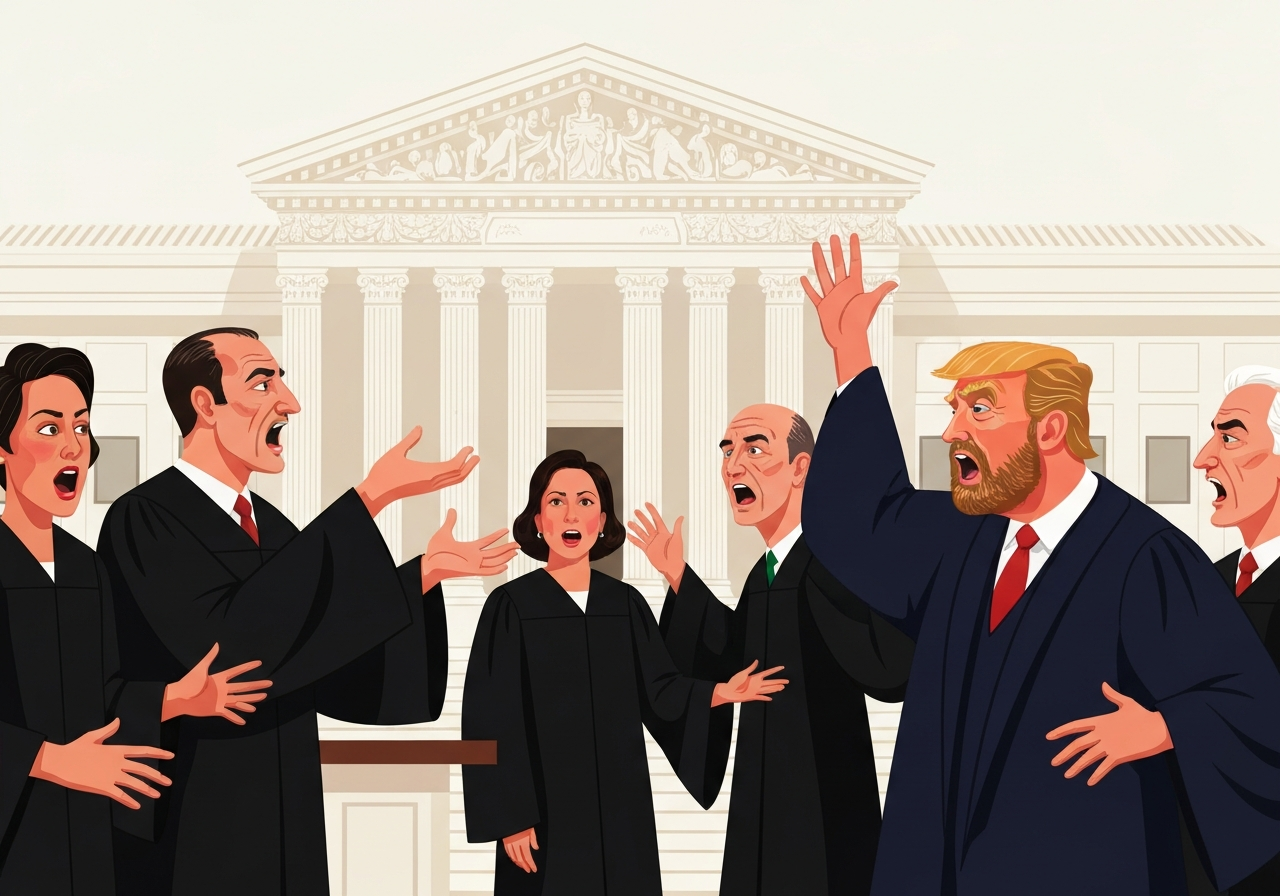
Lead: On a crowded morning outside and a tense session inside the Supreme Court, President Donald Trump left oral arguments over whether the 14th Amendment guarantees automatic citizenship to most people born on U.S. soil. The case — brought by the ACLU and stemming from an administration move to limit birthright citizenship — reopened a nearly 130-year-old precedent from US v. Wong Kim Ark (1898). Justices pressed government and defense lawyers on concepts such as “jurisdiction,” “domicile” and narrow historical exceptions, while protesters and elected officials rallied outside. A decision is expected by June.
Key Takeaways
- The court heard arguments over whether children born in the United States to parents lacking lawful permanent status are automatically citizens under the 14th Amendment; a ruling is expected in June.
- The ACLU’s Cecillia Wang invoked historical examples — including babies born in 1942 Japanese internment camps and the 1924 Indian Citizenship Act — to argue broad application of birthright citizenship.
- The government’s solicitor general, John Sauer, urged a narrower reading tied to parents’ “domicile,” calling current U.S. practice an outlier among modern nations.
- Justices repeatedly questioned the administration’s reliance on limited historical exceptions (diplomats, hostile occupying forces) to justify broader exclusions.
- Chief Justice John Roberts and Justices Elena Kagan and Sonia Sotomayor voiced skepticism about stretching narrow exceptions to cover large immigrant groups.
- More than 100 people queued for scarce public seats; outside, both noisy protests and attentive listeners were present as public speakers and politicians responded in real time.
- President Trump became the first sitting president to attend oral arguments in the chamber; he left the court before proceedings concluded.
Background
The dispute centers on five words in the 14th Amendment: “subject to the jurisdiction thereof,” which courts have long read, following the 1898 decision in US v. Wong Kim Ark, to mean that nearly all persons born on U.S. soil are citizens. That precedent applied to a child born to legal Chinese immigrants and rejected efforts to limit the Amendment’s reach based on parents’ immigration status.
Over time, the United States has recognized only a few narrow exceptions to birthright citizenship: children of foreign diplomats and members of hostile occupying armies, and historically some Native Americans before Congress extended citizenship by statute in 1924 (Indian Citizenship Act). The current administration argues those exceptions show the 14th Amendment was not meant to cover children of undocumented or temporary visitors.
The ACLU filed suit challenging an executive-order-driven effort to restrict automatic citizenship; the Court took the case and scheduled oral argument. The outcome could affect millions of people born in the U.S. and reverberate through immigration, administrative, and family law.
Main Event
Inside the courtroom, Solicitor General John Sauer defended a reading that would tie birthright citizenship to a parent’s “permanent domicile” in the United States. He characterized modern U.S. practice as unusual among contemporary nations and warned of perceived pull factors such as “birth tourism.” Several justices pressed him on how domicile would be determined at birth and whether that approach squares with the text of the 14th Amendment.
ACLU national legal director Cecillia Wang responded by citing historical instances in which children born on U.S. soil were universally treated as citizens — including babies born to Japanese families held in internment camps during World War II. Wang told the court that limiting birthright citizenship would unsettle settled expectations and could imperil the citizenship of many people.
Justices probed both sides energetically. Chief Justice Roberts questioned how narrow historical exceptions could justify disqualifying a sizeable contemporary population. Justice Kagan emphasized the textual link between being “subject to the jurisdiction” and being governed by U.S. law rather than amorphous notions of allegiance. Justice Gorsuch and others pressed the government on obscure historical sources and practical enforcement problems.
Outside, crowds mixed protest and quiet attention. Democratic Senator Alex Padilla addressed demonstrators, saying the 14th Amendment should not be debated away and pledging resistance if the court narrows the rule. Individual attendees, including the son of immigrants Luis Villaguzman, said the proceedings felt personal and historic — especially with the sitting president present.
Analysis & Implications
If the Court narrows or overturns Wong Kim Ark, the immediate legal effect would be to allow the government to exclude some children born in the U.S. from automatic citizenship going forward. The government says the change need only apply prospectively; critics note that future legislatures or administrations could seek retroactive measures, raising denaturalization risks and litigation over long-settled status.
A ruling against broad birthright citizenship would have substantial administrative consequences: federal and state agencies rely on birth-based citizenship in recordkeeping, benefits eligibility, and identity documentation. Courts would face a new wave of cases testing who qualifies as “subject to the jurisdiction” and how domicile should be proven or rebutted at birth.
Politically, a decision curtailing automatic citizenship would hinge on a Court now widely described as conservative-leaning; it would also reshape a central element of immigration politics and likely intensify legislative and electoral battles over immigration and nationality law.
Conversely, upholding Wong Kim Ark would preserve the current near-universal rule and foreclose a major executive-level alteration of nationality policy. It would also affirm a textual and precedent-based approach to the 14th Amendment, limiting the reach of historically narrow exceptions.
Comparison & Data
| Item | Historic/Current Status |
|---|---|
| Wong Kim Ark (1898) | Established birthright for children born in U.S. to immigrant parents |
| Indian Citizenship Act (1924) | Extended citizenship to most Native Americans born in U.S. |
| Common exceptions | Children of diplomats; hostile occupying forces |
The table above highlights key legal markers referenced repeatedly during argument. Those precedents anchor the debate: defenders of broad birthright citizenship emphasize stable judicial constructions since 1898, while the government leans on narrow historical exceptions to argue for a more restricted rule.
Reactions & Quotes
“Even in World War II, when the United States was detaining Japanese nationals…when those enemy aliens had babies in the detention camps, everyone agreed those babies were US citizens.”
Cecillia Wang, ACLU (oral argument)
Wang used the internment example to show consensus across fraught historical moments that birthplace, not parental status, defined citizenship for children born on U.S. soil.
“I’m not quite sure how you can get to that big group from such tiny and sort of idiosyncratic examples.”
Chief Justice John Roberts (questioning Solicitor General)
Roberts expressed skepticism that the government’s reliance on limited exceptions could justify excluding large contemporary populations from birthright citizenship.
“If you’re born here, you are a citizen, it couldn’t be more clear…It’s wrong that the president wants to pick who gets to be an American and who doesn’t.”
Senator Alex Padilla (outside the Court)
Padilla framed the legal stakes in political terms for listeners gathered outside the courthouse and urged defenders of the 14th Amendment to mobilize.
Unconfirmed
- Whether a ruling limiting birthright citizenship would be strictly prospective without any legal mechanism for retroactive denaturalization remains uncertain until the Court’s opinion is published.
- The precise administrative system the government would use to verify parental domicile at the time of every birth has not been detailed or publicly formalized.
- Claims that an executive order was issued “on the first day of his second term” appear in public reporting of the dispute; the practical status and scope of any such executive action may require further confirmation in official records.
Bottom Line
The Supreme Court’s consideration of birthright citizenship presses a foundational constitutional question into contemporary politics and administrative practice. A narrow ruling for the government would allow major changes to who is recognized as an American at birth, with cascading legal and bureaucratic consequences; a decision upholding existing precedent would preserve current expectations and reduce near-term disruption.
Observers should watch the Court’s forthcoming opinion for specific holdings on text, precedent and remedy: whether any change would be prospective or somehow affect existing citizens, and how the Court treats the concepts of jurisdiction and domicile. The decision will likely shape immigration and citizenship debates for years and prompt legislative and administrative responses regardless of outcome.
Sources
- BBC — live coverage of Supreme Court arguments (media: live reporting)
- American Civil Liberties Union (ACLU) (advocacy organization: case counsel)
- US v. Wong Kim Ark, 169 U.S. 649 (1898) (legal archive/academic)