
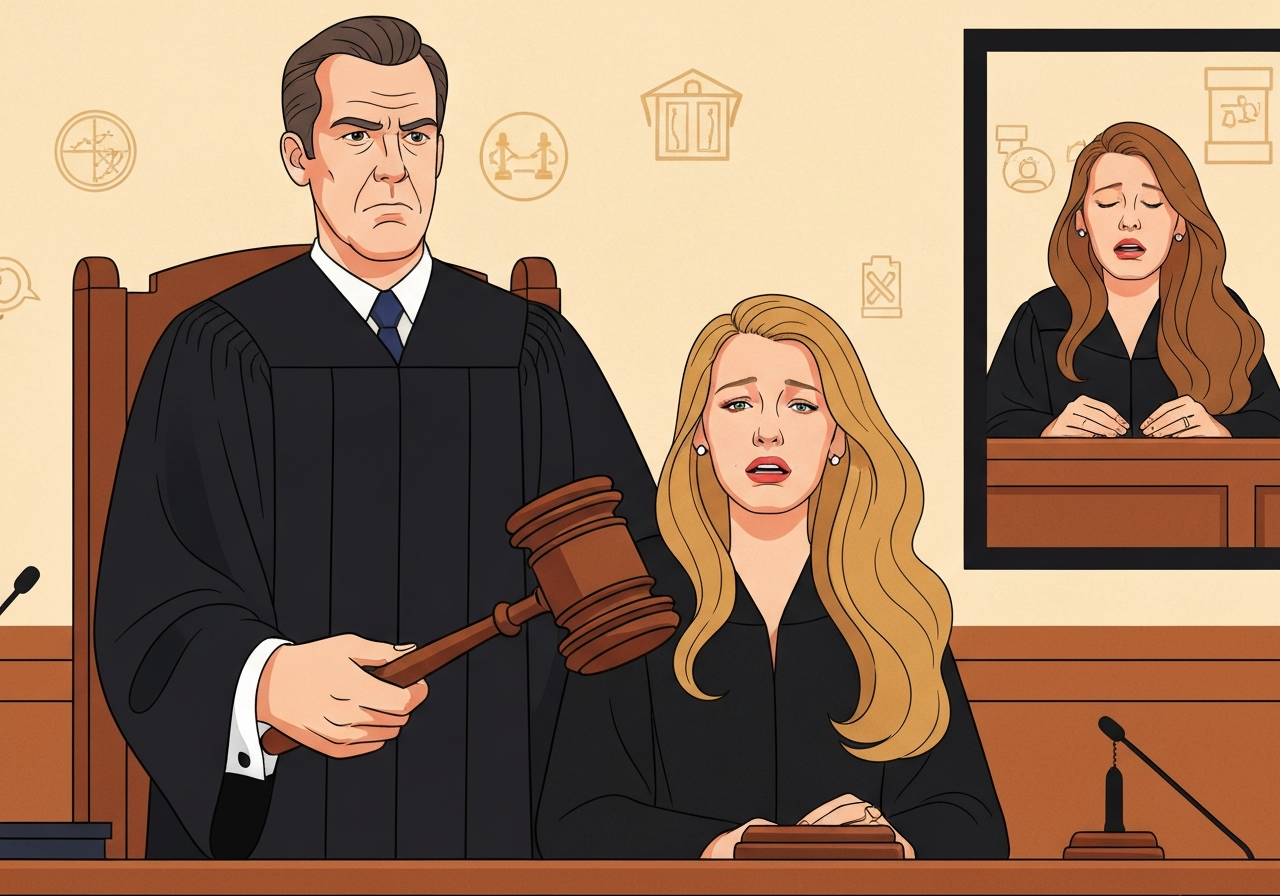
On April 2, 2026, a federal judge in Manhattan ruled that actor Blake Lively’s sexual-harassment claims against co-star and director Justin Baldoni under Title VII must be dismissed, while leaving three claims — including retaliation and a breach-of-rider contract claim — intact for a jury to consider. The written opinion by U.S. District Judge Lewis J. Liman found Lively to be an independent contractor, not an employee, removing Title VII as a basis for the harassment counts. Lively, who sued Baldoni in December 2024 over conduct on the set of the film It Ends With Us, remains scheduled for trial on May 18, 2026. The ruling preserves the central dispute over whether defendants engaged in a campaign that damaged Lively’s reputation and career.
Key Takeaways
- Judge Lewis J. Liman issued the written ruling on April 2, 2026, in the U.S. District Court in Manhattan.
- The court concluded Lively was an independent contractor, so Title VII sexual-harassment claims were dismissed.
- Three claims survived: two retaliation counts (including one against It Ends With Us Movie LLC and Wayfarer Studios) and a breach-of-rider-contract claim.
- A trial is scheduled to begin May 18, 2026, when a jury will hear the remaining allegations.
- Baldoni’s countersuit against Lively and her husband, Ryan Reynolds, was previously dismissed in June 2025.
- The film It Ends With Us opened in August 2024 with a $50 million debut at the box office.
- Judge Liman noted on-record conduct alleged during filming — including on-set comments and physical gestures — while distinguishing acting choices from actionable harassment under Title VII.
Background
The dispute traces to the production of It Ends With Us, a 2024 adaptation of Colleen Hoover’s 2016 novel that mixes romance with darker themes of domestic violence. Blake Lively starred in and produced the film; Justin Baldoni directed and co-starred. Lively sued Baldoni and his production entities in December 2024, alleging sexual harassment, retaliation and related contract claims tied to on-set behavior and a subsequent campaign she says harmed her reputation.
Baldoni and his production company, Wayfarer Studios, responded with counterclaims accusing Lively and her husband, Ryan Reynolds, of defamation and extortion. Those counterclaims were dismissed by the court in June 2025. The procedural fight has been conducted in federal court in Manhattan, where the judge has parsed which legal theories apply when performers are classified as independent contractors versus employees.
The case has unfolded against a high-profile backdrop: the film’s commercial success following its August 2024 release and public reporting about tension during production. Both principals have significant industry profiles — Lively from roles including Gossip Girl (2007–2012) and several films, and Baldoni from directing and acting credits such as Five Feet Apart (2019) and the series Jane the Virgin.
Main Event
In his written opinion, Judge Liman recited specific allegations Lively presented about on-set interactions. She alleges that during filming Baldoni leaned in as if to kiss, kissed her forehead, rubbed his face and mouth against her neck, touched her mouth, flicked her lower lip, caressed her and said, according to the complaint, “it smells good.” The judge acknowledged that if identical conduct occurred in a non-creative workplace it could support a hostile work environment claim.
But Liman concluded those acts occurred in the context of performing a scene and were aimed at Lively’s character rather than clearly directed at Lively herself as an employee. The judge wrote that creative professionals must retain a degree of freedom to experiment within agreed scripts without triggering Title VII liability for ordinary dramatic conduct.
The opinion also flagged other on-set episodes alleged by Lively: Baldoni’s comment “pretty hot” after she removed a jacket exposing a lace bra; an allegedly dismissive reaction when production staff warned the comment was inappropriate; and a scene in which Baldoni pressed for a nude birth sequence that was filmed over hours without closing the set to nonessential personnel. Those factual allegations informed the court’s decision to allow retaliation claims to proceed.
Retaliation claims survived because the judge found sufficient evidence that defendants may have taken steps to harm Lively’s reputation and career out of concern she would pursue discrimination claims. Lively’s counsel says the surviving claims center on a calculated effort to damage her after she raised safety concerns on set.
Analysis & Implications
Legally, the ruling underscores the boundary courts draw between artistic context and workplace protections under Title VII. By classifying Lively as an independent contractor, the court removed the statute most commonly used in workplace harassment litigation, narrowing the available federal remedies. That distinction will be central at trial and in potential appeals.
Substantively, the decision to preserve retaliation and contract-based claims keeps the core factual contest alive. Retaliation law focuses on whether the defendant took adverse actions because the plaintiff engaged in protected activity; jurors will weigh whether alleged public statements or internal steps were materially aimed at harming Lively for complaining or asserting rights.
For the industry, the opinion may reverberate beyond this case. Studios and creative teams will watch how courts treat on-screen conduct tied to performance and where lines are drawn about set safety and closure of sensitive scenes. The ruling could encourage production companies to document consent and safety protocols more meticulously for intimate or nudity-related sequences.
Practically, the decision leaves open reputational and contractual exposure for Baldoni and his companies. Even without Title VII counts, a jury finding on retaliation or breach of contract could impose damages and influence contracts and on-set policies across Hollywood. The outcome may also affect how agents and performers negotiate rider protections and who is classified as an employee versus an independent contractor.
Comparison & Data
| Claim Type | Federal Statute/Contract | Court Ruling |
|---|---|---|
| Sexual harassment (Title VII) | Title VII of the Civil Rights Act of 1964 | Dismissed (Lively deemed independent contractor) |
| Retaliation | Retaliation provisions under civil rights and related state/common-law claims | Survived (jury to decide) |
| Breach of rider agreement | Contract law | Survived (against It Ends With Us Movie LLC) |
The table summarizes the court’s disposition: statutory harassment claims were cut, but retaliation and contract claims remain for trial. This split outcome illustrates how classification (employee vs. contractor) and the factual context of alleged acts can lead to mixed results in litigation involving creative work.
Reactions & Quotes
The parties’ legal representatives framed the next steps differently. Lively’s attorney emphasized the surviving claims and the role of alleged post-complaint conduct in the dispute.
“Ms. Lively looks forward to testifying at trial and continuing to shine a light on this vicious form of online retaliation,”
Sigrid McCawley, counsel for Blake Lively
Judge Liman explained his legal reasoning in the opinion, distinguishing on-screen performance from actionable workplace harassment while acknowledging the seriousness of some alleged conduct.
“Creative artists . . . must have some amount of space to experiment within the bounds of an agreed script without fear of being held liable for sexual harassment,”
Judge Lewis J. Liman (written ruling)
A representative for Baldoni and his production company did not immediately offer a comment to the press after the ruling was released.
Unconfirmed
- The precise scope and participants in the alleged smear campaign remain unverified in public filings and will be litigated at trial.
- Internal communications cited by the complainant or defendants have not been fully disclosed in public reports; their content and timing are therefore not independently confirmed.
- Details about which nonessential personnel were present during the alleged extended birth scene are based on the complaint and have not been corroborated by third-party testimony in court filings available publicly.
Bottom Line
The court’s April 2, 2026 decision narrows the legal theories available to Blake Lively by removing Title VII harassment counts but preserves claims that can still result in significant legal and reputational consequences if a jury finds in her favor. The surviving retaliation and contract allegations ensure the factual record — including contested on-set interactions and post-filming conduct — will be thoroughly examined at trial.
Beyond this case, the ruling highlights cleavages in workplace protections for creative professionals and may prompt changes in how productions document consent, close sets for sensitive scenes and classify talent. Observers should watch the May 18, 2026 trial for how jurors reconcile performance context with alleged misconduct and for any appellate litigation that could clarify employer-employee boundaries in entertainment.