
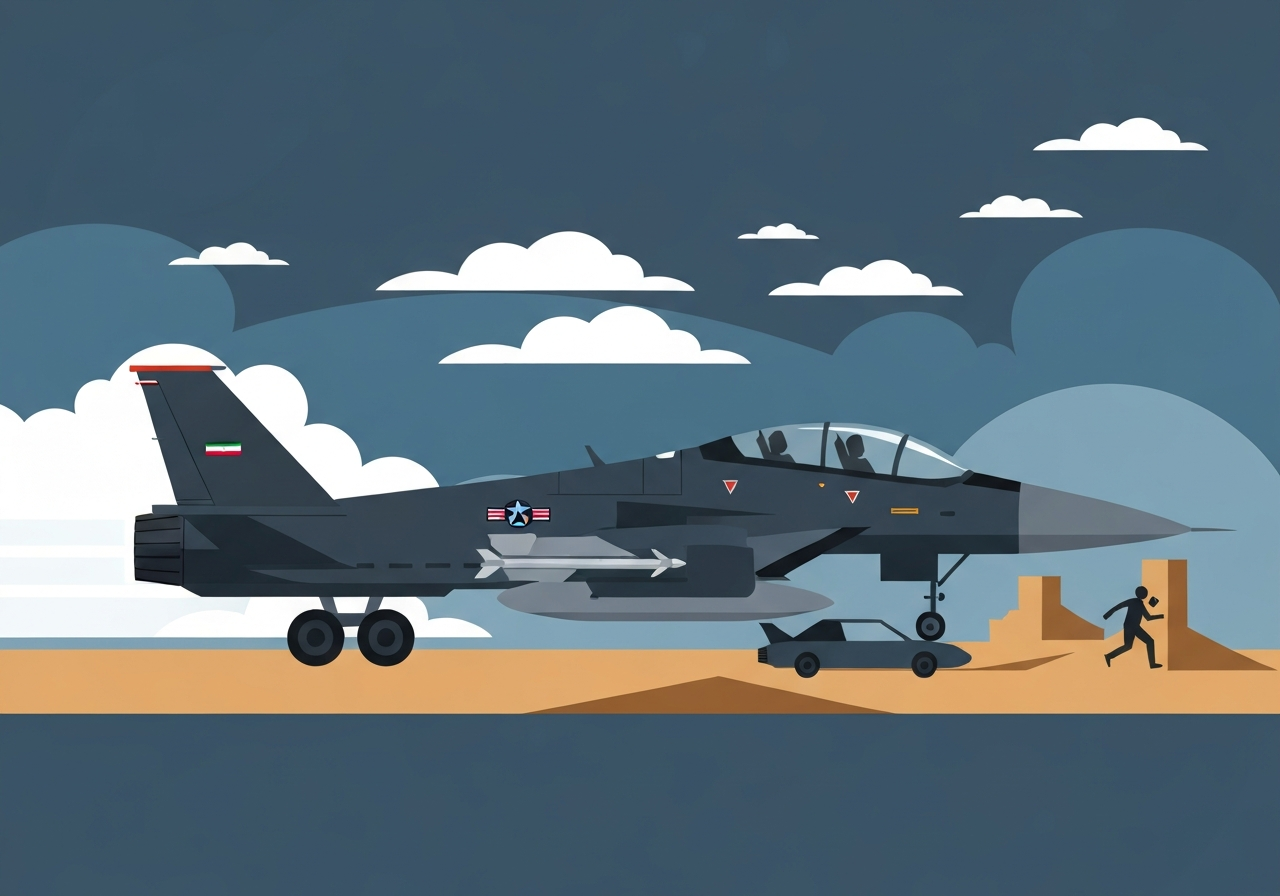
US forces and Iranian authorities mounted competing searches after a US F-15E Strike Eagle was downed in southwestern Iran on Friday, leaving one crew member rescued and a second unaccounted for. US media and officials say a pilot was recovered but a weapon systems officer remains missing; Iran state outlets have urged civilians to help and reported offering a bounty. The US dispatched dedicated combat search-and-rescue teams, while Iran claimed it also shot down an A-10 involved in the recovery effort — the A-10 pilot reportedly ejected and was rescued. The incident unfolded amid broader regional strikes and exchanges that the Pentagon says have left 365 US service members wounded and 13 dead since the war began.
Key takeaways
- One crew member of a downed US F-15E was rescued; a second crew member (reported as the weapon systems officer) remains missing as searches continue.
- Iranian state media reported offering roughly £50,000 ($66,100) to citizens who capture the missing airman; that figure is far above typical local monthly wages.
- Iran claims to have downed a US A-10 Warthog involved in the search; US reporting says the A-10’s pilot ejected over the Gulf and was later rescued.
- Video geolocated to Khuzestan province (31.591393, 50.275430) shows a US aircraft and two helicopters conducting search operations.
- The Pentagon says 365 US service members have been wounded since the start of the US-Israeli war with Iran; breakdown: Army 247, Navy 63, Marines 19, Air Force 36; deaths remain at 13.
- US rescue crews reportedly encountered small-arms fire during recovery operations; Iranian outlets circulated footage of armed civilians searching southern provinces.
- Israeli forces have continued strikes elsewhere in Iran and Lebanon, while some operations near the downing site were reportedly restrained to avoid compromising the search.
Background
The incident comes during a period of expanded hostilities between Iran, Israel and the United States that has intensified over several weeks. Both state and independent outlets report multiple airstrikes, missile launches and interceptions across the region, with Tehran and Tel Aviv exchanging accusations and military actions. US military operations in the area include patrols, strike missions and dedicated search-and-rescue capabilities intended to recover downed aircrews. Historically, US aircraft losses over hostile territory have been rare but consequential — past cases include F-15 crashes in Iraq and friendly-fire losses in the region, underscoring how sensitive such recoveries are.
Iranian state channels have broadcast appeals for civilians to assist in finding the missing airman, offering monetary incentives that analysts say exceed local income norms. Those appeals coincided with circulating videos showing armed groups or civilians mobilising in Khuzestan and nearby provinces. The tactical situation is further complicated by ongoing Israeli strikes in other parts of Iran and Lebanon, which officials say have targeted missile infrastructure and other military sites.
Main event
According to US media quoting officials, an F-15E Strike Eagle was downed over southern Iran on Friday. Two crew members were aboard; one was recovered by US forces, while the other — described as a weapon systems officer — was not located during initial operations. US combat search-and-rescue crews used helicopters and escort aircraft in the recovery attempt, with video verified by independent checks showing search aircraft over the Karun river area in Khuzestan at coordinates 31.591393, 50.275430.
State-affiliated Iranian outlets said citizens should capture the missing airman alive and publicised a reward of about £50,000 ($66,100). Shortly afterwards, videos circulated online showing groups of armed men in at least two southern provinces searching for the crew. In one unverified clip from Khuzestan, men carrying firearms and flags are heard saying they will find the airman, according to captions and audio in the footage.
During the rescue operation, US reporting indicates an A-10 Warthog joined the mission and was subsequently struck; the A-10 pilot reportedly ejected over the Gulf and was recovered by US forces. Iran’s military has claimed it shot down the A-10, but public details remain limited. US helicopters carrying rescued personnel were also reportedly fired upon with small-arms fire during extraction, though they landed safely and evacuated survivors.
Analysis & implications
The immediate tactical race to recover a missing airman has strategic implications beyond a single rescue. If Iran were to detain a US service member, it would create a high-stakes diplomatic and military dilemma that could widen the conflict and force rapid policy choices in Washington. Conversely, rapid US recovery would mitigate the risk of capture being used for leverage. Either outcome affects operational tempo and the rules of engagement for both sides in the short term.
Domestically within Iran, public appeals and rewards signal an intent to mobilise popular support for state objectives, while also reflecting propaganda value. Offering a large cash incentive—circa £50,000—also risks incentivising irregular actors and complicating command-and-control in a volatile border region. For US forces, the possibility of being tracked or engaged during recovery operations increases reliance on specialised pararescue teams and protective air cover, which themselves become targets in congested airspaces.
Regionally, the event may prompt restraint in some targeting decisions — several reports note Israeli commanders held off strikes near the search area to avoid endangering recovery efforts — yet it could also accelerate retaliatory strikes elsewhere. The broader casualty figures released by the Pentagon (365 wounded, 13 dead) underline how attrition is mounting and may push further adjustments in force posture and alliance coordination.
Comparison & data
| Category | Number |
|---|---|
| US wounded since conflict start | 365 |
| Army | 247 |
| Navy | 63 |
| Marines | 19 |
| Air Force | 36 |
| US deaths | 13 |
The casualty breakdown above was provided by the Pentagon; it highlights the disproportionate burden on ground forces. While numbers alone do not capture severity or operational impact, they offer a snapshot of personnel effects and may influence strategic decisions about force allocation and medical evacuation resources.
Reactions & quotes
Officials and analysts responded quickly, offering both operational detail and strategic context.
“The president has been briefed,” the White House statement said, offering limited public detail as military movements continued.
White House (official statement)
“These are the most dangerous missions I know of — specialised rescue teams will not give up while there is a chance of recovery,” said a former senior US envoy, describing the training and persistence of combat rescue units.
James Jeffrey (former US special representative)
“Survivors are trained to evade capture and to sustain themselves; pararescuers provide medical capabilities and extraction under fire,” a defense analyst explained when outlining typical rescue procedures.
Jennifer Kavanagh (Defense analyst)
Unconfirmed
- Whether the A-10 Iran claims to have shot down is the same A-10 reported by US media remains unverified in open-source reporting.
- The exact location and condition of the missing weapon systems officer have not been publicly confirmed by US authorities.
- Some online videos showing armed civilians searching for the crew are unverified and may not represent organised or state-directed operations.
Bottom line
The downing of a US F-15E and the continued search for a missing crew member represent a flashpoint that could rapidly escalate broader hostilities if personnel are captured or killed. Rapid, successful recovery would reduce immediate risk of diplomatic fallout, but the event already complicates operations across a wider regional battlefield.
For policymakers, the incident tightens the timeframe for decisions about force protection, de-escalation channels, and public messaging. Observers should watch for official confirmations about the missing airman’s status, any detention claims, and subsequent changes in military posture from the US, Iran and Israel.
Sources
- BBC Live (breaking live coverage) — media reporting and geolocation verification
- CBS News (US media partner) — reporting quoting US officials on rescue and A-10 involvement
- US Department of Defense (Pentagon) — official casualty figures and statements
- Reuters (news agency) — reporting on regional strikes and incidents
- Israel Defence Forces (official) — statements on strikes in Iran and Lebanon