
Lead
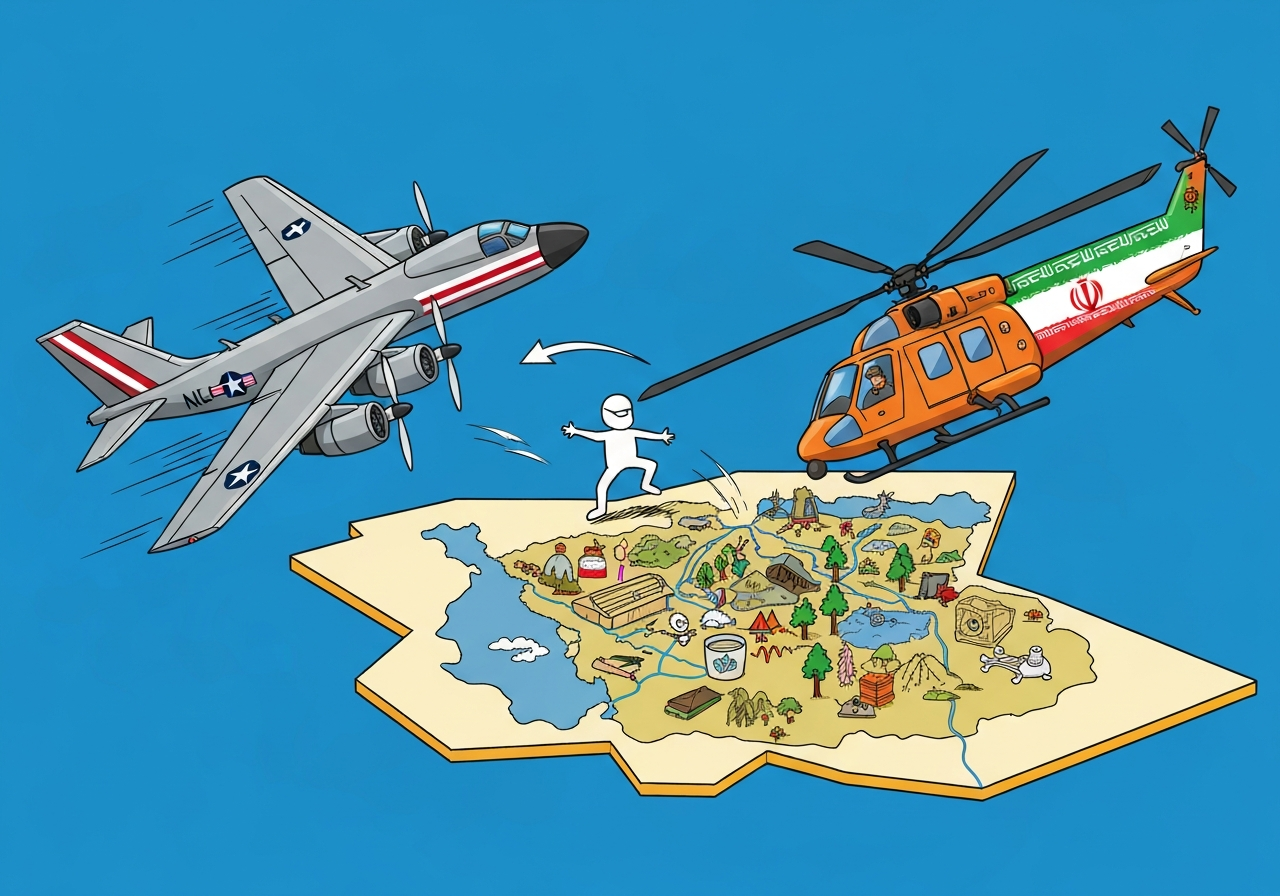
US and Iranian forces raced on 4 April 2026 to locate a crew member from an F-15 shot down over Iran, after Tehran said it downed the jet and state and US media reported one crew member rescued and one still missing. The incident unfolded days into a wider US‑Israel campaign of strikes across Iran and the region and followed reports of an A‑10 also shot down, whose pilot was said to have been recovered. Meanwhile, commercial traffic through the Strait of Hormuz — which carries roughly a fifth of the world’s oil — showed limited movement as a second Turkish‑owned vessel was reported to have exited the waterway.
Key takeaways
- On 4 April 2026 Iran said it shot down a US F-15; US media reported one crew member rescued and one missing, prompting joint search efforts.
- Iran also reported an A‑10 was downed; US sources said that pilot was rescued following the incident.
- Turkey’s transport minister Abdulkadir Uraloglu said two of 15 Turkish‑owned ships in the Strait of Hormuz have left since the conflict began on 28 February; officials are trying to move nine remaining vessels.
- The first Turkish ship was granted safe passage on 13 March after Iranian permission; the timing of the second ship’s transit was not specified.
- Iranian state media reported strikes on the Mahshahr petrochemical zone that wounded five people; Tasnim named damage at Bandar Imam facilities.
- The IAEA said a projectile struck near Bushehr nuclear power plant, that one support‑staff member died, auxiliary buildings were affected, but there was no rise in radiation levels.
- Five EU finance ministers (Germany, Italy, Spain, Portugal, Austria) asked the EU commission to consider a windfall profits tax on energy firms amid price spikes tied to the effective closure of Hormuz.
- Diplomatic visits and high‑level statements — including Italian PM Giorgia Meloni’s Gulf trip — underline growing concern about energy security and regional escalation.
Background
The confrontation between the US, Israel and Iran has escalated since major strikes began in late February 2026. The conflict widened across multiple fronts: airstrikes inside Iran, attacks in Lebanon and Syria, and repeated threats to commercial shipping in the Persian Gulf. Iran’s control over the Strait of Hormuz has emerged as strategic leverage because about 20% of global oil transits that channel; Tehran’s partial chokehold has elevated energy prices and triggered emergency responses from governments worldwide.
Before the April incidents, a small number of commercial vessels had been allowed to transit the strait under Iranian approval. On 13 March, Iranian authorities permitted a Turkish‑owned ship to leave; subsequent diplomatic effort has focused on clearing remaining merchant vessels, many of which are energy carriers or engaged in regional trade. The war has also had humanitarian and peacekeeping consequences: UNIFIL reported multiple incidents in southern Lebanon that have wounded or killed Indonesian peacekeepers in recent days.
Main event
Early on 4 April 2026, Tehran announced it had shot down a US F-15 fighter; Iranian authorities also reported an A‑10 was downed in the Gulf. US and Iranian accounts diverge on details. US media said American special operations forces recovered one of the F‑15 crew and that a second remains missing, prompting concurrent search and recovery operations in rugged south‑west Iran where authorities urged civilian assistance for locating the crew.
The IAEA was informed that a projectile struck close to the Bushehr nuclear power plant earlier that morning. Iranian outlets reported one death among site protection staff and shockwave damage to an auxiliary building; the IAEA later said it detected no increase in radiation but that the director general expressed “deep concern” about possible impacts to backup systems and vital safety equipment.
On the same day, Iranian state media reported US‑Israeli airstrikes on the Mahshahr petrochemical special zone that wounded five people and damaged facilities at Bandar Imam. Israel said it had targeted Hezbollah infrastructure in Beirut and struck Tehran sites, including air‑defence and missile storage facilities; the IDF posted brief statements describing those objectives as degrading Tehran’s strike capacity.
Separately, Turkey’s transport minister Abdulkadir Uraloglu told CNN Turk that a second Turkish‑owned vessel had passed through the Strait of Hormuz after the war began on 28 February. He said 15 Turkish‑owned ships were in the strait when hostilities began, two have left, four had not requested to leave, and Turkish authorities were coordinating with the foreign ministry to remove nine remaining ships.
Analysis & implications
The recovery operation for the missing F‑15 crew member is both a tactical priority and a political flashpoint. If Iran holds a US airman, it could use that person to press demands in negotiations or as leverage in the broader theatre; conversely, a successful US recovery would demonstrate operational reach despite strikes inside Iran. Either outcome will influence domestic political debates in the US and allies’ calculations about escalation risk.
Control of the Strait of Hormuz has become central to the conflict’s economic and diplomatic fallout. Iran’s intermittent allowance of transits — such as the French CMA CGM container ship and Turkish vessels — signals selective de‑escalation but not a full reopening. That ambiguity preserves Tehran’s leverage: keeping the strait effectively constrained continues to lift global fuel prices and spur calls, such as the EU ministers’ letter, for redistributive measures like a windfall tax on energy companies.
Strikes near critical infrastructure — petrochemical zones and a civilian nuclear plant per Iranian reports — raise the possibility of unintended escalation and non‑military damage. The IAEA’s involvement and its public expressions of concern make clear that even limited damage to auxiliary systems is politically sensitive, prompting additional international scrutiny and potential pressure on both Tehran and its opponents to avoid attacks that could risk radiological consequences.
Comparison & data
| Item | Relevant figure |
|---|---|
| Ships Turkish‑owned in Hormuz at outbreak | 15 |
| Turkish ships escaped so far | 2 |
| Proportion of world oil via Hormuz | ~20% |
| Conflict start date | 28 February 2026 |
| First Turkish ship cleared | 13 March 2026 |
These figures show the narrow margin for commercial traffic through Hormuz: a small number of vessels account for a disproportionate share of regional trade and energy transit, which helps explain why diplomatic channels have been urgently engaged to clear remaining ships while states weigh the cost of escort operations or alternate routing.
Reactions & quotes
The IAEA said it had been informed that a projectile struck near Bushehr and warned of possible secondary effects on vital safety equipment; the agency’s director general expressed deep concern.
IAEA (international agency)
“We are working in coordination with the ministry of foreign affairs to remove the remaining nine ships,” Turkey’s transport minister Abdulkadir Uraloglu said regarding Turkish‑owned vessels in the strait.
Abdulkadir Uraloglu / CNN Turk (Turkish official / broadcaster)
President Trump told NBC that the loss of the F‑15 would not alter negotiation posture and said the situation did not mean the war was over.
Former US President Donald Trump (comment to NBC)
Unconfirmed
- Exact timing and route of the second Turkish‑owned ship’s transit through Hormuz has not been independently verified beyond the transport minister’s statement.
- Attribution for the strikes near Bushehr and the Mahshahr petrochemical zone remains contested; the US and Israel had not issued immediate, detailed claims of responsibility at the time of reporting.
- Reports that Iran used recovered air‑defence assets or underground bunkers to reconstitute missile capacity are based on intelligence reporting and open‑source reconstructions; independent confirmation of repair timelines is limited.
Bottom line
The April 2026 downing of a US F‑15 and related strikes deepen an already volatile regional crisis by adding a high‑value human recovery and nuclear‑adjacent damage to the list of risks. The missing crew member issue could become a bargaining chip or a trigger for wider retaliation depending on how rescue and diplomatic efforts unfold.
Commercial traffic through the Strait of Hormuz remains fragile: selective safe passages have occurred, but the bulk of shipping is deterred by Iranian threats and military activity. That constrained flow sustains energy price shocks and strengthens calls in Europe for measures such as windfall taxes to shield consumers from the war’s economic fallout.
Expect continued diplomatic activity in the Gulf, urgent international monitoring of nuclear and petrochemical sites, and intensified search‑and‑rescue operations in the immediate hours and days ahead. How these strands resolve will shape whether the crisis slides toward wider regional confrontation or a managed de‑escalation with heavy economic and humanitarian costs.
Sources
- The Guardian — live reporting (international news outlet).
- International Atomic Energy Agency (IAEA) — press centre (international agency statement).
- Reuters — news agency (news reporting on intelligence and EU finance ministers).
- Tasnim — Iranian state media (state media reporting on strikes and casualties).
- CNN Turk — broadcaster (interview source for Turkish transport minister).