
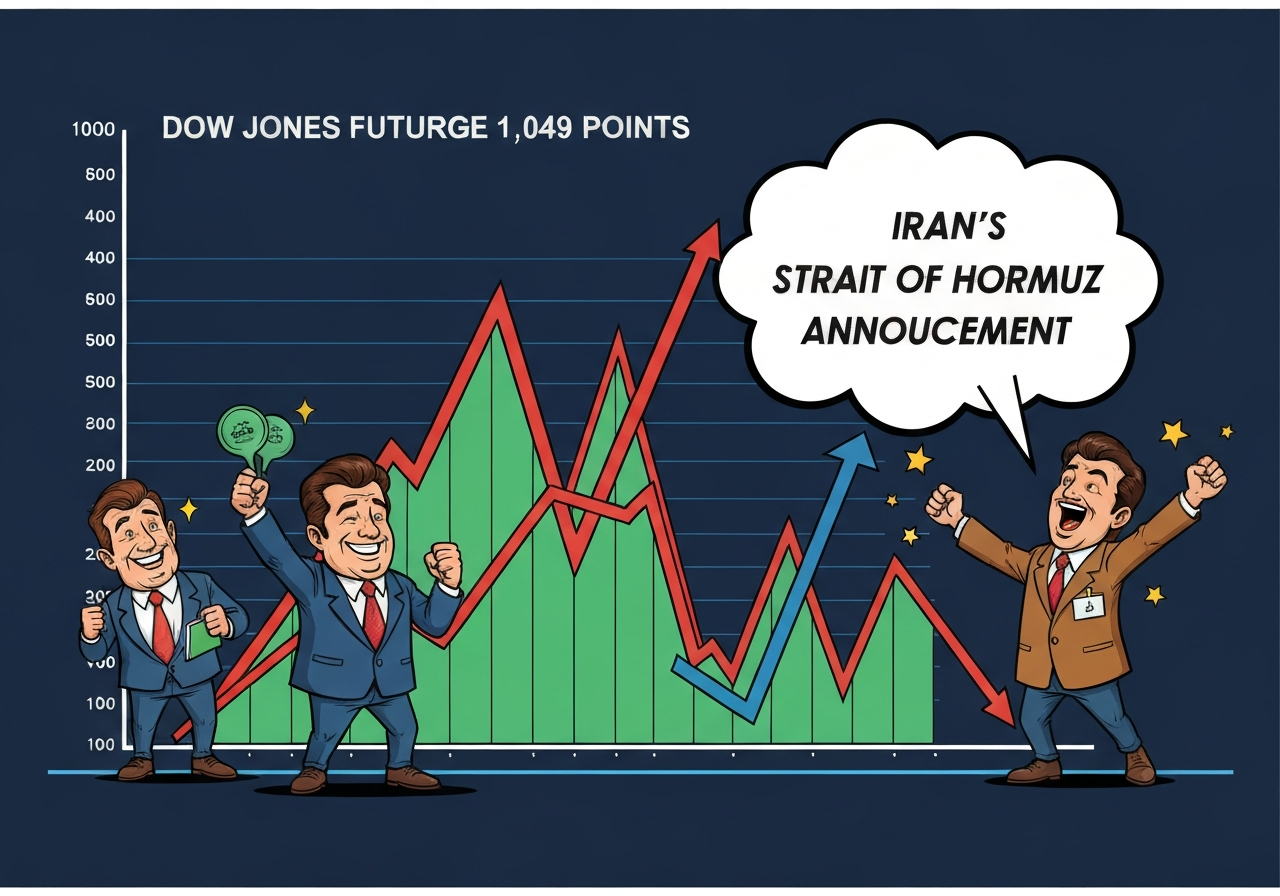
Lead: U.S. equity markets surged on April 16, 2026, after Iran announced that the Strait of Hormuz would be “completely open” to commercial traffic during a ceasefire between Israel and Lebanon. The Dow Jones Industrial Average rose 1,049 points (2.2%), while the S&P 500 climbed 1.4% and crossed 7,100 intraday for the first time; the Nasdaq gained 1.6%. Oil prices plunged amid reduced supply-disruption concerns, prompting broad-sector rotation into travel and cyclical names.
Key Takeaways
- The Dow advanced 1,049 points, a 2.2% gain, after Iran declared the Strait of Hormuz open during the ceasefire announced April 16, 2026.
- The S&P 500 rose 1.4% and briefly traded above 7,100, while the Nasdaq Composite gained 1.6% and both indices hit new intraday records.
- U.S. crude (WTI) tumbled intraday—at one point down roughly 14% and trading above $80 per barrel; later quotes showed May WTI near $85.37 and Brent around $90.38 as volatility persisted.
- The small-cap Russell 2000 reached a fresh high above 2,750 (previous peak 2,735 on Jan. 22), up roughly 14% from its March 30 low.
- Consumer discretionary led S&P sectors, rising about 2.5%, with cruise lines (Royal Caribbean, Norwegian, Carnival) surging more than 9%.
- President Donald Trump said the leaders of Israel and Lebanon agreed to a 10-day ceasefire effective 5 p.m. ET on April 16; Iran’s foreign minister posted the Strait reopening on X.
- Strategists cautioned the reopening is temporary and conditional: Iran requires vessels to follow a coordinated route and said the opening applies for the ceasefire period through April 21.
Background
The announcement that commercial shipping could resume through the Strait of Hormuz followed a ceasefire agreement between Israel and Lebanon that U.S. President Donald Trump said would last 10 days and took effect at 5 p.m. ET on April 16, 2026. The Strait of Hormuz is a strategic chokepoint through which a significant share of global oil shipments transit; any Iranian threat to close or restrict traffic historically spikes energy and insurance costs and unnerves global markets.
Since hostilities escalated earlier in 2026, markets priced in a range of scenarios from short-lived disruptions to prolonged supply shocks. The expectation that the conflict could de-escalate—combined with comments from Tehran that commercial routes would be coordinated during the ceasefire—shifted investor focus back to growth and corporate fundamentals. The move came after several sessions of volatility in both equities and commodities.
Main Event
On April 16, Iranian Foreign Minister Seyed Abbas Araghchi posted on X that, in line with the Israel-Lebanon ceasefire, passage for commercial vessels through the Strait of Hormuz was “completely open” for the remaining ceasefire period on a coordinated route announced by Iran’s maritime authority. Markets reacted immediately: the large-cap Dow jumped 1,049 points and the S&P and Nasdaq hit intraday records.
Oil markets fell sharply as traders pared worst-case disruption scenarios. At one point U.S. West Texas Intermediate futures fell about 14% and traded above $80 per barrel; intraday quotes later showed May WTI near $85.37 and Brent around $90.38. The rapid moves reflected both relief and high short-term volatility as participants rebalanced positions.
Industries sensitive to regional shipping risks led equity gains. Cruise companies and airlines reversed earlier losses, with Royal Caribbean and peers rallying more than 9% and Boeing advancing roughly 3%. Retail and travel-related names such as Amazon and Airbnb also moved higher as investors rotated toward cyclicals on the view that the supply threat had eased.
Market strategists noted breadth and rotation: the Russell 2000 climbed above 2,750—surpassing its Jan. 22 high of 2,735—reflecting a small-cap rebound of about 14% since March 30. Despite the one-day surge, some analysts urged caution, citing the temporary nature of the reopening and remaining geopolitical uncertainty.
Analysis & Implications
The immediate market reaction shows how sensitive global asset prices remain to developments in the Middle East. A credible, even temporary, reopening of the Strait trims near-term risk premia for oil and shipping insurance, lowering one input into inflation and corporate cost forecasts. That dynamic explains the steep decline in oil and the equity rally concentrated in trade- and travel-exposed sectors.
However, relief may be fragile. Iran conditioned the reopening on a coordinated transit route and tied the window to the ceasefire period through April 21. If negotiations falter or a subsequent incident occurs, prices and risk assets could reprice quickly. Strategists from Wells Fargo and other firms warned markets should not assume a permanent resolution.
For policy and geopolitics, the episode underscores the leverage of maritime chokepoints. Even a temporary accommodation by Tehran reshapes bargaining space among regional actors and external powers. The U.S. administration’s posture—simultaneously publicly thanking Tehran for reopening and asserting naval blockades remain—illustrates a delicate mix of diplomacy and deterrence that investors will watch closely.
Economically, lower oil prices will be welcomed by consumption and profit margins in oil-importing economies, but energy-sector capital spending and national revenues tied to hydrocarbons could be pressured if prices stay lower. For market positioning, the rally suggests investors are willing to look past the conflict in the short term, but they will require clearer earnings visibility and macro signals—particularly for growth-sensitive technology names—to sustain higher valuations.
Comparison & Data
| Market / Commodity | Intraday Move (April 16, 2026) |
|---|---|
| Dow Jones Industrial Average | +1,049 points (+2.2%) |
| S&P 500 | +1.4% (crossed 7,100 intraday) |
| Nasdaq Composite | +1.6% (intraday high) |
| Russell 2000 | New all-time high above 2,750 |
| WTI crude (intraday) | Down ~14% at one point; traded above $80, later quoted near $85.37 |
| Brent crude (intraday) | Down ~13% at worst; later around $90.38 |
The table summarizes key index and oil moves on April 16, 2026. Note that oil quotes moved quickly across the trading day; the initial large percentage drops reflected short-term de-risking and then partial price recovery into later quotes.
Reactions & Quotes
“In line with the ceasefire in Lebanon, the passage for all commercial vessels through Strait of Hormuz is declared completely open,”
Seyed Abbas Araghchi, Iranian foreign minister (social post)
Araghchi’s post triggered immediate relief in markets; he also specified vessels must transit via a coordinated route announced by Iran’s maritime authority.
“This process should go very quickly… the U.S. navy’s blockade of Iranian ports will remain in full force until a peace agreement is reached,”
President Donald Trump (social post)
Trump thanked Iran for the reopening and said leaders agreed to a 10-day ceasefire effective 5 p.m. ET on April 16; his comments emphasized both diplomatic progress and continued U.S. military pressure.
“Markets care more about the free flow of oil in the short term…we urge some caution,”
Doug Beath, Wells Fargo Investment Institute (global equity strategist)
Beath warned the opening is conditional and could include transit rules or fees; he said investors should not assume a permanent de-escalation.
Unconfirmed
- Whether Iran will permanently refrain from closing the Strait: Iranian statements tie the opening to the ceasefire; a durable commitment has not been independently verified.
- Claims that Iran agreed to “never close the waterway again” as stated by the U.S. president are not corroborated by an independent, formal treaty text at this time.
- Potential charges or tolls for tankers following Iran’s designated route remain possible but unconfirmed; Iran’s post did not explicitly rule out fees.
Bottom Line
The markets interpreted Iran’s temporary reopening of the Strait of Hormuz as a material reduction in near-term supply risk, prompting a broad equity rally, sharp falls in oil and sector rotation toward travel and cyclical names. The scale of the move—Dow +1,049 and S&P crossing 7,100—reflects both relief and compressed risk premia that had been priced into assets.
Investors should treat the development as meaningful but potentially reversible. The opening is explicitly conditional on the 10-day ceasefire through April 21, 2026, and operational details (routes, fees, enforcement) remain under Tehran’s control. Markets will look for durable diplomatic outcomes and clearer economic signals—earnings, inflation, and central-bank guidance—to determine whether this rally has staying power.