
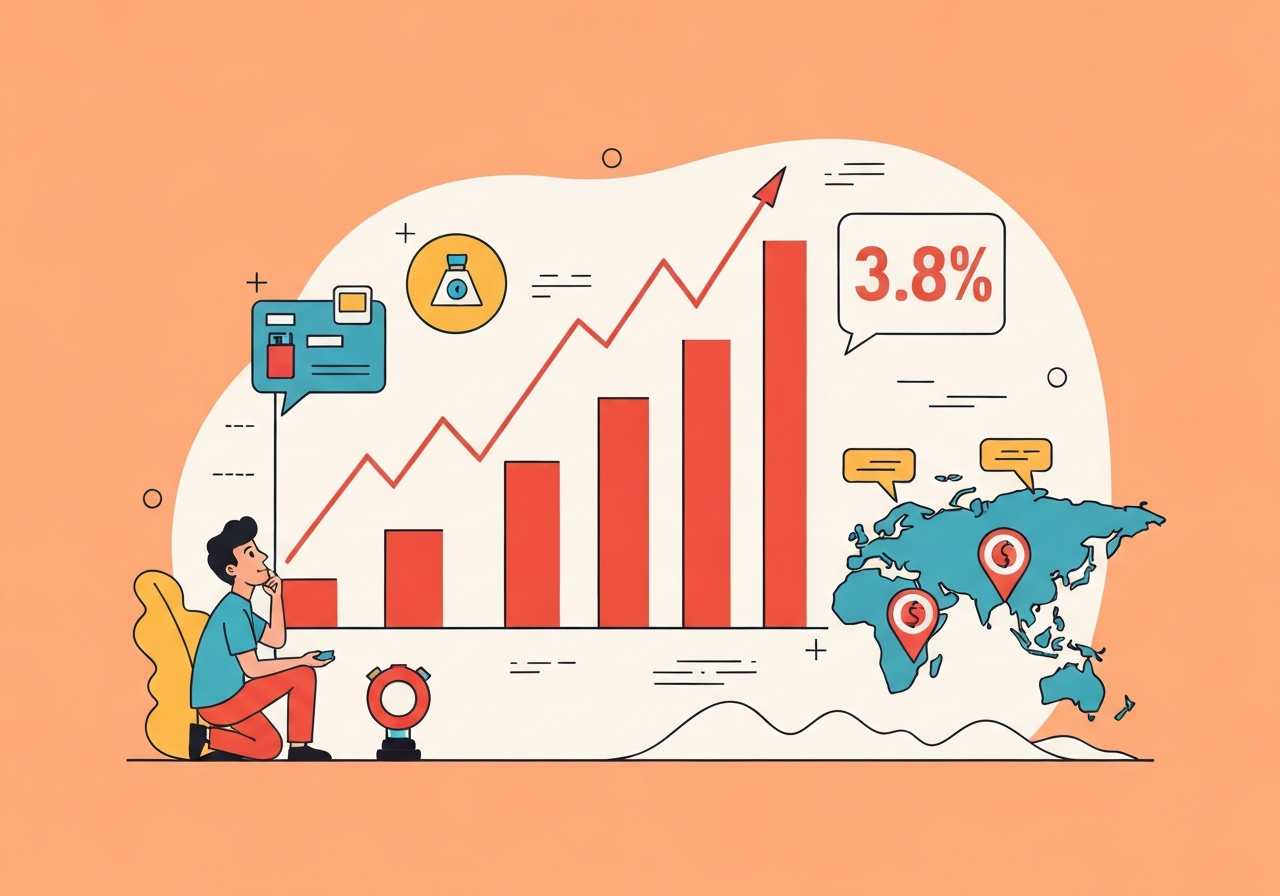
US consumer inflation accelerated to 3.8% in April, the fastest annual pace since May 2023, driven largely by a sharp rise in energy costs linked to the conflict in Iran. The Bureau of Labor Statistics reported the CPI climbed from 3.3% in March as higher gasoline and grocery prices pushed the overall index up. National average unleaded gasoline reached about $4.50 per gallon, the highest since July 2022, compounding pressure on household budgets. The rise makes a Federal Reserve rate cut this year increasingly improbable and complicates the political landscape ahead of the November elections.
Key Takeaways
- Headline CPI rose to 3.8% in the 12 months to April, up from 3.3% in March, according to the BLS.
- Almost half of April’s monthly increase was attributable to energy, with gasoline prices the largest single contributor.
- Average US unleaded gasoline price stood at $4.50 per gallon, the highest level since July 2022 (AAA data).
- Housing and food costs also added to the April increase, while new vehicle prices edged down slightly year-on-year.
- Market expectations for an interest-rate cut this year have decreased; some analysts say further hikes cannot be ruled out.
- Geopolitical disruption around the Strait of Hormuz has lifted oil prices, feeding through quickly to pump prices in the US.
Background
Inflation in the United States has moderated from the peak levels seen in 2022, but readings have remained above the Federal Reserve’s 2% target for an extended period. Energy prices are historically volatile and can move quickly when supply routes or production are threatened; the Strait of Hormuz is one of the world’s most important oil chokepoints. Recent hostilities involving Iran have effectively disrupted shipping in that corridor, prompting a surge in global crude prices that filters into domestic fuel costs.
Monetary-policy decisions over the past two years have focused on reining in excessive demand and anchoring inflation expectations. The Fed raised rates aggressively in 2022 and has since been weighing when and how to ease policy. Political developments — including the incoming Federal Reserve chair appointment and ongoing electoral campaigns — add pressure to central bank strategy, but the BLS data will be a primary input for policy deliberations.
Main Event
The BLS’s April CPI release showed a 3.8% annual increase in consumer prices, reflecting monthly moves concentrated in energy and food categories. Gasoline prices jumped substantially after crude oil rose on concerns about oil shipments through the Strait of Hormuz being disrupted by the Iran conflict. Grocery prices also rose, partly reflecting higher transportation and fuel costs passed through supply chains.
Housing costs continued to weigh on CPI, contributing meaningfully to the overall annual pace. In contrast, new-vehicle prices fell slightly over the 12 months to April, offering a modest offset to other upward pressures. Analysts noted the composition matters: when energy moves are large, headline inflation can spike even as underlying measures show more gradual trends.
Market commentary following the release emphasized policy implications. With inflation running hotter than in March, traders pared back the probability of a rate cut this year and priced in a non-trivial chance of additional tightening if inflation does not return toward 2% on a sustainable basis. Leadership change at the Fed was also highlighted as a factor that could shape the central bank’s policy stance going forward.
Analysis & Implications
Short-term: The immediate effect of higher gasoline prices is a direct squeeze on household discretionary spending; lower-income households tend to feel fuel and food price shocks most acutely. A sustained period of elevated energy costs risks slowing consumer spending on other categories, which could dampen overall growth later in the year.
Monetary policy: The April surprise complicates the incoming Fed chair’s task. If inflation remains elevated, the Fed may delay easing or even consider resuming a restrictive stance, depending on incoming data. Markets will closely watch labour-market indicators and core inflation readings that strip out volatile energy and food to judge underlying momentum.
Fiscal and political effects: Higher inflation ahead of November heightens pressure on the administration and Republican incumbents who have campaigned on lowering prices. Policymakers may face calls for targeted relief measures — for instance, fuel subsidies or tax credits — but such steps have trade-offs and uncertain effects on headline inflation.
Comparison & Data
| Series | March 2024 | April 2024 |
|---|---|---|
| Headline CPI (annual) | 3.3% | 3.8% |
| Average unleaded gasoline (US) | ~$4.20/gal | $4.50/gal |
| Highest gasoline level since | — | July 2022 |
The table illustrates the month-over-month change in headline CPI and the jump in average pump prices. While headline inflation has risen, core measures that exclude food and energy may display a different trajectory; analysts use those to assess whether the inflation pickup is broad-based or concentrated in volatile components.
Reactions & Quotes
“The jump in April’s CPI puts rate cuts this year out of reach unless inflation falls sharply in coming months,”
Isaac Stell, Wealth Club (investment manager)
This assessment reflects market sentiment that the Fed will require more evidence of easing price pressures before lowering borrowing costs. Stell also warned the incoming Fed chair may have limited latitude to loosen policy quickly.
“Nearly half of this month’s increase was driven by higher energy prices,”
Bureau of Labor Statistics (official data summary)
The BLS data release quantified the contribution of energy to April’s monthly change, underscoring how external shocks to oil markets can rapidly affect headline inflation readings.
Unconfirmed
- Whether the Strait of Hormuz is fully closed: reports describe effective disruption, but the exact scope and duration of any closure are evolving and not uniformly confirmed.
- Projected Fed actions under the incoming chair: statements about likely policy shifts are based on market expectations and analyst commentary, not confirmed policy decisions.
Bottom Line
April’s 3.8% CPI print marks a notable uptick driven chiefly by energy and food costs, tightening the policy trade-offs facing the Federal Reserve. The spike makes a near-term rate cut unlikely and raises the chance that the Fed will maintain or even extend its restrictive stance if inflationary pressures persist.
For households, higher gasoline and grocery bills will be the immediate impact; for markets and policymakers, the reading underscores the sensitivity of headline inflation to geopolitical shocks. Watch incoming monthly data on core inflation, wages, and labour-market participation to judge whether April represents a temporary blip or the start of a more sustained trend.
Sources
- BBC News — Media (news report summarising BLS data and market reaction)
- Bureau of Labor Statistics (BLS) — Official (monthly CPI release)
- AAA — Industry data (national average gasoline prices)