
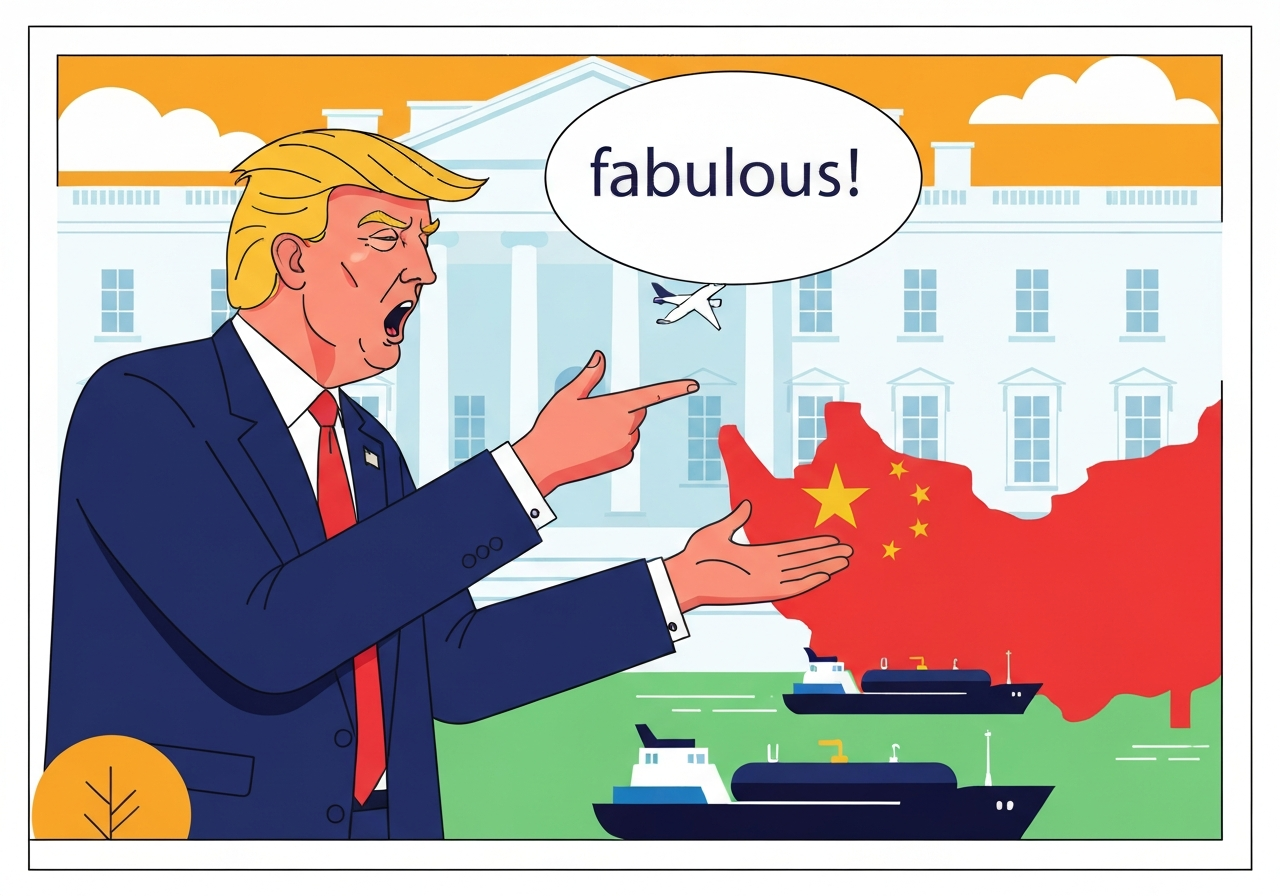
President Donald Trump concluded a three-day state visit to Beijing on Friday by describing the trip as producing “fantastic trade deals,” but few concrete confirmations followed his remarks. Markets reacted cautiously: China’s benchmark CSI 300 Index fell 1.1% on Friday for a second consecutive day and ended the week down 0.3%. Officials and the White House offered piecemeal details — including possible purchases of up to 200 Boeing jets and multi‑billion-dollar agricultural orders — but formal, verifiable agreements were not announced before Trump departed for the United States.
Key Takeaways
- Trump completed a three‑day state visit to Beijing and publicly hailed unspecified “fantastic trade deals.”
- China’s CSI 300 Index slipped 1.1% on Friday and was down 0.3% for the week, reflecting investor profit‑taking.
- Tech benchmarks — the Star Market 50 and ChiNext 50 — retreated from record highs amid optimism that U.S. export curbs on advanced technologies might ease.
- The White House suggested China could buy as many as 200 Boeing jets and “double‑digit billions” in U.S. agricultural goods annually over the next three years.
- Beijing reportedly signalled interest in purchasing U.S. crude oil, though details and timelines were not provided.
- No comprehensive, signed trade package was released publicly during or immediately after the visit; most specifics came from administration statements and interviews.
Background
This visit followed months of intermittent diplomatic engagement between Washington and Beijing amid persistent tensions over trade, technology controls, and strategic rivalry. U.S. export restrictions on semiconductors and other cutting‑edge technologies have been a central point of contention, affecting large Chinese tech firms and shaping investor expectations about future market access. Chinese markets had rallied on hopes of partial relaxation of those curbs, lifting tech‑heavy indices to records earlier in the week before Friday’s pullback.
State visits historically combine public diplomacy with private negotiations; presidents often highlight progress while leaving final contractual steps to ministries, agencies or commercial parties. The contrast between high‑profile photo opportunities, public statements and the slower mechanics of trade implementation means declarations at the summit are typically followed by a period of verification and paperwork. Key stakeholders include U.S. aerospace manufacturers, agricultural exporters, state‑owned and private Chinese energy buyers, and regulators on both sides.
Main Event
Across two days of bilateral meetings with President Xi Jinping, Mr. Trump framed the talks as productive and mutually beneficial. He told reporters on Friday: “This has been an incredible visit. I think a lot of, a lot of good has come of it. We’ve made some fantastic trade deals, great for both countries.” Aside from that statement, the administration offered selective numbers and timelines in media interviews rather than releasing full memoranda or signed contracts.
Market participants and commentators parsed those comments for tangible outcomes. The administration indicated potential near‑term commercial activity: up to 200 Boeing commercial aircraft could be bought, and China might increase U.S. agricultural imports to the “double‑digit billions” annually over the next three years. Beijing was also reported to have expressed interest in U.S. crude oil purchases. None of these elements was accompanied by a trade‑level confirmation or serially published agreements at the time of Trump’s departure.
Financial markets reacted with modest volatility. The CSI 300 dropped 1.1% on Friday in a second straight daily decline, while the Star Market 50 and ChiNext 50 fell from record levels recorded earlier in the week amid earlier optimism. Traders cited profit‑taking on a recent tech rally and uncertainty over whether announced intentions would translate into enforceable contracts or immediate shipments.
Analysis & Implications
If the administration’s headlines are followed by concrete purchase orders, the economic impacts could be meaningful for select U.S. exporters. A confirmed order of up to 200 Boeing jets would represent a significant revenue stream for the aerospace sector and releasable export activity after years of trade friction. Similarly, sustained agricultural purchases in the “double‑digit billions” annually would support U.S. farm income and related supply chains, provided that commitments are contractual and durable over multiple years.
However, verbal affirmations at a state visit do not automatically resolve regulatory or political barriers. Implementing large cross‑border sales requires export licenses, financing arrangements, delivery timetables and compliance with both U.S. and Chinese regulatory frameworks. For technology sectors, potential easing of export curbs would need formal policy changes and agency rulings; mere optimism on the sidelines of a summit does not equate to a policy reversal.
For Chinese markets, the near‑term effect may be limited to sentiment shifts. Stock moves in the days around the visit — including the run‑up of tech indices and subsequent profit‑taking — signal that investors are pricing possibility rather than certainty. Macroeconomic ripple effects hinge on whether purchases are immediate and large enough to alter trade balances or whether they are phased, contingent or conditional on parallel negotiations.
Comparison & Data
| Index | Change (Friday) | Change (Week) |
|---|---|---|
| CSI 300 | -1.1% | -0.3% |
| Star Market 50 | Down from weekly record | Up earlier, then retreated |
| ChiNext 50 | Down from weekly record | Up earlier, then retreated |
The table highlights the immediate market reaction: a modest decline in the broad CSI 300 and pullbacks in technology‑heavy gauges after earlier gains. This pattern is consistent with short‑term profit‑taking after rallies driven more by expectations of policy easing than by confirmed legal changes or shipment data. Longer‑term comparisons will require verified deal announcements and delivery figures.
Reactions & Quotes
Traders and analysts adopted a cautious tone, emphasizing the gap between public statements and completed transactions. Many market participants noted that the administration’s public comments provided a directional signal but lacked the legal and logistical details needed to count as finalized sales.
“This has been an incredible visit. I think a lot of, a lot of good has come of it. We’ve made some fantastic trade deals, great for both countries.”
President Donald Trump
Separately, market observers summarized investor sentiment without attributing a single speaker: investors expressed concern that announcements were more aspirational than binding, prompting profit‑taking after a record stretch for Chinese tech stocks and elevating short‑term volatility.
“Investors are parsing words rather than signed contracts, which has led to swift market adjustments following the trip.”
Market observers (summary)
Unconfirmed
- China’s purchase of as many as 200 Boeing aircraft was described by U.S. officials and media interviews but had not been confirmed with signed contracts at the end of the visit.
- Claims of “double‑digit billions” in annual U.S. agricultural purchases over the next three years were announced in interviews but lacked published purchase agreements or schedules.
- Reports that Beijing agreed to buy U.S. crude oil were signalled informally; firm contracts and delivery timetables were not publicly available at the time.
- Any definitive easing of U.S. export controls on advanced technologies remains unconfirmed and would require formal regulatory action beyond summit statements.
Bottom Line
The Beijing visit produced high‑visibility statements of intent and optimistic headlines, but substantive verification is still pending. Market reactions — including the CSI 300’s 1.1% drop on Friday and the pullback from tech records — indicate investors are treating the announcements as conditional signals, not completed deals. Policymakers and commercial parties will need to follow through with written agreements, regulatory approvals and logistical planning for the touted purchases to materialize.
Observers should watch for formal announcements from companies (for example, Boeing), ministries and trade agencies, and for any agency rulings on export controls that would materially change market access. Until such documents and approvals appear, the summit’s economic footprint will remain largely contingent and monitored through market flows and subsequent official disclosures.
Sources
- South China Morning Post — News reporting on the state visit and market reaction