
Lead
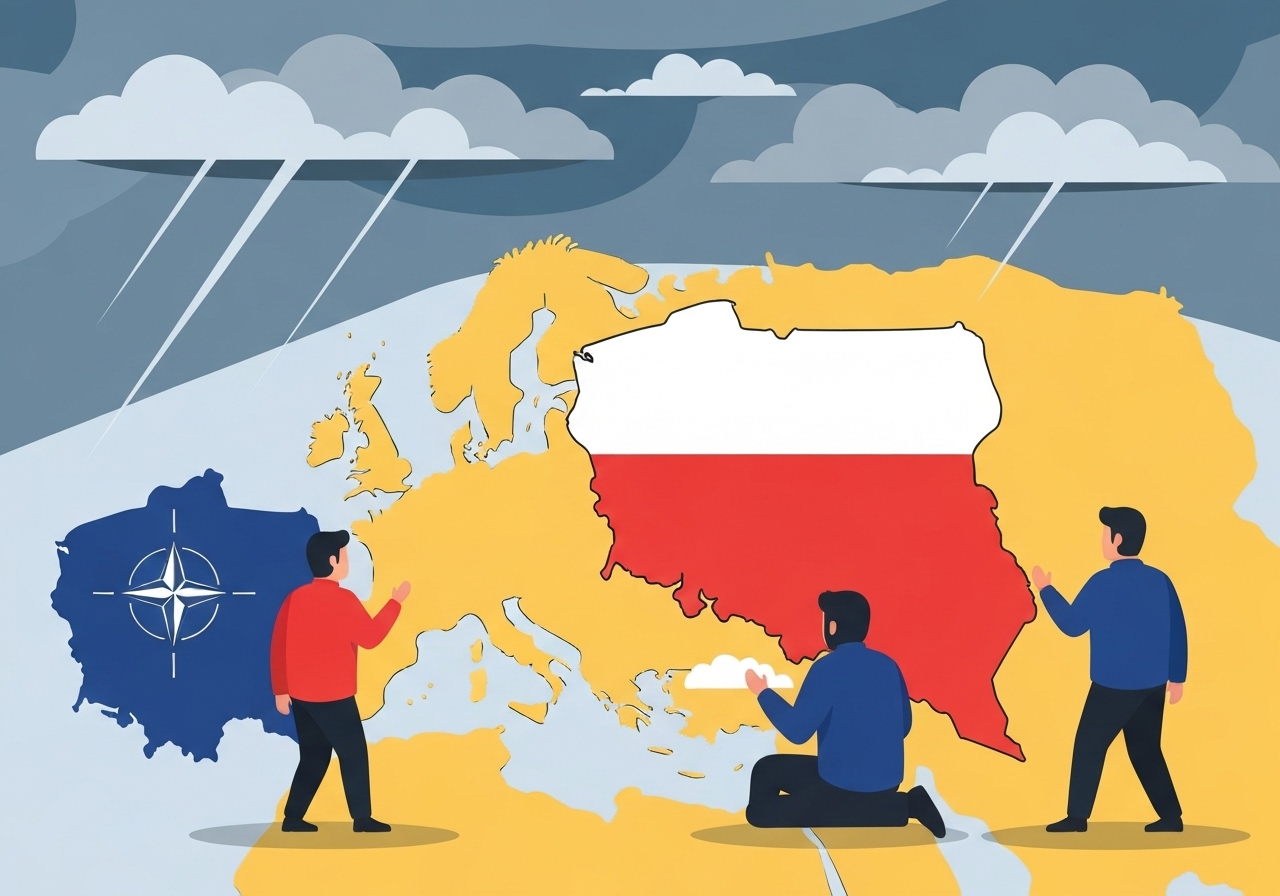
On 10 September 2025, Poland said it shot down multiple suspected Russian drones that entered its airspace during a large overnight strike on Ukraine. Prime Minister Donald Tusk announced talks with European partners and NATO and said several allies have offered concrete help for Poland’s air-defence. Warsaw triggered NATO consultations under Article 4 and summoned allies to assess responses and reinforce defensive measures. The incident has prompted rapid diplomatic contact across Europe and renewed debate about air-defence gaps on NATO’s eastern flank.
Key Takeaways
- Poland reported intercepting and downing suspected Russian drones on 10 September 2025, prompting it to call a NATO meeting under Article 4 for consultations.
- Prime Minister Donald Tusk said he spoke with leaders of France, Germany, the United Kingdom, Italy, the Netherlands, Ukraine and NATO and received offers of concrete air-defence support.
- Ukraine reported that Russia launched 415 strike and decoy drones, 42 cruise missiles and one ballistic missile overnight; Ukrainian forces said they intercepted or jammed 386 drones and 27 cruise missiles.
- Germany publicly backed Poland’s Article 4 move and described the violators as “clearly armed,” while NATO leaders called the incursions “reckless.”
- Ukrainian President Volodymyr Zelenskyy offered Poland training and technical help to improve joint drone-shootdown capabilities and urged an effective European air shield.
- Russia’s Defence Ministry denied planning strikes on Poland and claimed the drones’ operational range did not exceed 700 km; the Kremlin declined further comment.
- Poland’s foreign minister said the incursions were not accidental and described the episode as an unprecedented attack on NATO territory.
Background
Since Russia’s full-scale invasion of Ukraine in February 2022, the use of strike and loitering drones has increased dramatically, becoming a persistent threat across front lines and to neighbouring states. NATO members on the eastern flank have repeatedly reported errant or crashed Russian drones and fragments entering their territory, with incidents recorded in Latvia, Lithuania, Poland and Romania. Poland itself has reported multiple episodes in recent months, including a drone that entered Polish airspace and exploded in a field last month; Warsaw characterized that earlier event as a provocation.
The proliferation of inexpensive but effective unmanned systems has exposed gaps in European integrated air-defence networks, from radar coverage to interceptor availability and coordination among allies. In response, governments and NATO have discussed pooled assets, the Prioritized Ukraine Requirement List (PURL) and stepped-up production of counter-drone systems. Political leaders in the EU and NATO now face pressure to translate expressions of solidarity into deployable sensors, interceptors and command-and-control links.
Main Event
Poland said that on 10 September 2025 fighters stationed in the country — including Polish and Dutch jets — intercepted drones that had crossed into Polish airspace during a widescale Russian strike on western Ukraine. Warsaw reported the downings publicly and immediately sought consultations with NATO allies under Article 4 of the Washington Treaty, which calls for discussion when a member’s security is threatened. Prime Minister Donald Tusk wrote on X that, after his calls with partner leaders and NATO, Poland had received offers of concrete air-defence assistance.
Ukrainian authorities provided the most detailed tally of the overnight assault, reporting 415 strike and decoy drones and dozens of cruise and ballistic missiles; Kyiv said most aerial threats were intercepted or jammed. In Brussels and capitals across Europe, defence ministers and heads of government held emergency talks and issued condemnatory statements. Germany’s chancellor and defence minister publicly supported Poland’s invocation of Article 4 and warned that the strikes tested NATO’s eastern defences.
Moscow has, for now, limited its public response. Russia’s Defence Ministry said it had targeted military facilities in western Ukraine and did not intend to hit Polish soil, adding that the drones in question have an operational range of up to 700 km. The Kremlin declined further comment and said the matter fell under the purview of the defence ministry. Polish officials rejected any suggestion of accident, calling the mass incursion a deliberate provocation against NATO territory.
Analysis & Implications
The episode sharpens an existing dilemma for NATO: how to deter and defend against swarms of low-cost drones that can saturate sensors and overwhelm interceptors. Traditional air-defence setups—designed around costly cruise and ballistic missiles—are not optimized for thousands of small or kamikaze drones, so allies face a choice between rapid procurement of counter-drone systems, improved radar coverage and greater information-sharing to enable timely responses.
Politically, Poland’s Article 4 move is calibrated to seek allied unity while avoiding immediate military escalation. Article 4 obliges consultations but does not automatically trigger collective defence under Article 5. Still, the consultations create diplomatic momentum for concrete support, including integrated air-defence deployments, training and equipment transfers. Offers from France, Germany, the UK, Italy, the Netherlands and Ukraine indicate willingness to move from words to capability-sharing, but conversion into deployed assets will take time.
Economically and industrially, the crisis accelerates pressure on European defence production lines. European Commission discussions — including a €6 billion package mentioned by EU leaders for Ukrainian drone production — point to a wider shift toward sustaining both offensive and defensive unmanned capabilities. The changing pattern of US assistance and Germany’s increased role in supplying Kyiv may also reshape procurement and financing channels, influencing how fast allied air-defence gaps can be closed.
Comparison & Data
| Threat | Launched (reported) | Intercepted/Jammed (reported) |
|---|---|---|
| Strike & decoy drones | 415 | 386 |
| Cruise missiles | 42 | 27 |
| Ballistic missiles | 1 | — |
These figures from Ukrainian authorities show high interception rates for the mass drone attack, but they also illustrate the scale of the assault and the strain placed on air-defence systems. Even with many successful interceptions, residual fragments and unneutralised devices can cause cross-border damage or escalate political tensions. Comparing this incident with earlier incursions—such as drone crashes in Lithuania (July) and a Shahed-type crash in Latvia (September 2024)—highlights a persistent pattern of spillover risk for NATO neighbours.
Reactions & Quotes
Allied defence officials expressed unified condemnation and vowed closer cooperation. UK Defence Secretary John Healey joined defence counterparts from France, Germany, Italy, the Netherlands and Ukraine in denouncing the strikes and stressing a joint approach to countering drone threats.
“Together, we the E5 totally condemn these attacks.”
John Healey, UK Defence Secretary (E5 meeting)
Germany’s leadership characterized the incursion as reckless and dangerous, underscoring the risk to lives in a NATO and EU member state and supporting Poland’s consultations with allies.
“Russia has endangered human lives in a state that is a member of NATO and the EU.”
Friedrich Merz, German Chancellor
Ukrainian President Volodymyr Zelenskyy framed assistance as both technical and cooperative, offering training and expertise to help Poland and calling for a common European air-defence umbrella.
“We need to work on a joint system of air defence and create an effective air shield over Europe.”
Volodymyr Zelenskyy, President of Ukraine
Unconfirmed
- Whether the drones that crossed into Poland were deliberately aimed at Polish territory or were misdirected remains formally unproven; intent has not been independently verified.
- Russia’s claim that the drones have an operational range no greater than 700 km is a technical assertion that NATO and Polish authorities have not publicly corroborated.
- Specific details of proposed allied air-defence contributions (types, timelines, deployment locations) remain under negotiation and are not yet confirmed.
Bottom Line
The downing of suspected Russian drones over Poland on 10 September 2025 has elevated a cross-border security incident into a diplomatic and defence test for NATO and the EU. Warsaw’s Article 4 consultations have produced offers of assistance, but converting those offers into deployed sensors, interceptors and integrated command-and-control will be the decisive next step.
Observers should watch three near-term indicators: whether allied assets are deployed to strengthen Poland’s air-defence posture; any changes in the tempo or geographic pattern of drone strikes; and how NATO and EU institutions translate political support into sustained industrial and logistical measures to harden Europe against drone and missile saturation attacks. The incident underscores the urgency of collective planning to prevent inadvertent escalation while protecting allied territory.