
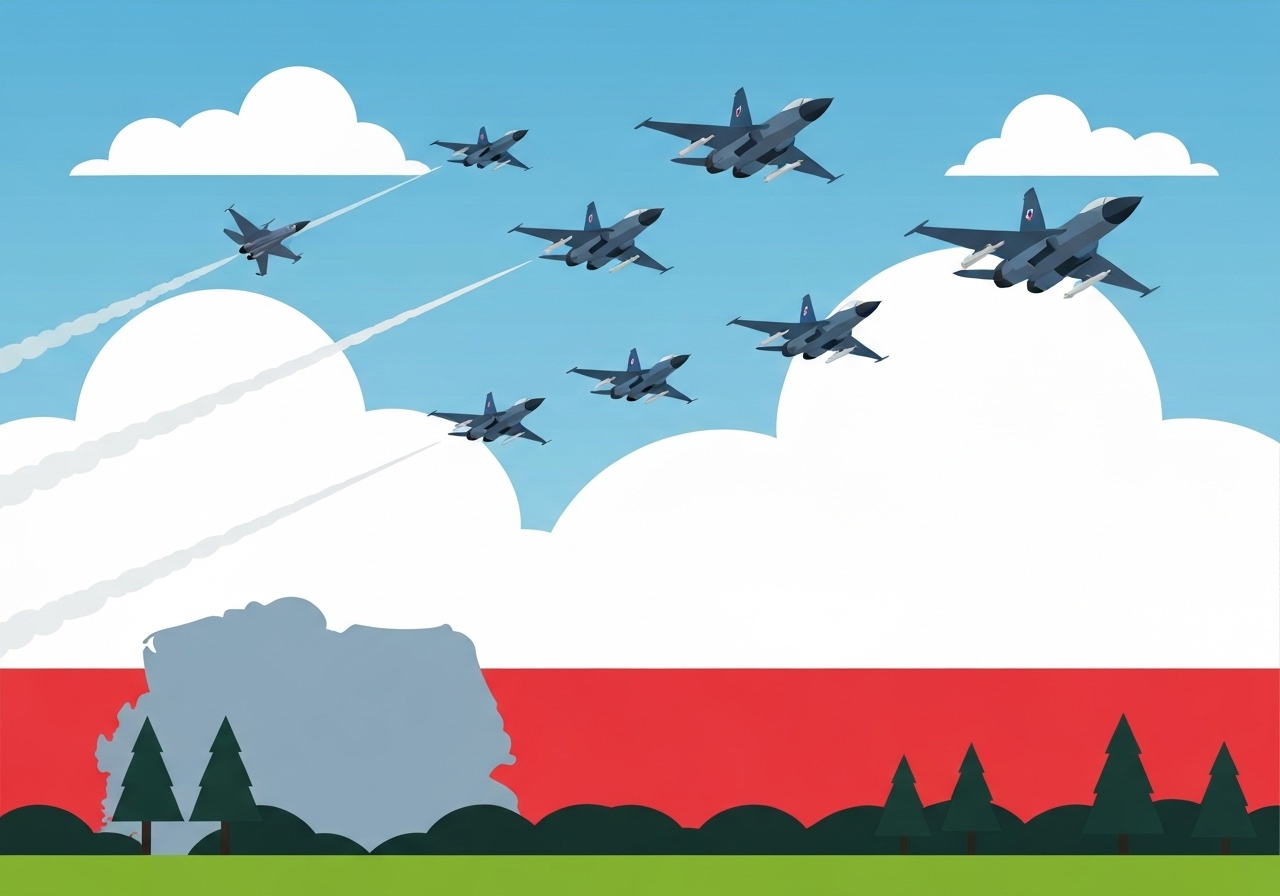
Lead
On Wednesday, Sept. 10, 2025, multiple Russian-origin unmanned aerial vehicles (UAVs) entered Polish airspace, prompting NATO fighter jets to intercept and shoot several down. The incursion, which coincided with a major wave of Kremlin strikes on Ukraine, marked the first time NATO engaged potential threats inside allied airspace, officials said. Polish authorities recorded dozens of violations and found multiple crash sites, and allied leaders warned the episode raises real risk of the Ukraine war spilling across NATO borders. Both Russia and Belarus issued denials or explanations, while NATO and EU officials called the event a serious escalation.
Key Takeaways
- Incident date and scope: The airspace violations occurred overnight into Sept. 10, 2025, with Polish officials reporting 19 recorded violations over about seven hours.
- Intercepts and crash sites: Polish authorities identified nine crash sites, some located hundreds of kilometers from the border, and at least one house was damaged in Wyryki (Lublin region) with no fatalities reported.
- NATO response: NATO scrambled allied jets, including Dutch F-35s, which intercepted and helped neutralize several drones; alliance spokespeople described this as the first engagement of potential threats in allied airspace.
- Wider strike context: The breaches happened amid a large Russian aerial campaign on Ukraine that Ukrainian authorities said involved 415 strike and decoy drones, 42 cruise missiles and one ballistic missile that night.
- Air-defense claims: Ukraine reported intercepting or jamming 386 drones and 27 cruise missiles overnight; Russia said its strikes targeted military-industrial sites in western Ukraine and denied striking Poland.
- Alleged origin: Polish officials said a significant number of the UAVs came from Belarusian direction; Belarus claimed some drones lost course after jamming and that it warned neighbors of unidentified aircraft.
- Political fallout: The incident triggered NATO consultations under Article 4 and prompted senior EU and NATO officials to call for firm responses and additional deterrence measures.
Background
Poland and other NATO members have experienced repeated airspace violations since Russia launched a full-scale invasion of Ukraine in 2022, ranging from stray missiles to isolated drone incursions. Until this episode, none had prompted NATO aircraft to engage potential threats inside allied airspace, a threshold that has long been treated as a stark line in alliance defense planning. The eastern flank of NATO—particularly the Baltic states and Poland—has consistently warned about the risk of miscalculation as Russia adapts long-range strike methods and uses Belarusian territory for operations.
Diplomatically, NATO has balanced deterrence with caution to avoid an unintended escalation into a direct NATO–Russia conflict, relying on Article 4 consultations to coordinate responses short of invoking collective defense under Article 5. Militarily, allied air defenses have been reinforced since 2022 but officials and some analysts argue the scale and sophistication of recent Russian long-range strikes have outpaced certain preparedness assumptions. The gathering of Russian and Belarusian troops for scheduled exercises that week raised additional alarm among Warsaw and its allies about lines of responsibility and operational control.
Main Event
Polish authorities say the first violation occurred at about 11:30 p.m. on Tuesday and continued until roughly 6:30 a.m. Wednesday. Prime Minister Donald Tusk told parliament that 19 violations were recorded in that period and that investigators were still collecting data on exact flight paths and origins. Local emergency services and security forces located nine crash sites; some debris landed far from the Ukrainian border, which analysts noted as significant for assessing intent.
Allied air defenses were activated and NATO dispatched fighter jets from member states to assist Poland. The Netherlands’ defense ministry reported that Dutch F-35s intercepted some of the UAVs. Poland’s foreign minister publicly thanked the Dutch for their role in neutralizing the objects. NATO spokespeople confirmed allied aircraft engaged potential threats in allied airspace for the first time in the alliance’s history.
Russia’s Defense Ministry said its overnight strikes targeted military-industrial infrastructure in western Ukraine and denied any planned strikes on Polish territory, adding that it was open to consultations with Poland’s defense authorities. Belarusian military officials said their forces tracked drones that ‘lost their course’ after electronic jamming and that they alerted Polish and Lithuanian counterparts about unidentified aircraft approaching their airspace. Several European governments, however, judged the incursion as deliberate and not the result of navigational error.
Analysis & Implications
Strategically, the incident tests NATO’s deterrence posture on its eastern flank. That allied jets engaged and shot down UAVs inside NATO territory shifts the operational baseline: allies have long pledged to defend every inch of NATO, but this action marks an observable change from rhetoric to kinetic enforcement. The move may deter immediate repeat incursions but also increases the risk of miscalculation if Moscow perceives allied actions as a direct confrontation.
Legally and politically, the consultations under Article 4 indicate allies treated the episode as serious but did not automatically escalate to collective-defense measures under Article 5. Article 4 allows members to seek urgent meetings; invoking it keeps diplomatic options open while allies gather evidence and calibrate responses. Whether this event leads to stronger sanctions, expanded air-defense deployments, or new NATO rules of engagement will depend on forensic findings about flight origins and command responsibility.
Economically and operationally, an expansion of strikes into NATO airspace could prompt accelerated military assistance to Ukraine and faster deliveries of air-defense systems to frontline allies, with implications for defense budgets and supply chains across Europe. It also elevates energy and trade risk perceptions, potentially affecting markets sensitive to geopolitical stability. For Russia, a deliberate expansion risks deeper political isolation and could trigger sweeping punitive measures, yet Moscow may also calculate that limited, deniable operations impose pressure without provoking a full allied military response.
Comparison & Data
| Category | Reported Count |
|---|---|
| Russian strike/decoy drones fired at Ukraine (night) | 415 |
| Cruise missiles fired | 42 |
| Ballistic missiles | 1 |
| UAVs Ukraine says were intercepted or jammed | 386 |
| Cruise missiles Ukraine says were intercepted | 27 |
| Poland-recorded airspace violations (overnight) | 19 |
| Poland crash sites located | 9 |
The table aggregates the principal counts reported publicly by Ukrainian and Polish authorities and NATO spokespeople. Numbers reflect early official tallies and may be revised as damage assessments and forensic analyses continue. Comparing these figures to earlier cross-border incidents shows a marked increase in scale and geographic reach during this episode.
Reactions & Quotes
‘Russia’s war is escalating, not ending. What happened in Poland is a game changer.’
Kaja Kallas, EU foreign policy chief
Kallas urged stronger punitive measures and said the incursion should prompt recalibrated EU policies toward Moscow.
‘There are definitely no grounds to suspect that this was a course correction mistake.’
Boris Pistorius, German defense minister
Pistorius spoke in parliament to argue that the drones’ trajectories and dispersion suggested deliberate direction rather than accidental drift.
‘For the first time NATO planes have engaged potential threats in Allied airspace.’
Col. Martin O’Donnell, NATO spokesperson
O’Donnell framed the interceptions as consistent with the alliance’s commitment to defend allied territory while stopping short of describing the incident as a NATO–Russia clash.
Unconfirmed
- Full chain of command: It remains unconfirmed whether the Russian government directly ordered any drones that crossed into Poland or whether rogue elements or third-party actors were involved.
- Exact launch points: While Polish officials said many drones arrived from the Belarus direction, full forensic evidence tracing every device to precise launch coordinates is not yet public.
- Intent to target Polish territory: No conclusive public evidence has established that Polish territory was an intended target rather than collateral overshoot or navigational failure.
- Belarusian claim of jamming: Belarus says some UAVs ‘lost their course’ after jamming; independent verification of that jamming and its effect on trajectory is not yet available.
Bottom Line
The overnight drone incursions into Poland and NATO’s decision to intercept them represent a consequential escalation in the Ukraine conflict’s spillover risk. Allies have for the first time used kinetic measures in NATO airspace to neutralize perceived threats, signaling both resolve and a higher tolerance for direct defensive actions on the alliance’s eastern flank. That action may deter immediate repetition but also elevates the possibility of miscalculation, especially if forensic analysis later yields ambiguous attribution.
In the near term, expect intensified diplomatic activity, additional NATO consultations, and renewed calls for accelerated air-defense deployments and sanctions against actors judged responsible. Analysts and policymakers will be watching forensic results, Belarusian and Russian military communications, and the alliance’s next posture moves to judge whether this episode becomes an isolated alarm or a new, more dangerous phase of the conflict.
Sources
- Associated Press (international news agency)
- NATO (official alliance website)
- Government of Poland (official government site)
- Russian Ministry of Defence (official ministry statements)
- Belarus Ministry of Defence (official ministry statements)
- Ministry of Defence of Ukraine (official ministry statements)
Hello pals!
I came across a 143 great platform that I think you should take a look at.
This site is packed with a lot of useful information that you might find valuable.
It has everything you could possibly need, so be sure to give it a visit!
https://autobala.com/how-to-prepare-for-a-long-journey-simple-tips-for-drivers-and-passengers/315994/
And remember not to neglect, guys, — one constantly are able to within the article find solutions for the most most tangled queries. We tried to lay out the complete information via an extremely easy-to-grasp way.