
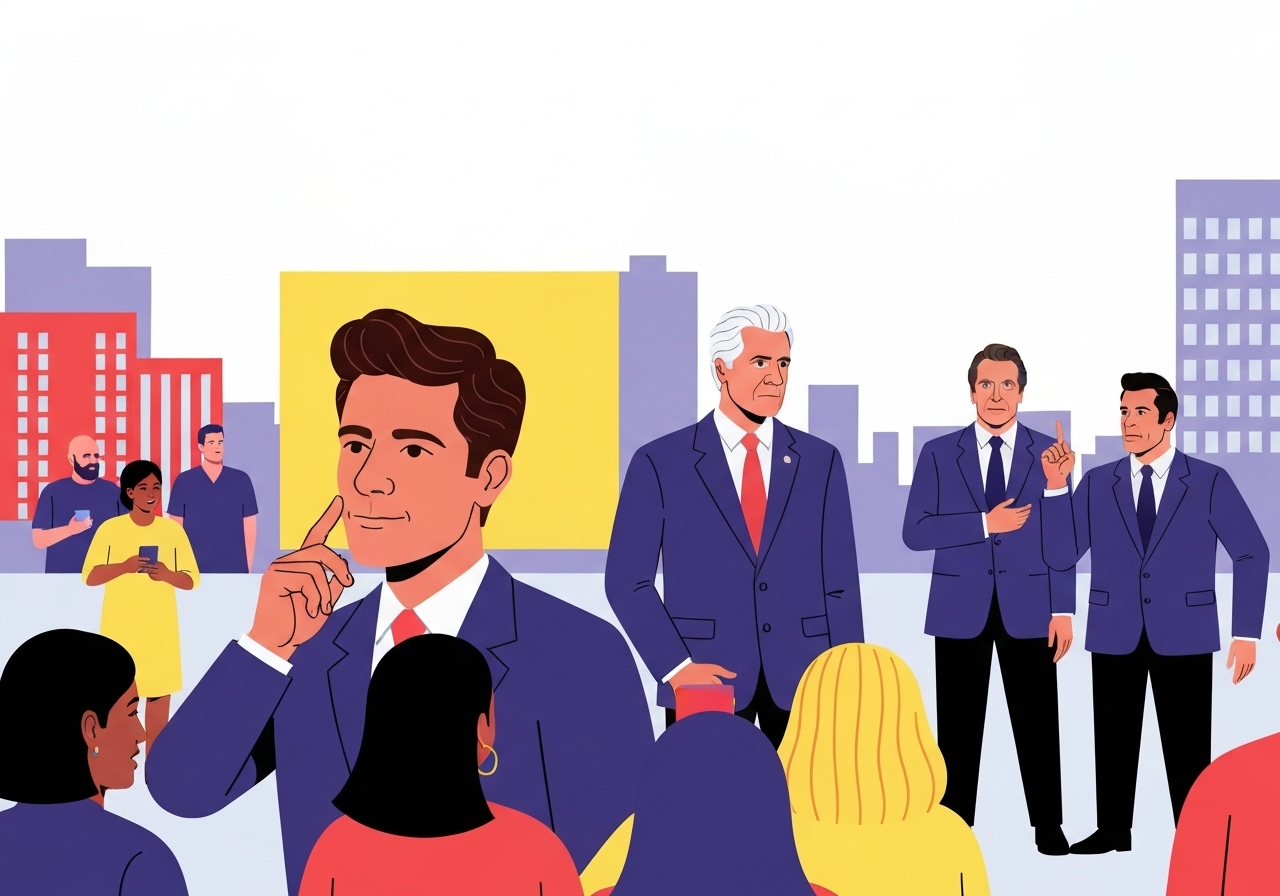
Lead: New York City voters poured into polling places on Tuesday to choose a new mayor in one of the most closely watched municipal contests in recent memory. By midday roughly 460,000 people had voted in the first six hours, and combined with 735,000 early ballots nearly 1.2 million votes had been cast — exceeding the 1.15 million total in 2021. The three leading contenders — Democrat Zohran Mamdani, former governor Andrew M. Cuomo (running as an independent) and Republican Curtis Sliwa — campaigned across the city as polls remained open until 9 p.m. The outcome could reshape city power arrangements and send signals about national party politics.
Key Takeaways
- Turnout surge: About 460,000 ballots were cast in the first six hours of Election Day; together with 735,000 early votes the total reached nearly 1.2 million, topping 2021’s 1.15 million turnout.
- Three-way contest: Zohran Mamdani, 34, leads in polls after defeating Andrew Cuomo in the June Democratic primary; Cuomo, 67, is running independently; Curtis Sliwa, 71, is the Republican nominee.
- Ballot lines: Mamdani and Sliwa appear twice on the ballot due to cross-endorsements; Cuomo appears once on his independent “Fight and Deliver” line, consistent with New York election law.
- Money and disclosure: Cuomo reported $4,712,978 from consulting in 2024 through Innovation Strategies; he has not publicly listed individual clients tied to that income.
- Economic distress: Nearly 104,000 people slept in city shelters nightly in August; an estimated 4,500 were living outdoors; about 150,000 public-school students lacked stable housing in 2023–24.
- SNAP squeeze: Nearly 1.8 million New Yorkers faced the prospect of reduced or delayed Supplemental Nutrition Assistance Program benefits amid the federal funding disruption.
- Policy contrasts: Mamdani runs on an expansive affordability platform including free child care and a rent freeze; Cuomo emphasizes experience; Sliwa centers on public safety.
Background
New York’s 2025 mayoral contest unfolded against a national backdrop of partisan intensity and local crises — from record shelter populations to growing climate vulnerabilities. Zohran Mamdani rose from relative obscurity to win the Democratic nomination in June, propelled by grassroots organizing and a platform that calls for taxing the wealthy to expand social programs. That primary victory forced Andrew Cuomo, a three-term former governor, into an independent bid after his loss, creating an unusual three-way dynamic that has kept polling margins tight.
The mechanics of New York elections added another wrinkle: state law permits multiple parties to endorse the same candidate, producing ballot lines that can list a single name more than once. That fact drew attention — and criticism — this week from high-profile figures who argued the layout was confusing, though board officials said the listings follow established rules based on prior gubernatorial vote totals and filing order. Meanwhile, national actors and donors weighed in on the contest, amplifying its significance beyond the five boroughs.
Main Event
On Election Day the three principal candidates visited polling sites and closed the campaign with watch parties and events across the city. Mamdani voted in Queens and told supporters he would back the housing proposals on the ballot, measures designed to fast-track some affordable housing projects and shift aspects of approval from the City Council to the mayor’s office. Cuomo cast his ballot in Manhattan and continued to campaign on his track record and managerial experience. Sliwa had voted during the early period and spent the day mobilizing Republican-leaning precincts.
The first half of Tuesday saw a marked increase in voter participation: the City Board of Elections reported about 460,000 votes in the first six hours, which when added to the early-vote total pushed the overall count above the entire 2021 turnout. Poll sites reported a mix of enthusiastic supporters, undecided swing voters, and residents for whom immediate economic pain — such as interruptions to SNAP benefits — shaped their choices at the ballot box. Campaigns emphasized ground operations, while reporters tracked long lines and localized energy in neighborhoods from Queens to the Bronx.
Two procedural flashpoints cropped up in public debate. Elon Musk and some conservative commentators criticized the ballot design because Mamdani and Sliwa each appear on two lines while Cuomo appears only once; election officials explained the differences stem from party cross-endorsements and independent filing rules. Separately, questions about voter identification requirements recurred after critics urged stricter checks; board officials noted New York’s voter-registration process, signature matching and affidavit ballots for first-time voters as protections intended to preserve access while preventing fraud.
Analysis & Implications
Short-term, the winner inherits an urgent fiscal and human-services agenda. A mayor will face immediate pressures to stabilize food-assistance deliveries for nearly 1.8 million affected residents and to manage shelter capacity for the roughly 104,000 people recorded in city shelters in August. Those numbers, plus the roughly 4,500 people estimated to be living on streets, sharpen the political stakes: voters are weighing candidates’ promises against a backdrop of daily hardship and long-running structural shortages of affordable housing.
Politically, a Mamdani victory would constitute a significant shift: a 34-year-old democratic socialist would command City Hall, testing whether an expansive social agenda can be financed and implemented in a city with entrenched real-estate and business interests. A Cuomo win would be read as a return to managerial, insider governance; Sliwa’s success would tilt policy discussions towards law-and-order priorities. Each outcome would send signals to state and national actors about the electoral viability of progressive economics, centrist experience, or conservative safety-first messaging in dense, diverse urban electorates.
On governance and finance, the new mayor must contend with competing revenue levers. Infrastructure and climate adaptation — notably sewer upgrades to cope with flash flooding and compliance with Local Law 97 to cut building emissions — require significant capital. Potential responses range from rate increases on water and stormwater fees to new revenue streams or budgetary re-prioritization. Any path chosen will provoke trade-offs between affordability and infrastructure resilience.
Comparison & Data
| Metric | 2021 | 2025 (so far) |
|---|---|---|
| Total votes cast | 1,150,000 | ~1,195,000 (735,000 early + ~460,000 first 6 hrs) |
| Shelter population (avg. nightly, Aug) | — | ~104,000 |
| Estimated unsheltered | — | ~4,500 |
| Cuomo 2024 consulting income | — | $4,712,978 |
| Mamdani 2024 income | — | $131,398 (+ $1,267 royalties) |
The table above highlights turnout growth and selected social and financial indicators that shaped the campaign narrative. Rising participation in 2025 underscores the intensity of this contest; simultaneous spikes in homelessness and threats to SNAP benefits focused voter attention on immediate material needs rather than abstract debates. Candidate finances — notably Cuomo’s roughly $4.7 million consulting haul — fed questions about transparency and conflicts of interest, even where the reporting met legal disclosure standards.
Reactions & Quotes
“Zohran is looking to represent and lead the eight million New Yorkers who call this city home,”
Dora Pekec, Mamdani campaign spokeswoman (statement)
Ms. Pekec’s remark was offered after reporters pressed the campaign about outreach to Jewish voters and other concerns raised during the campaign. The statement reiterated Mamdani’s focus on city-wide representation amid criticism from opponents.
“It’s not a homelessness crisis — it’s a housing crisis,”
Dave Giffen, executive director, Coalition for the Homeless (advocacy group)
Giffen’s framing was used by advocates and many candidates to argue that the scale of shelter use reflects broader shortages in affordable housing rather than a purely social-services problem.
Unconfirmed
- Extent of Jeremy Corbyn’s campaign involvement: reports of his role in a phone-bank event are verified, but the scale of his influence on voter decisions is not established.
- Trump’s stated threat to withhold federal funds if Mamdani wins: the post exists, but any actual federal withholding would require legal and administrative steps that have not been announced or confirmed.
- Claims that the ballot layout altered voter behavior substantially: questions were raised publicly, but there is no firm evidence yet showing the layout materially changed vote totals.
Bottom Line
The 2025 New York City mayoral vote has been defined by unusually high turnout, stark contrasts among three very different candidates, and urgent local crises that have pushed affordability and basic services to the forefront. Whoever wins will confront immediate obligations: stabilizing food assistance, addressing record shelter use, and funding climate adaptation and building compliance while balancing a city budget strained by competing demands.
Beyond municipal governance, the result will carry symbolic weight nationally. A Mamdani victory would signal the electoral promise of a democratic-socialist platform in a major U.S. city; a Cuomo comeback would be read as a vindication of managerial experience; a Sliwa win would elevate a safety-focused Republican voice in a largely Democratic metropolis. In all scenarios, the new mayor will need to navigate Albany, federal relations and entrenched local stakeholders to turn campaign pledges into durable policy.