
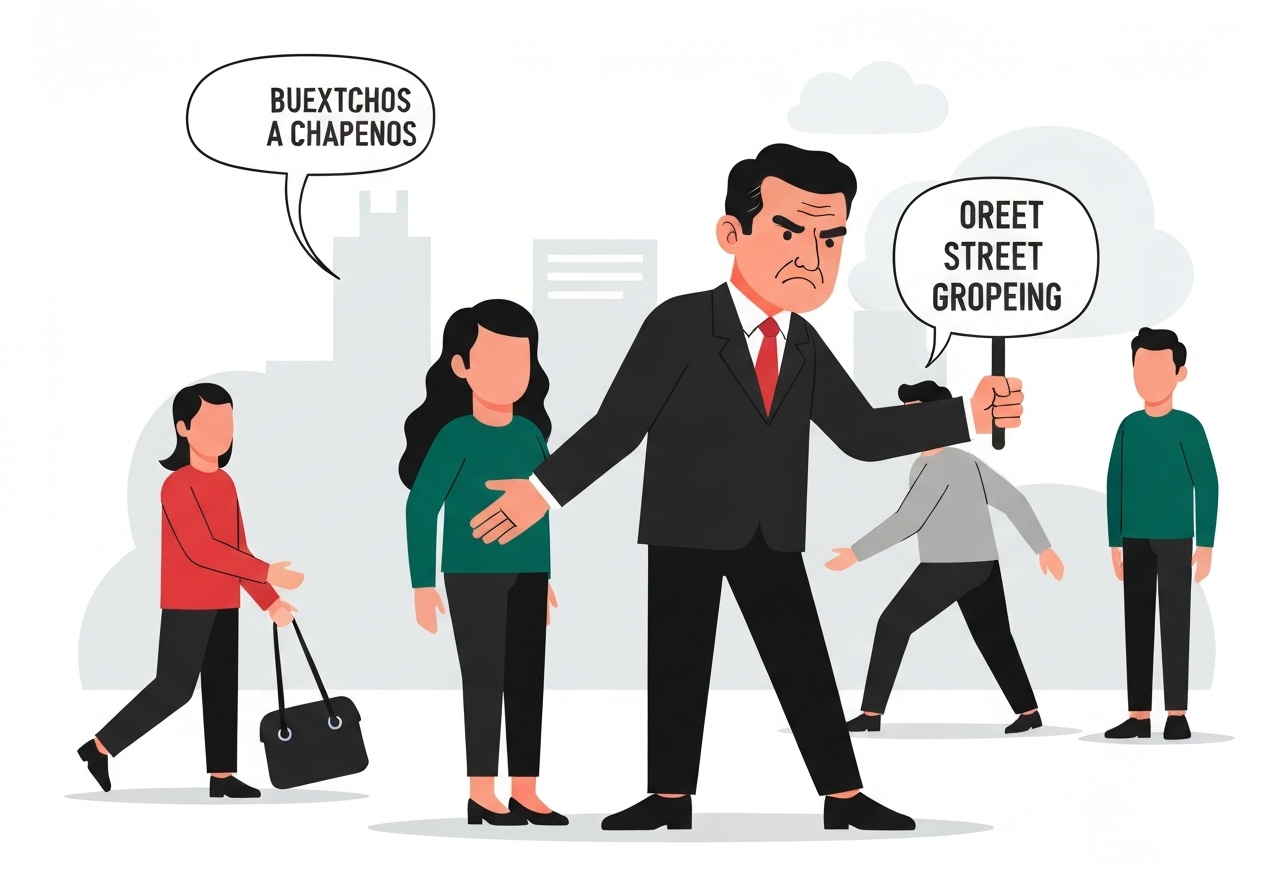
Lead: On Nov. 5, 2025, Mexico’s president, Claudia Sheinbaum, said she filed a criminal complaint after a man groped her in Mexico City’s historic center in an episode captured on video. The footage shows the assailant approach, attempt a kiss and place his hands on the president’s chest before aides intervened; authorities later arrested a 33-year-old identified as Uriel Rivera Martínez. Ms. Sheinbaum, who made ending violence against women a central campaign pledge, said the decision to press charges was meant to set a precedent for all Mexican women. She urged lawmakers and officials to review gaps in how sexual harassment is defined and prosecuted across the country.
Key Takeaways
- Date and place: The incident occurred on Nov. 4, 2025, in Mexico City’s historic center and was publicly discussed by the president on Nov. 5, 2025.
- Suspect identified: Authorities named the arrested man as Uriel Rivera Martínez, 33; officials said he was “totally inebriated” when he approached the president.
- Legal patchwork: Sexual harassment is a crime in Mexico City but is not criminalized at the federal level and remains inconsistently defined across states.
- Security details: Ms. Sheinbaum said she was between meetings, accompanied by a single aide and without formal security at the moment of the incident.
- Public response: The video circulated widely online and reignited debate about everyday harassment that many Mexican women report experiencing in public spaces.
- Policy signal: The president said she would ask officials to examine the law so that all women can file charges, not only those in Mexico City.
- Victim advocacy: Activists and experts framed the filing as a potential catalyst for legal and cultural change on gender-based harassment.
Background
Claudia Sheinbaum made combating violence against women a central theme of her presidential campaign and remains Mexico’s first woman to hold the office. Her administration has highlighted gender-based violence as a national priority, but the legal framework across Mexico remains fragmented: some jurisdictions treat street harassment as a punishable offense while others do not. For many women in Mexico, unwanted touching and groping in public spaces—from buses and subways to crowded streets—are recurring hazards, public advocates say, and reporting mechanisms often feel inadequate or discouraging.
The episode landed against this broader social context. Women’s rights groups have long called for clearer criminal definitions, better police response and prevention through education. Mexico City prosecutors can pursue harassment charges under local statutes, but when conduct crosses municipal lines or involves states with weaker protections, victims face procedural and legal barriers. The president’s decision to go to police thus intersects with a movement pressing for uniform protections and improved enforcement nationwide.
Main Event
Video that circulated on social media shows a man approaching President Sheinbaum as she walked in the historic center on Tuesday and attempting a kiss while placing his hands on her breasts, before aides intervened. Officials later announced the man’s arrest and identified him as Uriel Rivera Martínez, 33. At a Nov. 5 news conference, Ms. Sheinbaum said the suspect appeared “totally inebriated” and that he had accosted other women earlier that day, according to her remarks.
Ms. Sheinbaum said she filed a complaint with Mexico City authorities, noting that the act constitutes a crime under local law. She framed the complaint as a public statement — if she did not report the incident, she said, it would send the wrong message to women nationwide about what is acceptable and what will be tolerated. Officials did not immediately confirm whether the suspect had legal representation; local authorities handled the arrest and initial processing.
Ms. Sheinbaum also addressed security arrangements, saying she had been moving between meetings to save time and had a single aide with her, but no formal security detail at the moment. She said the episode would not change her practice of mingling with the public, emphasizing a desire not to distance herself from ordinary citizens. At the same time, the assault prompted scrutiny of how public officials are protected and how ordinary women are left vulnerable in daily life.
Analysis & Implications
The president’s decision to press charges turns a personal violation into a legal and political moment. By using her platform to file a complaint, Ms. Sheinbaum elevated a commonplace form of gendered violence into a public test of Mexico’s legal patchwork. That could accelerate debate about harmonizing criminal definitions of sexual harassment at the federal level and standardizing procedures so victims can pursue complaints without prohibitive delays or requirements—an issue the president highlighted when she said women are often discouraged from reporting because of lengthy, cumbersome processes.
Legally, any push to federalize or harmonize harassment statutes will face competing priorities in Congress and across state legislatures. Some lawmakers and prosecutors may support clearer statutory language and faster investigative protocols, while others may resist reforms on cost, enforcement capacity or political grounds. Even with new laws, practical enforcement and cultural change—educating boys and men, improving police training and ensuring responsive complaint mechanisms—will be essential for real impact.
Politically, the episode could carry repercussions beyond legal reform. For an administration that campaigned on women’s safety, the incident tests credibility: critics may argue the attack underlines gaps between promise and progress, while supporters may point to the president’s visible response as a sign of leadership. Public reaction—especially among women who say harassment is routine—may push authorities to act faster on reforms or resources for prevention programs and victim support services.
Comparison & Data
| Jurisdiction | Criminalization of Street Harassment |
|---|---|
| Federal (Mexico) | Not criminalized as a distinct offense |
| Mexico City | Criminal offense under local law |
| Other states | Mixed — some have local statutes, others do not or apply different standards |
The table above reflects how definitions and penalties for public sexual harassment vary in Mexico. That uneven legal landscape can limit victims’ access to redress, depending on where an incident occurs and how local authorities implement statutes.
Reactions & Quotes
Human rights advocates and women who spoke publicly described the episode as an echo of daily experiences for many Mexican women and framed the president’s filing as a potential turning point. They emphasized that visibility and legal action can shift both policy and public norms.
“If I don’t file a complaint, then what message does that send to all Mexican women?”
Claudia Sheinbaum, President of Mexico
At her press conference the president said she wanted the incident to be a call to action, not a special case because of her office. She stressed the need for education, awareness campaigns and for authorities to process complaints efficiently so women are not discouraged from reporting.
“Such violence is completely real and must be named and punished,”
Wendy Briceño, former lawmaker and gender-equality commissioner
Briceño, who led a commission on gender equality, praised the president for bringing attention to the problem and urged legislative follow-up. Journalists and researchers who study gender-based violence also called for law reform and improved enforcement to change everyday behaviors described by many women.
Unconfirmed
- Legal representation: It was not clear whether Uriel Rivera Martínez had a lawyer at the time of reporting.
- Prior complaints: Authorities have not made public a full record confirming earlier complaints against the suspect beyond the president’s remark that he accosted other women that day.
- Policy outcomes: Whether Ms. Sheinbaum’s filing will lead to concrete federal legislative change or uniform state action remains undecided.
Bottom Line
The public groping of President Sheinbaum and her decision to file charges turned a widely shared everyday violation into a high-profile legal and political test. Her action spotlights the inconsistent criminal treatment of street harassment across Mexico and may increase pressure for legal harmonization and better enforcement. Whether the episode prompts durable legal reform will depend on follow-through by legislators, prosecutors and the capacity of authorities to implement clearer procedures.
For many women in Mexico, the incident crystallizes longstanding frustrations about safety in public space; for policymakers, it presents a moment to reconcile the symbolic weight of the president’s actions with practical changes—training, reporting systems and laws—that could make reporting more effective for all victims.
Sources
- The New York Times — U.S. newspaper (media reporting on the incident and quotations)