
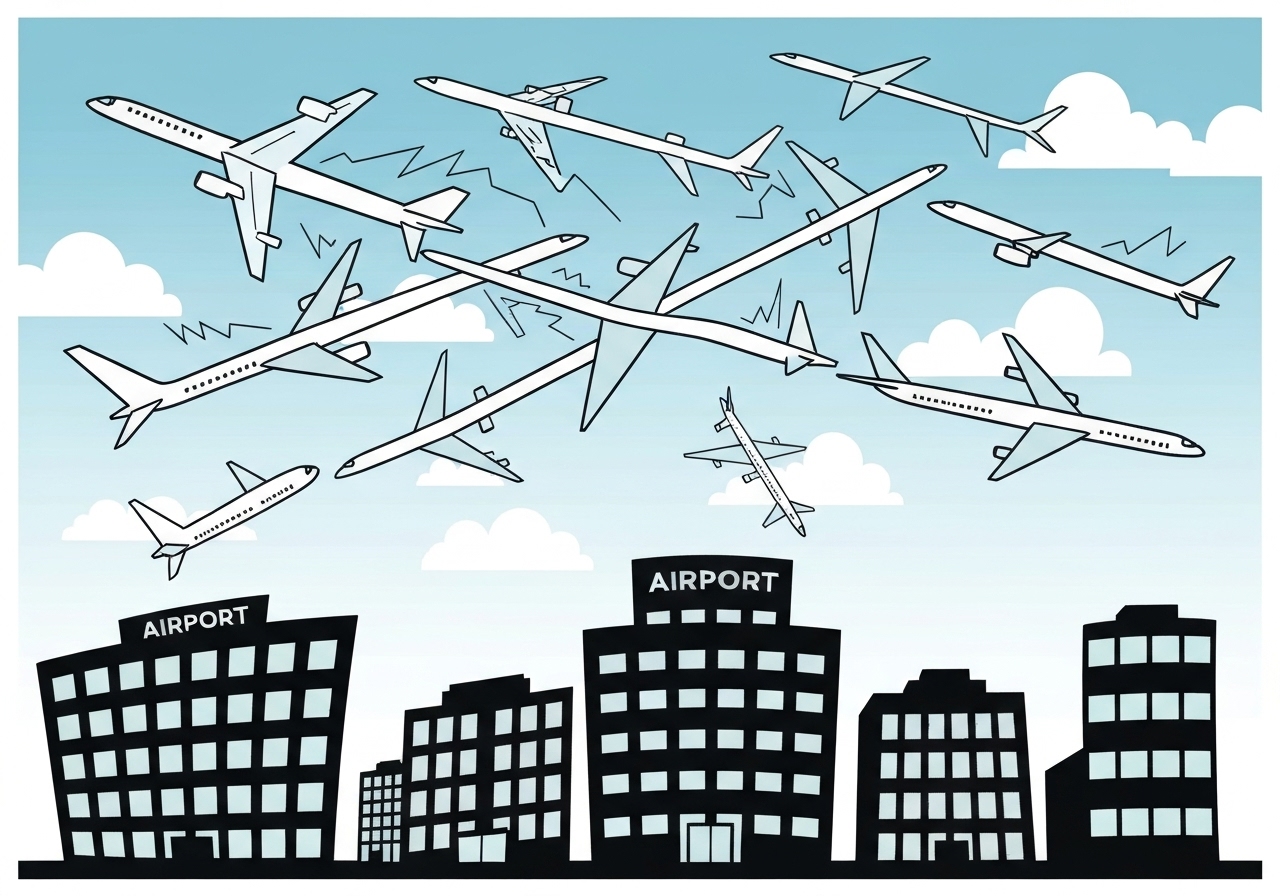
U.S. carriers began canceling hundreds of flights Thursday after the Federal Aviation Administration directed airlines to reduce scheduled operations at many of the nation’s busiest airports starting Friday amid the federal government shutdown. The FAA’s guidance targets roughly 40 high-volume airports and asks airlines to scale back service gradually, beginning with a roughly 4% cut and working toward a 10% reduction to ease pressure on air traffic control. By late Thursday, industry trackers reported more than 500 flights already removed from Friday schedules and carriers were continuing to adjust routings and notify affected passengers. The move aims to preserve safety and system resilience while controllers work without pay during the shutdown that began Oct. 1.
Key takeaways
- The FAA asked airlines to reduce flights at about 40 high-volume U.S. airports, with phased cuts beginning Friday and a target of 10% overall in affected markets.
- Flight-tracking service FlightAware and airlines reported more than 500 Friday cancellations by Thursday evening; Cirium data cited carrier reports including Delta canceling roughly 170, United 145 and American 32 for Friday.
- Cirium estimated the policy could affect as many as 1,800 daily flights, potentially disrupting as many as 268,000 passengers per day if cuts reach the upper range.
- Affected hubs include New York, Los Angeles, Chicago, Atlanta, Denver, Orlando, Miami and San Francisco; multiple airports in Dallas, Houston and Chicago are on the list.
- Air traffic controllers are working without pay, taking more sick days and logging mandatory overtime, prompting the FAA to cite safety and staffing concerns as the rationale for reductions.
- Airlines plan to phase reductions and prioritize trimming service to and from smaller and mid-size cities to limit major hub disruption; refund policies were announced for passengers who choose not to fly.
Background
The federal government shutdown began on Oct. 1, leading to significant unpaid obligations for many Transportation Department employees, including air traffic controllers. Controllers traditionally work rotating shifts and, during the shutdown, many have had to rely on unpaid overtime or side jobs; rising financial pressure has been accompanied by an increase in sick calls and attendance shortfalls at some facilities. The FAA has for weeks been monitoring staffing trends and, in recent periods, has delayed or modified operations at airports where controller availability fell below safe staffing thresholds. Aviation regulators say the temporary reductions are intended to lower controller workload so facilities can operate within safe margins while staffing remains constrained.
Airlines and industry groups are accustomed to short-notice cancellations during severe weather, but those episodes are typically time-limited; the current reductions are tied to an open-ended political impasse with no firm return date. The FAA provided a list of airports to affected carriers and asked each airline to develop a plan to reach the specified reductions, initially cutting roughly 4% of flights on Friday and phasing up to the 10% target if necessary. The political context includes heightened pressure from the executive branch to push Congress to resolve the budget impasse, and regulators emphasize the action is a safety-focused contingency rather than a scheduling preference.
Main event
Implementation began with airlines working Thursday night to rework schedules and issue cancellations that would meet FAA direction for Friday. Flight-tracking services logged steadily rising cancellations through the day; some travelers preemptively changed or abandoned itineraries amid uncertainty. Carriers said they would attempt to minimize major hub impacts by concentrating cuts on thinner routes that serve smaller markets, but some large connecting airports still faced notable reductions.
Specific carrier reports to analytics firms showed Delta expecting about 170 cancellations Friday, United cancelling about 145, and American reporting 32, while other carriers were still finalizing plans. Airlines indicated customers whose flights were canceled would be offered refunds, including in many cases passengers holding nonrefundable fares. Frontier’s chief executive advised travelers to consider backup tickets with alternate carriers to avoid being stranded, reflecting the uneven and evolving nature of schedule changes.
Beyond passenger travel, the reductions affect air cargo networks because two major distribution hubs—Memphis (a major FedEx hub) and Louisville (a UPS hub)—appear on the FAA’s list. The timing and location of cuts have the potential to ripple into parcel delivery and logistics chains, especially as businesses approach the holiday shipping season. Regulators also noted that the cuts would be phased — beginning with smaller percentages — to allow the system to adjust and to limit sudden congestion elsewhere in the network.
Analysis & implications
Short-term, passengers face higher cancellation risk, longer rebooking times and potential increases in fares on remaining flights as carriers consolidate capacity. Airlines will incur operational costs from disrupted networks, including repositioning crews and aircraft, ticket refunds and passenger accommodations; smaller regional carriers that feed major hubs could be disproportionately affected if their flights are trimmed. Cargo customers may see delayed deliveries or rerouted loads, and logistics firms will need contingency plans for peak-season volumes.
Safety and labor-management implications are central: the FAA frames the reductions as a temporary workload-management tool intended to keep individual controller shifts within safe limits. If the shutdown persists, prolonged unpaid duty could deepen staffing shortfalls through attrition or extended absences, increasing the likelihood of larger or more persistent network constraints. That in turn would raise operational risks and force more severe curtailments of service, with economic consequences for airports, airlines and dependent regional economies.
Politically, the FAA action increases pressure on lawmakers by creating visible consumer pain that can influence public opinion during the budget impasse. Operational measures tied to safety are difficult to dispute publicly without appearing to challenge safety assessments, which may harden incentives for a near-term resolution. Internationally, extended U.S. airspace constraints could reroute traffic, affect transborder cargo flows and complicate airline schedules that coordinate global fleet use.
Comparison & data
| Metric | Reported value | Source |
|---|---|---|
| Airports targeted | ~40 busiest U.S. airports | FAA / airlines |
| Initial cancellations logged for Friday | 500+ (as of Thursday evening) | FlightAware / Cirium |
| Carrier-specific Friday cancellations | Delta ~170, United ~145, American 32 | Cirium (carrier reports) |
| Potential maximum daily impact | Up to 1,800 flights / ~268,000 passengers | Cirium estimate |
The table above summarizes reported figures circulating in news and analytics feeds. Numbers are evolving: flight trackers update in real time and airlines continued to adjust schedules as the FAA’s guidance was phased in. The initial 4% reduction on Friday was intended to be a first step toward the agency’s 10% target in high-volume markets, meaning day-to-day impacts could grow if staffing issues persist.
Reactions & quotes
Industry analysts and trade groups warned that the cuts would be broadly felt across the travel system while noting the FAA framed the move as safety-driven. Below are representative reactions and the public context in which they were made.
Before the FAA direction was widely implemented, an industry analyst described how reduced flight counts translate to network strain and passenger disruption.
“This will noticeably affect the U.S. air transportation system,”
Henry Harteveldt, industry analyst
Harteveldt’s comment summarized the anticipated operational ripple effects: fewer departures at major hubs force airlines to rebook passengers on longer routings, reduce frequency on thin routes, and increase the complexity of crew and aircraft positioning. Analysts said those second-order effects often magnify initial cuts, producing outsized delays and cancellations in connecting markets.
The travel industry’s trade group expressed concern about the broader impact on traveler confidence and economic activity.
“The shutdown is straining the system and eroding traveler confidence,”
Geoff Freeman, U.S. Travel Association
Freeman warned that prolonged disruptions during a peak booking window could depress consumer demand and harm businesses that rely on air visitors. The association urged a swift return to funded operations to stabilize both service and public confidence.
Individual travelers described immediate, personal consequences of sudden cancellations and uncertainty.
“I don’t know if I get there, will I get home?”
Fallon Carter, traveler
Carter’s experience illustrates the practical stress passengers face when itineraries are at risk, especially for time-sensitive travel such as weddings or business commitments. Frontline customer-service staff and airline rebooking systems were under pressure as cancellations spread across affected airports.
Unconfirmed
- The final FAA written order had not been published publicly as of late Thursday; circulating figures and lists came from carrier briefings and internal distribution—official text and full operational details remained pending.
- The upper-bound estimate of 1,800 impacted flights and 268,000 passengers per day is a Cirium projection and could vary materially depending on how airlines choose to allocate cuts and how staffing trends evolve.
- Any direct causal link between the recent Louisville cargo plane crash and the FAA reduction list (beyond both involving airports that process cargo) is not established in official materials and should not be assumed.
Bottom line
The FAA-directed reductions are a safety-focused, contingency response to controller staffing strains produced by the ongoing government shutdown; they are already producing tangible cancellations and traveler disruption. Initial cuts were designed to be phased and targeted, but the potential for larger or sustained reductions grows the longer staffing pressures continue. Passengers should expect elevated cancellation risk at dozens of major airports, consider flexible itineraries, and check carriers’ rebooking or refund policies ahead of travel.
For policymakers and industry leaders, the episode highlights how quickly operational strain can translate into widespread economic and logistical ripple effects. A rapid resolution of the funding impasse would likely return the system to normal more quickly, while a prolonged shutdown increases the chance of deeper, longer-lasting constraints on U.S. air travel and cargo networks.
Sources
- PBS NewsHour (news) — original report summarizing FAA guidance and airline reactions
- FlightAware (flight-tracking service) (real-time flight disruption data)
- Cirium (aviation analytics) (carrier cancellation and impact estimates)
- Federal Aviation Administration (official) (agency guidance and safety rationale)
- The Associated Press (news) (contributing reporting on staffing and operational impacts)
- U.S. Travel Association (industry trade group) (statements on traveler confidence and economic impact)